
Exploring the Meaning of Tessarakontaetes in Greek
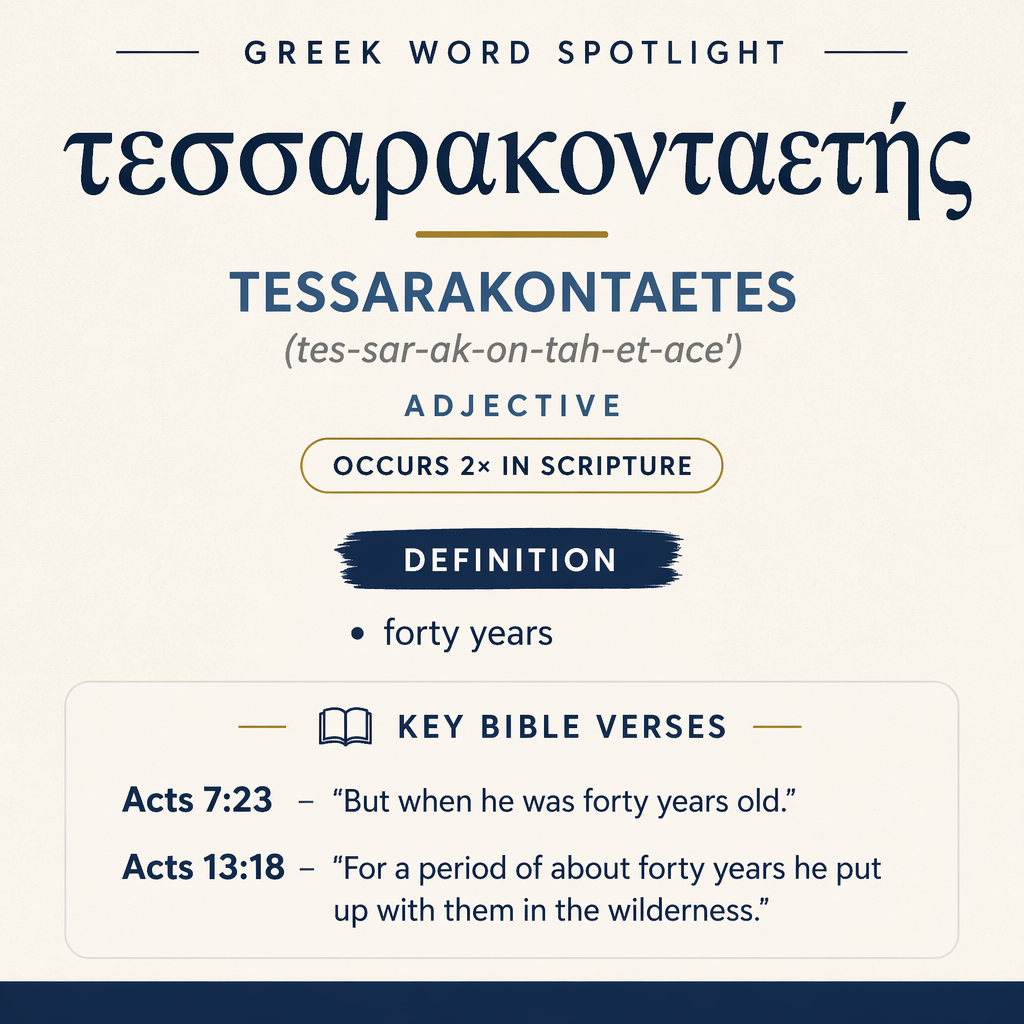
τεσσαρακονταετής means “forty years” and appears twice in Scripture, in Acts 7:23 and Acts 13:18.
Acts 7 Context
In Acts 7:23, it describes Moses being forty years old when he visited his brothers, the children of Israel.
Learn More →Acts 13 Context
In Acts 13:18, it refers to a period of about forty years in the wilderness.
Learn More →τεσσαρακονταετής means “forty years” and appears in Stephen’s speech in Acts (Acts 7) and in Paul’s synagogue address (Acts 13). In both places it gives a time measure that frames a major phase of Israel’s story.
Root and Related Words
τεσσαρακονταετής is formed from tessarakonta (τεσσαράκοντα), “forty” (Strong’s G5062), and etos (ἔτος), “year” (Strong’s G2094). The compound structure ties a number to a unit of time, creating a single term that functions as an age or duration marker in narrative discourse.

Occurrences
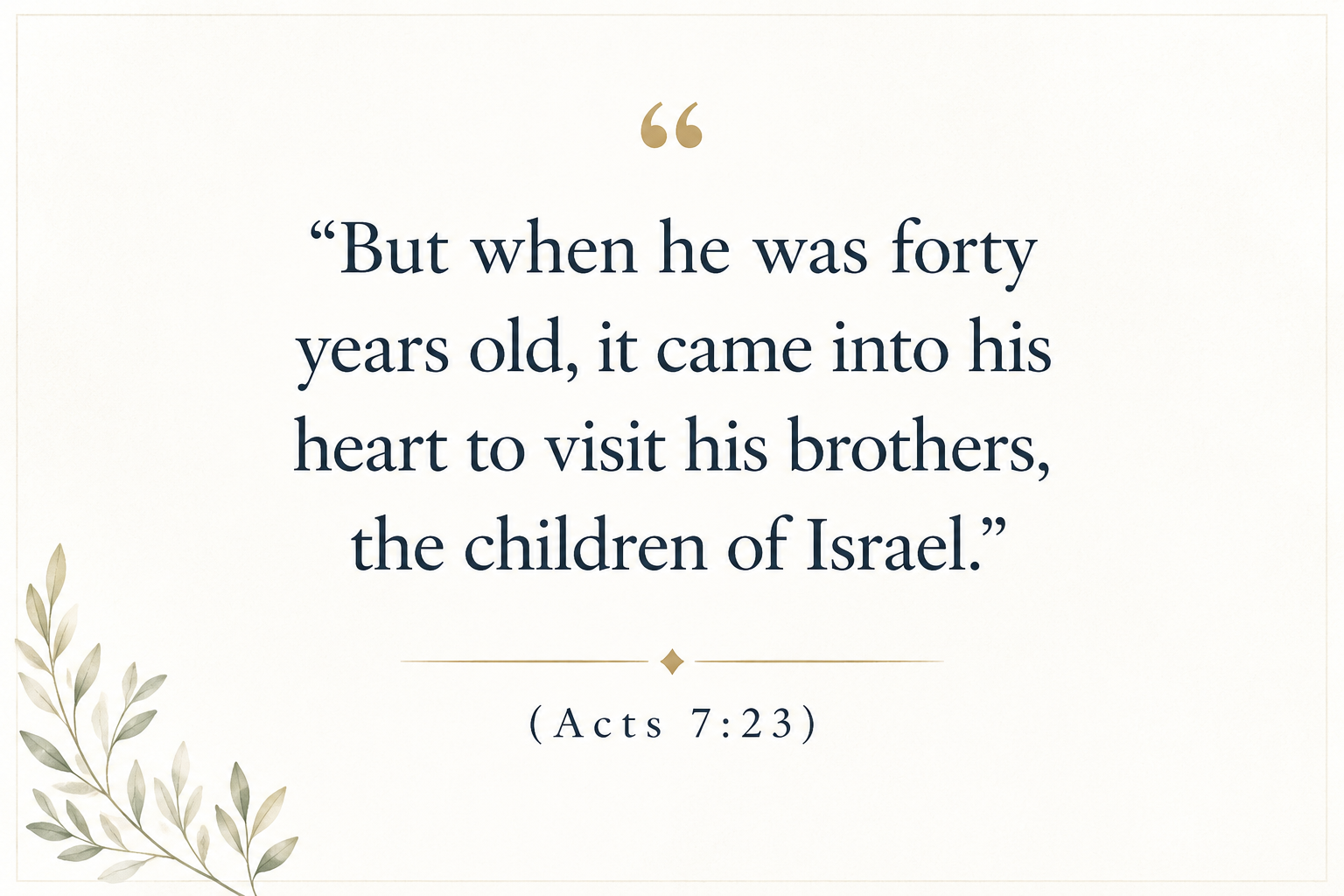
“But when he was forty years old, it came into his heart to visit his brothers, the children of Israel.” (Acts 7:23)
Here τεσσαρακονταετής fixes a decisive moment in Moses’ life to a specific age. The sentence is shaped around a turning point: “when he was forty years old” introduces the inward impulse (“it came into his heart”) and the outward action (“to visit his brothers”). The time reference does more than supply a biographical detail; it functions as a narrative hinge that sets the visit in a defined stage of Moses’ development and ties his personal timing to his identification with “his brothers, the children of Israel.” The expression “when he was…” treats the forty-year mark as a recognizable threshold, a point at which intention and action converge. In Stephen’s telling, the age marker helps present the visit not as incidental but as a moment that arrives with weight and deliberateness.
“For a period of about forty years he put up with them in the wilderness.” (Acts 13:18)
In this setting τεσσαρακονταετής sets the length of a sustained period rather than the age of an individual. The phrase “for a period of about forty years” frames what follows: “he put up with them in the wilderness.” The time-span gives scale to the verb phrase; the action described is not momentary but extended, requiring endurance across a long stretch. The addition of “about” keeps the focus on the broad duration rather than on exact chronology, while still anchoring the narrative in a substantial time frame. The wilderness setting, paired with the long duration, presents the forty-year measure as the temporal container for a whole era of communal experience, characterized here by God’s forbearance toward “them.”
Sense and Usage
Across its two uses, τεσσαρακονταετής serves as a compact way to name a forty-year measure, applied either to a person’s age (“when he was forty years old”) or to an extended interval (“for a period of about forty years”). In both cases it provides temporal framing that organizes the surrounding narrative: it tells the listener how to locate the action in time and how to feel the weight of the episode.
In Acts 7:23, the word operates like a timestamp for decision, marking the point at which Moses’ intention to “visit his brothers” surfaces and moves toward action. The time designation supports a reading of the event as purposeful and situated; it is introduced with “when,” making the forty-year age the condition under which the internal prompting and the visit occur. The result is a portrait of a life stage: the age reference stands at the head of the clause and governs the interpretation of what follows.
In Acts 13:18, the word functions as a duration label for a collective story. The narrative emphasis is not on a single decisive step but on what happens over time: “he put up with them.” By attaching that description to “a period of about forty years,” the passage highlights the persistence of God’s dealings with Israel in the wilderness. The time reference expands the reader’s horizon from an isolated incident to a prolonged season, presenting the action as something maintained, carried, and repeated across years.
Because τεσσαρακονταετής combines a specific number with the “year” unit, it can serve as an efficient summary marker in speeches. Both occurrences appear within public retellings of Israel’s past; the term helps the speaker compress large narrative space into a single, memorable measure. In Stephen’s speech it pinpoints an age-related turning point, and in Paul’s address it compresses a wilderness era into a single span. In each case, the word’s force lies in how it shapes pacing: it either slows the narrative to underscore the significance of a moment (“when he was…”) or stretches it to underscore endurance (“for a period of…”).
Imagery
Though the term itself is a time measure, both passages pair it with vivid narrative settings. Acts 7:23 links the forty-year mark to a personal movement toward kinship—Moses setting out “to visit his brothers, the children of Israel.” Acts 13:18 links the forty-year span to the wilderness as the scene of long-term endurance: “he put up with them in the wilderness.” In these speeches, forty years is not an abstract number; it becomes the time-sized frame around a visit and around a wilderness season.
Sources: Lexical data from Strong’s Exhaustive Concordance and the Translators Brief Lexicon of Extended Strongs for Greek (STEPBible, CC BY). Occurrence data from the Translators Amalgamated Greek New Testament (STEPBible, CC BY). Scripture quotations from the World English Bible (public domain).




