Exploring the Meaning of Teknion in Greek
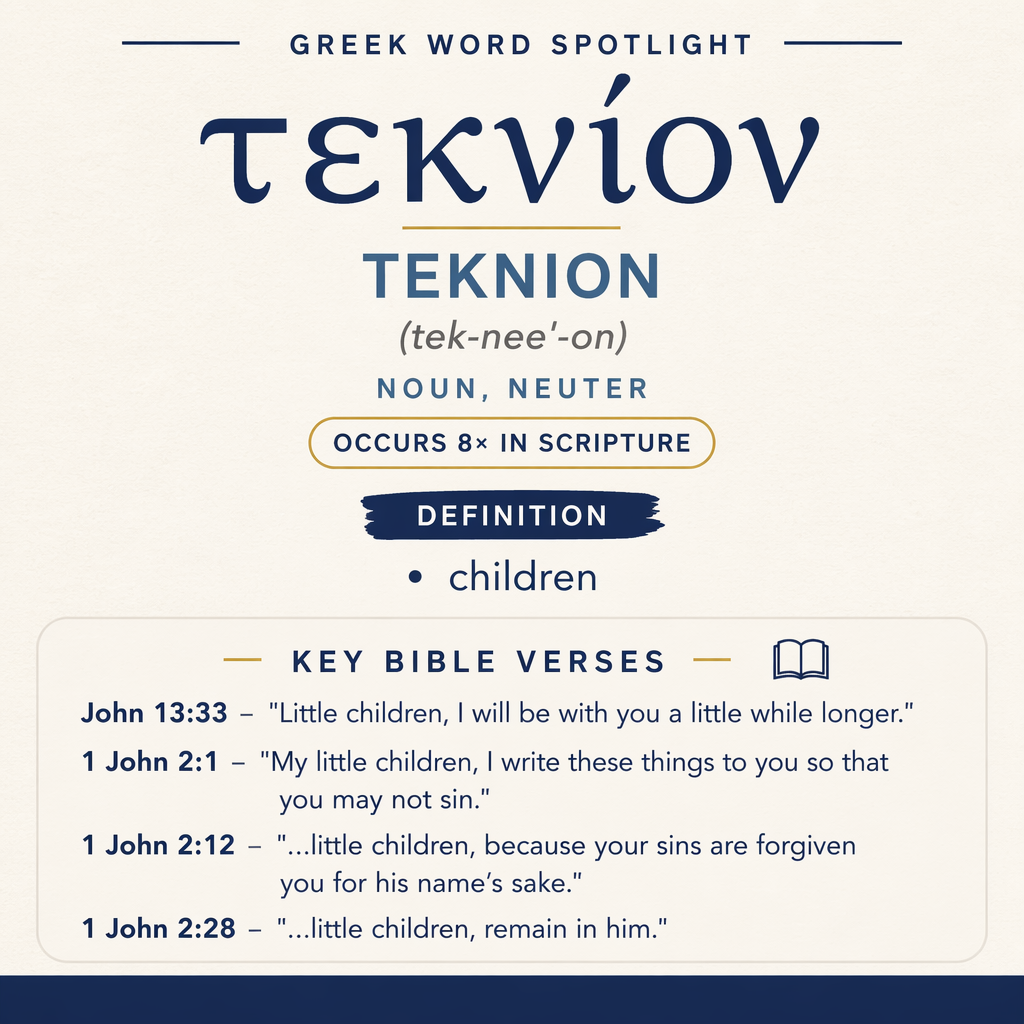
τεκνίον (Teknion) means “children” and occurs 8 times in John 13:33 and throughout 1 John.
Meaning
τεκνίον is defined as “children.” In the listed occurrences it appears in English as “little children.”
Learn More →Scripture Occurrences
It occurs 8 times in Scripture. The references are John 13:33; 1 John 2:1, 2:12, 2:28, 3:7, 3:18, 4:4, and 5:21.
Learn More →Context Phrases
In John 13:33 it appears in the address, “Little children, I will be with you a little while longer.” In 1 John it repeatedly introduces exhortations such as “keep yourselves from idols” (1 John 5:21).
Learn More →Teknion means “children” and appears in direct address in John 13:33 and repeatedly in 1 John. In these passages it functions as a relational way of speaking to an audience being instructed, warned, and reassured.
Occurrences
“Little children, I will be with you a little while longer. You will seek me, and as I said to the Jews, ‘Where I am going, you can’t come,’ so now I tell you.” (John 13:33)
Here Teknion frames Jesus’ words as intimate instruction to those who are with him at a decisive moment. The address “Little children” gathers the listeners into a single group being prepared for separation (“I will be with you a little while longer”) and for the frustration of seeking him without immediate access (“Where I am going, you can’t come”). In this setting the term helps set the tone for a hard saying: the distance that is coming is real, yet the way it is spoken is personal and close.
“My little children, I write these things to you so that you may not sin. If anyone sins, we have a Counselor with the Father, Jesus Christ, the righteous.” (1 John 2:1)
Teknion introduces a pastoral purpose statement (“I write these things to you so that you may not sin”) and then holds together warning and remedy. The audience is treated as “My little children,” and that relationship supports both the moral aim and the assurance that follows: the writer speaks to “children” while naming the possibility of failure (“If anyone sins”) and the provision in response (“we have a Counselor with the Father”). The term thus accompanies an appeal meant to protect the community from sin while keeping the door open to restored fellowship.
“I write to you, little children, because your sins are forgiven you for his name’s sake.” (1 John 2:12)
In this line Teknion is linked to reassurance: the addressed “little children” are told the reason for writing—“because your sins are forgiven you.” The relationship implied in addressing them as “children” fits the content: forgiveness is presented as an established reality for the recipients, grounded “for his name’s sake.” The word therefore supports a tone of settled confidence rather than uncertainty or accusation.
“Now, little children, remain in him, that when he appears, we may have boldness, and not be ashamed before him at his coming.” (1 John 2:28)
Here Teknion accompanies an exhortation to perseverance: “remain in him.” The address places the command within a familial, guiding voice, and it also ties present faithfulness to a future moment (“when he appears”). The expected outcome is communal—“we may have boldness”—and the danger is also communal—“not be ashamed.” Calling the audience “little children” suits instruction aimed at sustaining endurance and confidence as they anticipate “his coming.”
“Little children, let no one lead you astray. He who does righteousness is righteous, even as he is righteous.” (1 John 3:7)
Teknion stands at the front of a protective warning: “let no one lead you astray.” The address signals concern for vulnerability to deception and introduces a clarifying standard: righteousness is recognized in practice (“He who does righteousness is righteous”). Within the verse, “little children” frames the writer’s role as a guardian against misdirection, setting the audience up to evaluate claims by the concrete test given in the sentence that follows.
“My little children, let’s not love in word only, or with the tongue only, but in deed and truth.” (1 John 3:18)
Here Teknion marks a direct moral appeal about how love must be expressed. The affectionate “My little children” precedes a correction of inadequate love—speech-only love (“in word only… with the tongue only”)—and insists on love shown through action (“in deed and truth”). The term supports an exhortation that is both communal (“let’s not…”) and practical, urging the audience to match confession with conduct.
“You are of God, little children, and have overcome them; because greater is he who is in you than he who is in the world.” (1 John 4:4)
In this scene Teknion accompanies identity and encouragement in conflict: “You are of God… and have overcome them.” The address “little children” does not soften the seriousness of opposition; it strengthens reassurance by speaking to the audience as a unified family that shares a victorious standing. The reason given—“because greater is he who is in you than he who is in the world”—grounds their overcoming in an indwelling presence that outweighs worldly opposition. The term thus functions in a rallying, stabilizing way.
“Little children, keep yourselves from idols.” (1 John 5:21)
Teknion introduces a concise final command: “keep yourselves from idols.” The address gives the short imperative a personal edge, as though the writer draws close to deliver a last, essential safeguard. In the verse the term helps make the closing warning feel like protective counsel offered to “children” under care, not merely a detached rule.

Sense and Usage
Across these passages Teknion operates as a form of address to an audience positioned as “children” in relation to a speaker who instructs and protects. In John 13:33 it appears on the lips of Jesus in a moment of impending absence; the term gathers the listeners into a circle of closeness as he speaks of a coming separation and of their inability to follow where he is going. In 1 John it becomes a repeated way of naming the community, and the repetition gives the letter a consistent voice: guidance offered from within a relationship rather than merely from authority.
The content that follows Teknion regularly falls into recognizable types of speech. It introduces prevention and provision with respect to sin (1 John 2:1), reassurance about forgiveness (1 John 2:12), an exhortation to continued abiding that aims at confidence at an appearing and “his coming” (1 John 2:28), a warning not to be misled coupled with a concrete standard for recognizing righteousness (1 John 3:7), a call for love that moves beyond speech into action (1 John 3:18), encouragement that the audience “have overcome them” because of a greater indwelling power (1 John 4:4), and a final command to avoid idols (1 John 5:21). The address “children” is flexible enough to stand at the doorway of each of these themes; it does not change the topic, but it shapes how the topic lands—more like instruction within a household than like impersonal instruction.
The word’s placement is also telling: in each occurrence it comes at the start of the sentence (or near the start), functioning as a summons before the main point. That opening address draws attention and establishes the relationship before the exhortation, assurance, or warning is delivered. Even when the content is sharp (“let no one lead you astray”; “keep yourselves from idols”), the speech is wrapped in an appeal that treats the recipients as a group under care and responsibility.
Imagery
In these verses “children” evokes a household setting where guidance is given for safety and growth: staying with the speaker while he is present (John 13:33), being kept from sin while relying on a “Counselor with the Father” (1 John 2:1), living in the security of forgiveness (1 John 2:12), remaining so as to face an appearing with “boldness” rather than shame (1 John 2:28), refusing deception (1 John 3:7), practicing love in deeds (1 John 3:18), standing firm as those “of God” who have “overcome” (1 John 4:4), and avoiding idols (1 John 5:21). The repeated address gathers diverse instruction under a single relational picture: a community spoken to as children who are being formed, guarded, and strengthened.
Sources: Lexical data from Strong’s Exhaustive Concordance and the Translators Brief Lexicon of Extended Strongs for Greek (STEPBible, CC BY). Occurrence data from the Translators Amalgamated Greek New Testament (STEPBible, CC BY). Scripture quotations from the World English Bible (public domain).