
Exploring the Meaning of Teknogonia in Greek
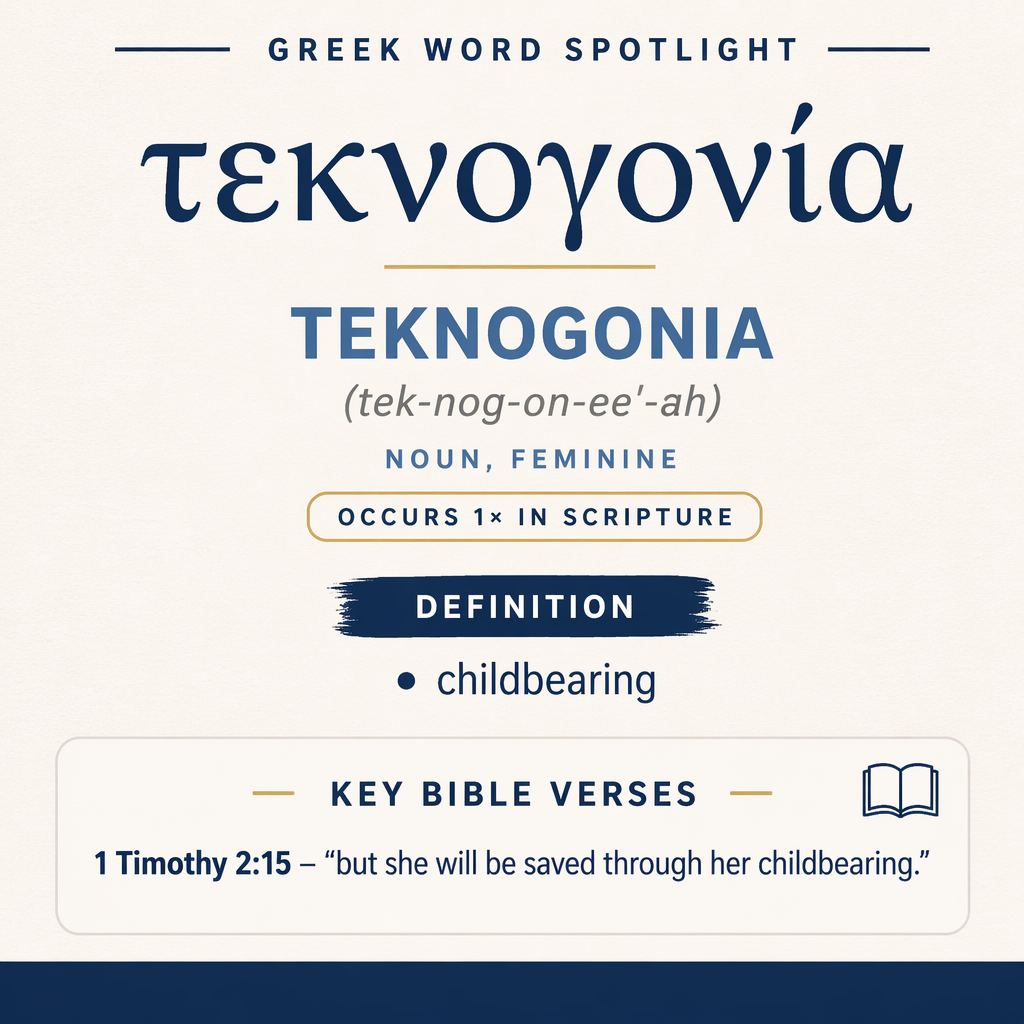
τεκνογονία means “childbearing” and appears once in Scripture, in 1 Timothy 2:15.
Scripture Occurrence
It occurs 1 time in Scripture. The occurrence is in 1 Timothy 2:15.
Learn More →Verse Context
In 1 Timothy 2:15 it appears in the phrase “saved through her childbearing.” The verse continues with continuing in faith, love, sanctification, and sobriety.
Learn More →Teknogonia means “childbearing” and appears in the New Testament in a single place, where it is set within Paul’s instructions about salvation, continuing virtues, and sobriety.
Root and Related Words
Teknogonia is related to teknogoneo (τεκνογονέω), meaning “to have children” (Strong’s G5041). The noun’s form aligns with an action or process named by the related verb: the verb expresses the activity (“to have children”), and the noun names that activity as a concept (“childbearing”).

Occurrences
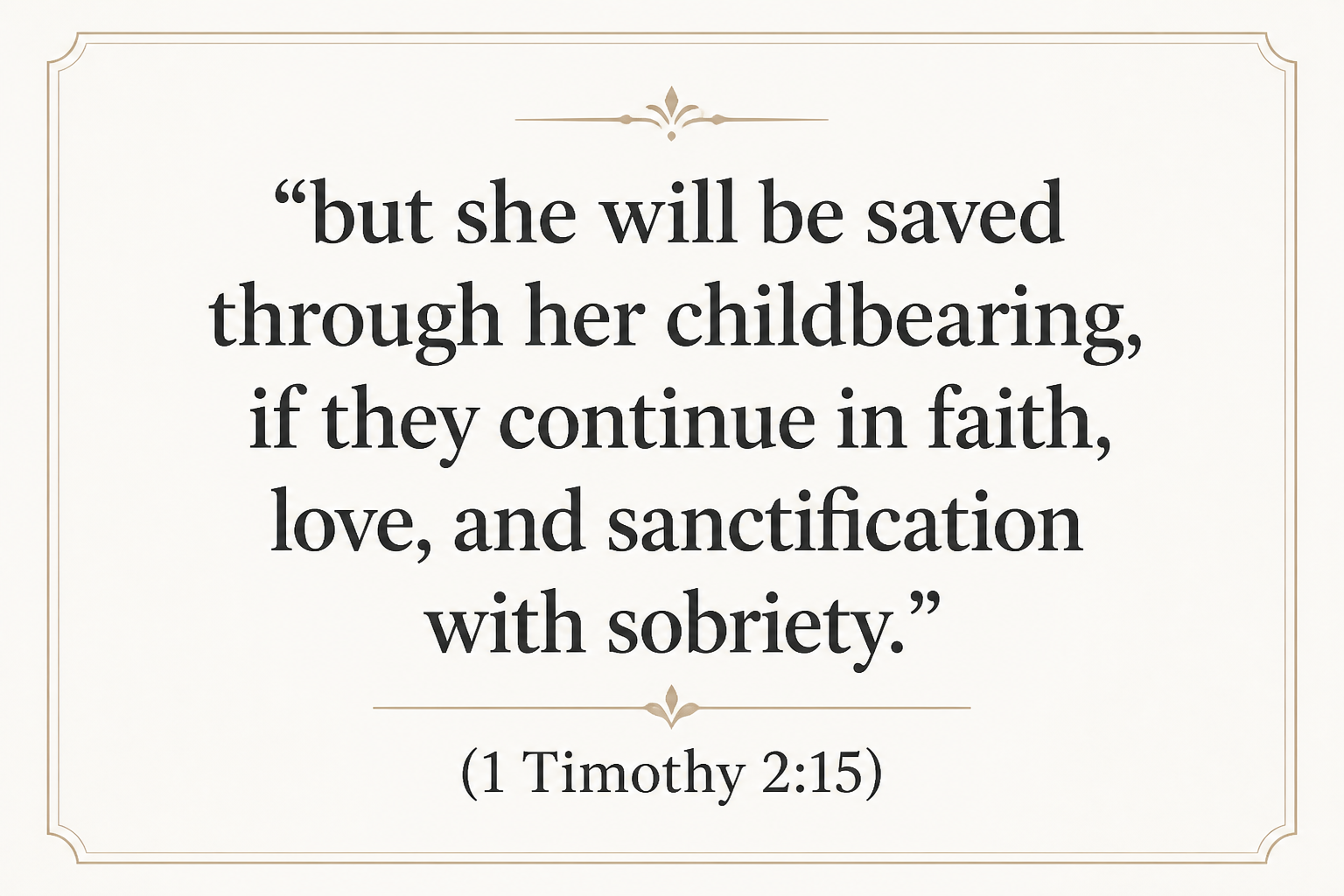
“but she will be saved through her childbearing, if they continue in faith, love, and sanctification with sobriety.” (1 Timothy 2:15)
Here teknogonia stands inside a tightly packed statement that connects “she,” “saved,” and “through her childbearing,” followed by a conditional continuation: “if they continue in faith, love, and sanctification with sobriety.” Within this sentence, childbearing functions as the medium or circumstance attached to the promised outcome (“will be saved”), expressed by the prepositional phrase “through her childbearing.” The wording presents childbearing not as an isolated topic but as one strand in a moral and spiritual frame: the sentence immediately moves from that phrase to ongoing perseverance in virtues, indicating that the term sits alongside the continuing pattern of life described by “faith, love, and sanctification,” and is to be understood within the same horizon of “sobriety.”
The verse also shifts from singular to plural: “she will be saved” is followed by “if they continue….” In that grammatical movement, teknogonia is attached to “her,” while the continued virtues are assigned to a wider subject (“they”). In context, then, childbearing is not presented as a detached abstraction; it is anchored to a particular woman (“her”), yet placed inside an instruction that reaches beyond one individual to a continuing communal or representative perseverance (“they continue”). This gives the word a connective role: it links a concrete sphere of life (“childbearing”) to the ongoing dispositions named at the end of the verse.
Sense and Usage
In 1 Timothy 2:15, teknogonia has its ordinary, concrete force as a term for childbearing. It does not appear as a background detail but as a prominent element in the clause “saved through her childbearing.” The sentence pairs that clause with an explicit moral condition: continuing “in faith, love, and sanctification with sobriety.” Read within the verse’s own structure, childbearing is treated as part of lived experience in which salvation and perseverance are spoken about. The term therefore carries an everyday, embodied association: it belongs to a realm of life that is physical and familial, yet the sentence makes it adjacent to enduring qualities (“faith,” “love,” “sanctification,” “sobriety”) that describe conduct and character over time.
The preposition “through” shapes how teknogonia operates in the verse: childbearing is portrayed as a channel or context within which the promise “she will be saved” is expressed. At the same time, the conditional clause keeps the verse from collapsing into a single-factor explanation; it binds the statement to continuing virtues. Teknogonia, as used here, is not presented as a standalone badge of spiritual status. It appears within a coordinated statement where the latter half (“if they continue…”) supplies a continuing pattern that frames the whole assertion. In the verse’s own terms, childbearing is set within a life marked by perseverance, not separated from it.
The possessive “her” further individualizes the noun: the verse does not speak of childbearing in the abstract only, but of “her childbearing.” That phrasing places the concept into personal experience and responsibility, and it keeps the noun from becoming merely a general idea. Yet the subsequent plural “they” prevents the focus from remaining purely individual; the verse’s logic spreads outward to a broader group who must “continue” in the named virtues. Teknogonia thus serves a bridging function between the singular experience (“her childbearing”) and the plural call to perseverance (“they continue”), keeping the statement rooted in lived realities while also addressing continuing communal patterns.
Imagery
Even in a single occurrence, teknogonia carries immediate, concrete imagery: the sphere of bearing children, with all the weight that “through her childbearing” implies in ordinary human life. In 1 Timothy 2:15, that imagery is set next to words that evoke steady moral and spiritual direction—“faith, love, and sanctification”—and a measured manner of life—“with sobriety.” The verse therefore places the physical reality of childbearing within the same sentence as ongoing qualities that are meant to endure.
Sources: Lexical data from Strong’s Exhaustive Concordance and the Translators Brief Lexicon of Extended Strongs for Greek (STEPBible, CC BY). Occurrence data from the Translators Amalgamated Greek New Testament (STEPBible, CC BY). Scripture quotations from the World English Bible (public domain).





