Exploring the Meaning of Sunakoloutheo in Greek
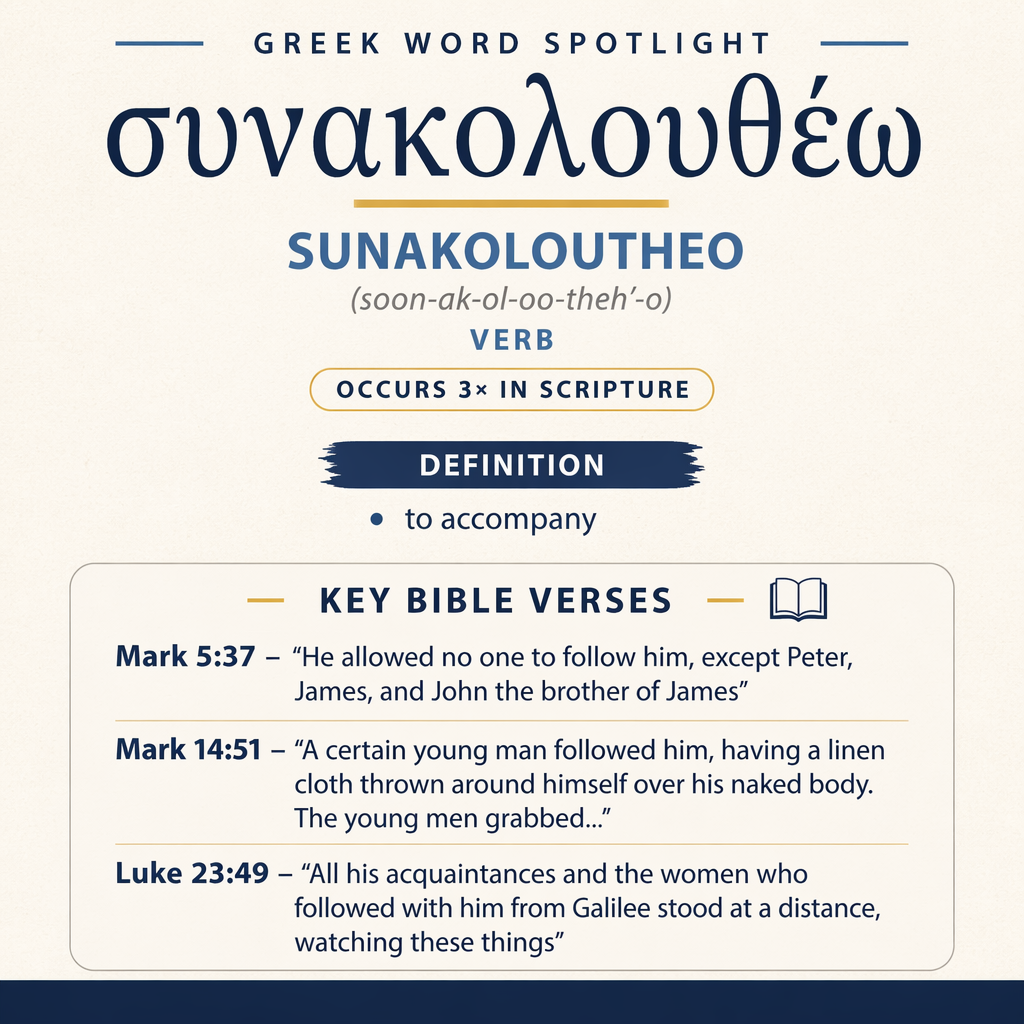
συνακολουθέω means “to accompany” and appears three times in Scripture: Mark 5:37; Mark 14:51; Luke 23:49.
Scene Summaries
In Mark, it describes following Jesus, including a young man who followed him. In Luke, it describes women who followed with him from Galilee.
Learn More →συνακολουθέω means “to accompany.” It appears in three narrative settings: two in Mark (during Jesus’ ministry) and one in Luke (at the crucifixion scene).
Root and Related Words
συνακολουθέω (Sunakoloutheo) is formed from ἀκολουθέω (akoloutheo), “to follow” (Strong’s G190), and σύν (syn), “with” (Strong’s G4862). The combined form expresses following as a “with-ness”: movement in company with someone rather than merely behind them at a distance.

Occurrences
“He allowed no one to follow him, except Peter, James, and John the brother of James.” (Mark 5:37)
Here the action is constrained by deliberate permission and exclusion. The scene is defined by a boundary: “no one” is allowed, “except” three named disciples. Within that boundary, the verb supplies the idea of accompanying Jesus as he goes forward, not as part of a crowd but as a selected company. The force of “accompany” fits the social shape of the moment: to go with him is to be admitted to his immediate presence and movement, while others are kept back. The clause does not merely record travel; it frames access—who is permitted to be with him as he proceeds.
“A certain young man followed him, having a linen cloth thrown around himself over his naked body. The young men grabbed him,” (Mark 14:51)
In this tense snapshot, the verb places the “certain young man” in motion in close association with Jesus at a moment when danger is present. The details about his linen cloth and exposed body heighten the vulnerability of someone who nevertheless stays near enough to be described as accompanying. The final clause (“The young men grabbed him,”) shows that his proximity has consequences: being with Jesus puts him within reach of those who seize. In this setting, the word carries the feel of risky nearness—accompanying not as a protected privilege but as a perilous attachment in a chaotic scene.
“All his acquaintances and the women who followed with him from Galilee stood at a distance, watching these things.” (Luke 23:49)
This occurrence explicitly marks a group relationship: “the women who followed with him from Galilee.” The verb ties them to Jesus’ journey in an ongoing way that began in Galilee and continued to the present scene. Yet the verse also stresses physical separation at this moment: they “stood at a distance, watching these things.” The word therefore carries both continuity and contrast. They are identified as those who had accompanied him, even though they are not near him now. In a scene dominated by watching, the verb functions as a marker of prior closeness and sustained association, anchoring their identity in their having gone with him on the way.
Sense and Usage
Across these passages, “to accompany” consistently describes attachment to a person in motion—being part of the company that goes with him. The word does not portray accompaniment as a mere accident of being nearby; it highlights the relational contour of the movement: a person or group is associated with Jesus as he goes where he goes.
Mark 5:37 shows accompaniment as restricted access. The “except” clause makes accompanying a granted privilege: only certain companions are allowed to be with him. The verb thus fits scenes where presence is regulated and company is intentional.
Mark 14:51 shows accompaniment under pressure. The young man’s physical description and the immediate grabbing underscore that accompanying can expose someone to danger. Here the verb does not change its core idea, but the scene’s tension colors it: being with Jesus is not only a matter of shared direction but also of shared risk.
Luke 23:49 shows accompaniment as a defining history even when proximity is no longer possible. The women are named by their past accompanying “from Galilee,” and that identification remains meaningful even as they “stood at a distance.” The word therefore can function as a social and narrative label: it names people whose story is bound up with Jesus’ path, even when the immediate scene places them farther off.
Taken together, these uses portray accompaniment as (1) selective, (2) costly, and (3) enduring as an identity marker. The passages keep the focus on concrete narrative realities—who is permitted to be with him, who dares to be with him, and who is remembered as having been with him—so that “accompany” is not an abstract association but a lived closeness expressed in shared movement.
Imagery
The verb’s imagery is that of a small company moving with a central figure, with the surrounding crowd either excluded, threatening, or distant. In Mark 5:37 the picture is a narrowed circle allowed to go on; in Mark 14:51 it is a lone follower close enough to be seized; in Luke 23:49 it is companions halted at a remove, watching events unfold. In each, accompaniment is pictured as being linked to someone’s path—sometimes near, sometimes forced back, but still defined by having gone with him.
Sources: Lexical data from Strong’s Exhaustive Concordance and the Translators Brief Lexicon of Extended Strongs for Greek (STEPBible, CC BY). Occurrence data from the Translators Amalgamated Greek New Testament (STEPBible, CC BY). Scripture quotations from the World English Bible (public domain).