Exploring the Meaning of Sunairo in Greek
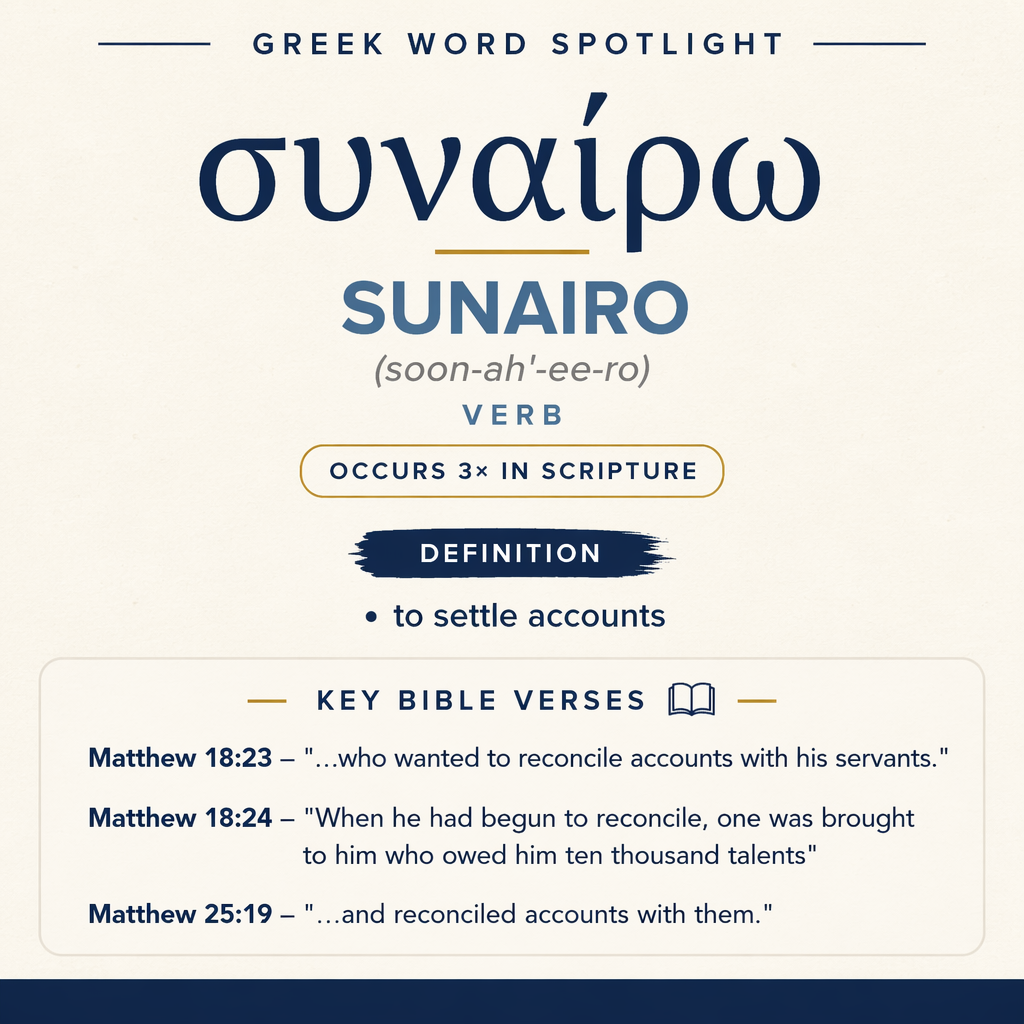
συναίρω means “to settle accounts” and occurs three times in Scripture, in Matthew 18:23–24 and Matthew 25:19.
Core Meaning
συναίρω means “to settle accounts.” In Matthew, it describes a ruler dealing with what servants owe.
Learn More →Matthew 18 Context
In Matthew 18:23 a king wants to reconcile accounts with his servants. In Matthew 18:24 he begins reconciling and one owing ten thousand talents is brought to him.
Learn More →Matthew 25 Context
In Matthew 25:19, after a long time, the lord of the servants comes and reconciles accounts with them.
Learn More →συναίρω refers to the act of settling accounts, a financial reckoning pictured through the relationship of a ruler or master to his servants. In the Gospels it appears in parables where a king or lord initiates a review of what is owed and brings servants to account.
Root and Related Words
συναίρω is linked with syn (σύν), “with” (Strong’s G4862), and airo (αἴρω), “to take up” (Strong’s G142). In combination, these components frame the verb as a matter handled “together,” with items taken up for review as part of a formal reckoning.

Occurrences
“Therefore the Kingdom of Heaven is like a certain king, who wanted to reconcile accounts with his servants.” (Matthew 18:23)
Here the word is placed inside a comparison: “the Kingdom of Heaven is like” a royal setting in which a king initiates a settling of accounts “with his servants.” The verb presents the king’s intention to move from a general state of obligation to a definite accounting, bringing what is outstanding into the open. The scene is relational as well as financial: the king’s authority and the servants’ responsibility meet in a moment of reckoning, and the settling is not incidental but something the king “wanted” to do—an act of will that sets the parable’s moral and narrative pressure.
“When he had begun to reconcile, one was brought to him who owed him ten thousand talents.” (Matthew 18:24)
This verse depicts the settling of accounts as a process with a starting point: “When he had begun to reconcile.” The word marks the transition from intention to action, and the narrative immediately supplies an example case: “one was brought to him who owed him ten thousand talents.” In this setting, settling accounts involves bringing the debtor into the king’s presence and identifying the magnitude of the debt. The verb therefore functions like a narrative hinge: once the settling begins, hidden or delayed obligations become specific and personal—someone is “brought,” and what he “owed” is stated. The act of settling accounts is the mechanism by which the relationship is tested under the weight of an enormous obligation.
““Now after a long time the lord of those servants came, and reconciled accounts with them.” (Matthew 25:19)
In this parable the word is tied to timing and return: “after a long time the lord of those servants came.” The settling of accounts follows the master’s absence and is presented as the decisive action that occurs upon his arrival. The verb links the master’s coming to an evaluative encounter with “those servants,” implying that time does not erase responsibility; rather, the eventual settling makes the earlier period meaningful by requiring an account at the end of it. Because the subject is “the lord of those servants,” the settling is not negotiated among equals; it is the master’s initiative carried out with those under his authority.
Sense and Usage
Across these passages, συναίρω consistently operates in a setting where authority (a king, a lord) meets stewardship (servants) through an intentional, formal reckoning. The action is more than a casual review; it is portrayed as something initiated from above (“wanted,” “had begun,” “came, and reconciled”) and directed toward those who are accountable to the initiator (“with his servants,” “with them”). The word therefore carries the force of a structured settling—an act that brings obligations into a concrete, speakable form, as illustrated when “one was brought to him who owed him ten thousand talents” (Matthew 18:24).
The contexts also show that settling accounts can be portrayed both as a present action that begins and unfolds (Matthew 18:24) and as a climactic action delayed until an appointed return (Matthew 25:19). In Matthew 18:23–24 the reckoning is introduced as the controlling frame for a story of debt: the king’s desire to settle accounts triggers the narrative, and the first debtor’s case demonstrates how reckoning exposes the true scale of obligation. In Matthew 25:19 the reckoning comes “after a long time,” so the settling of accounts functions as the concluding stage that interprets the intervening time; the period of waiting is not the end of the relationship, because the relationship is designed to culminate in settlement.
The interpersonal prepositions in these verses are also important for how the sense plays out. Each time the settling is done “with” the servants: the action is not merely internal bookkeeping but an encounter between parties. The king or lord does not simply tally privately; he brings servants into a meeting where what is owed is faced. In Matthew 18:24 the servant is “brought to him,” highlighting the asymmetry of the meeting: the debtor is summoned or presented, and the king is the one who receives him and addresses the debt. Thus the word’s usage in these parables portrays settlement as an authoritative, relational reckoning that creates a moment of decision—when accounts are settled, the matter of debt is no longer indefinite.
Imagery in Context
The imagery attached to συναίρω in these passages is the picture of a ruler seated in judgment over obligations, calling servants forward and bringing their debts into clear view. Matthew 18:23–24 places the reckoning at the start of the drama—“wanted to reconcile accounts,” “had begun to reconcile”—so the settling functions like the opening of a court session in which a vast debt is immediately disclosed. Matthew 25:19 places the reckoning after distance and delay—“after a long time”—so the settling of accounts becomes the inevitable meeting point between a master’s return and a servant’s responsibility.
Sources: Lexical data from Strong’s Exhaustive Concordance and the Translators Brief Lexicon of Extended Strongs for Greek (STEPBible, CC BY). Occurrence data from the Translators Amalgamated Greek New Testament (STEPBible, CC BY). Scripture quotations from the World English Bible (public domain).