
Exploring the Meaning of Suntrophos in Greek
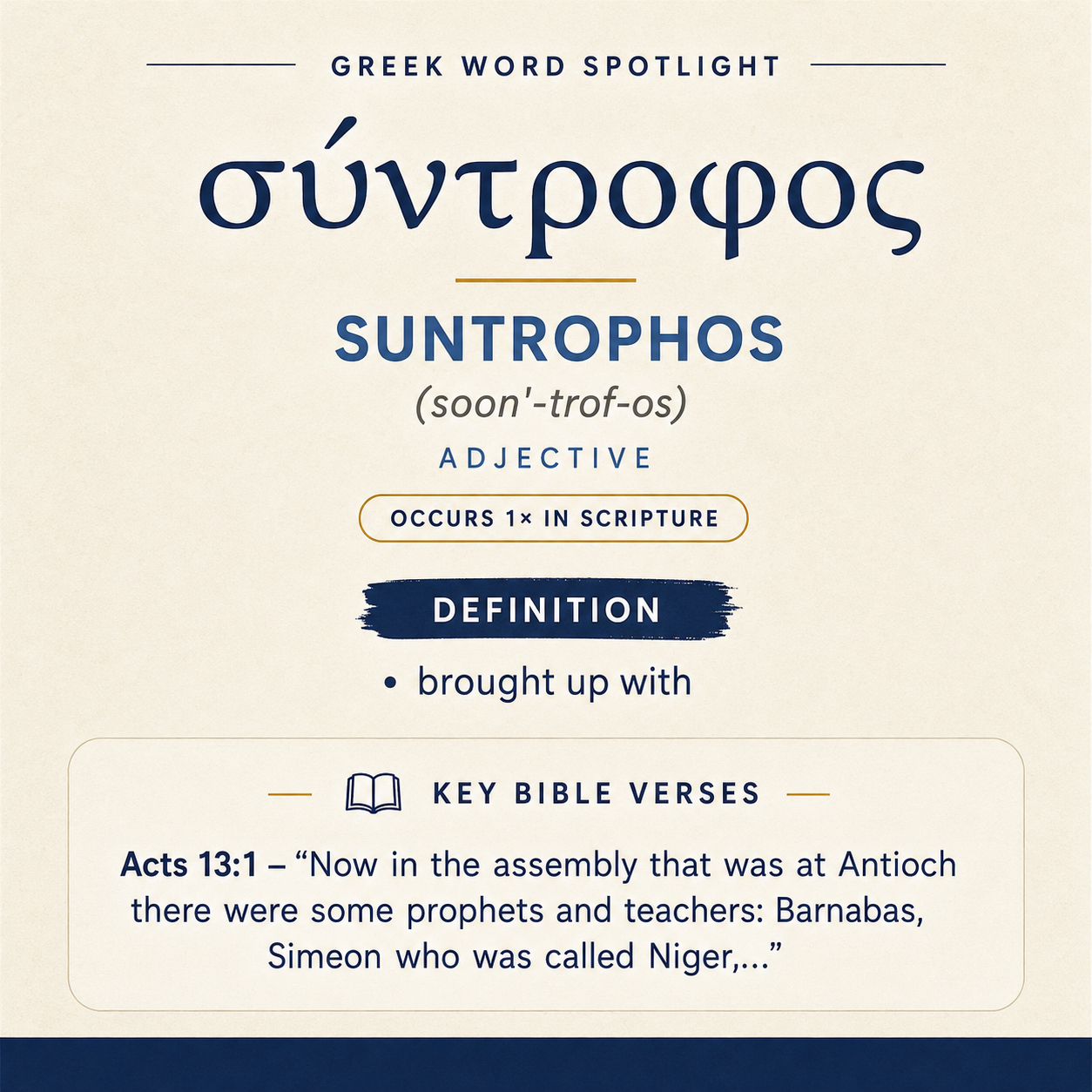
σύντροφος means “brought up with” and appears once in Scripture, in Acts 13:1.
Scripture Occurrence
This word occurs 1 time in Scripture. Its single occurrence is in Acts 13:1.
Learn More →Context Snapshot
In Acts 13:1, it appears within a listing of prophets and teachers in the assembly at Antioch.
Learn More →σύντροφος expresses the idea of someone “brought up with.” It appears once, in Acts 13:1, where it characterizes Manaen in relation to Herod the tetrarch.
Root and Related Words
σύντροφος (Suntrophos) is connected with the preposition syn (σύν), “with,” and with trophos (τροφός), “nursing mother.” Together these related elements frame the term as a relational descriptor that ties one person’s upbringing to another’s in a shared setting or alongside one another.

Occurrences
“Now in the assembly that was at Antioch there were some prophets and teachers: Barnabas, Simeon who was called Niger, Lucius of Cyrene, Manaen the foster brother of Herod the tetrarch, and Saul.” (Acts 13:1)
In this list of named leaders at Antioch, σύντροφος functions as a compact biographical marker placed within a sequence of identifiers (“who was called Niger,” “of Cyrene,” and the linkage to “Herod the tetrarch”). The term, rendered here as “the foster brother,” supplies a social connection that situates Manaen in proximity to political power: he is introduced not by a place of origin but by a shared upbringing with “Herod the tetrarch.” In the sentence, this relational note sits between the geographical tag of “Lucius of Cyrene” and the name “Saul,” helping to distinguish Manaen within a diverse group of “prophets and teachers.” The word’s contribution is thus not a doctrinal label or ministry role but a statement about formative association—an early-life tie that would be intelligible to readers as a meaningful credential of background and network.
The surrounding wording highlights how this upbringing-relationship is used: it is not developed with further narrative detail, but it is weighty enough to be included in a succinct roster. By pairing Manaen with Herod’s title (“the tetrarch”), the description also anchors the relationship to a specific public figure, making Manaen’s presence in the Antioch assembly stand out as someone whose upbringing intersected with high status, yet who now appears among Christian leaders named alongside Barnabas and Saul.
Sense and Usage
The sense “brought up with” is relational and biographical: it identifies a person by shared formative circumstances with someone else. In Acts 13:1 the term is applied as an attributive descriptor of Manaen, defining him by a connection that reaches back to upbringing rather than to current office. The immediate context shows how such a descriptor works in narrative prose: it functions like a brief appositive, adding specificity and texture without interrupting the forward movement of the list.

Because the Antioch assembly is presented as containing “some prophets and teachers,” the description of individuals serves to display the varied composition of leadership. Within that rhetorical purpose, σύντροφος contributes a particular kind of variety: not ethnic or geographic variety (as with “of Cyrene”), and not a nickname (as with “called Niger”), but variety of social proximity. The phrase “Manaen the foster brother of Herod the tetrarch” uses the upbringing relationship to identify Manaen in a way that would be memorable, marking him as someone whose early life was intertwined with a ruler’s household or sphere, even though the verse focuses on the church context (“the assembly that was at Antioch”).
The related words syn (σύν), “with,” and trophos (τροφός), “nursing mother,” help clarify what kind of relationship is in view: not a mere acquaintance, but an association rooted in being raised in company with another. In Acts 13:1, that shared upbringing is the only detail offered about Manaen beyond his name, indicating that the author considered it a sufficiently precise and meaningful identifier. The usage here shows σύντροφος operating as a term of connection—one person described through the lens of being raised alongside another—thereby shaping how the reader imagines Manaen’s background as the narrative proceeds from Antioch’s leadership.
Imagery
Even in a single occurrence, the word carries domestic imagery: the world of upbringing, nurture, and shared formation implied by being “brought up with.” In Acts 13:1 that imagery is juxtaposed with public life through the mention of “Herod the tetrarch,” so the term quietly evokes the movement from early shared life into later divergent paths, while remaining focused on the plain identification given in the verse.
Sources: Lexical data from Strong’s Exhaustive Concordance and the Translators Brief Lexicon of Extended Strongs for Greek (STEPBible, CC BY). Occurrence data from the Translators Amalgamated Greek New Testament (STEPBible, CC BY). Scripture quotations from the World English Bible (public domain).





