Exploring the Meaning of Sumphoneo in Greek
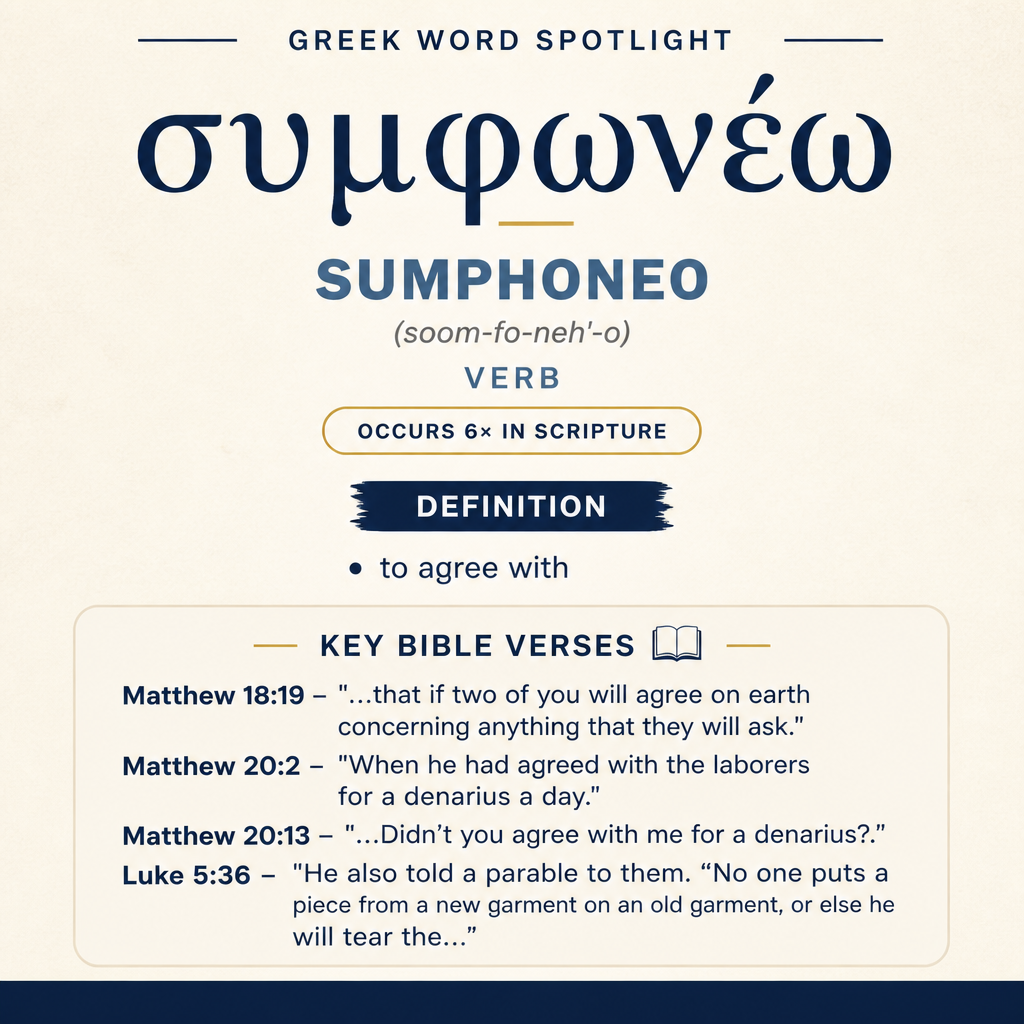
συμφωνέω (Sumphoneo) means “to agree with” and occurs 6 times in Scripture (Matthew 18:19; 20:2, 20:13; Luke 5:36; Acts 5:9; 15:15).
Core Meaning
συμφωνέω means “to agree with.” In Scripture it describes agreement between people and agreement with prophetic words.
Learn More →Gospel Occurrences
It appears in Matthew 18:19 about two agreeing concerning what they ask, and in Matthew 20:2, 20:13 about agreeing on a denarius. It also occurs in Luke 5:36.
Learn More →Acts Occurrences
In Acts 5:9, Peter asks how they “agreed together” to tempt the Spirit of the Lord. In Acts 15:15, it is used of agreement with the words of the prophets.
Learn More →συμφωνέω expresses agreement—people concurring with one another, or words aligning with other words. In the passages where it appears, the verb covers agreement in prayer, agreement in contracted work, agreement that exposes a coordinated deception, and agreement as a correspondence between testimony and written prophecy.
Occurrences
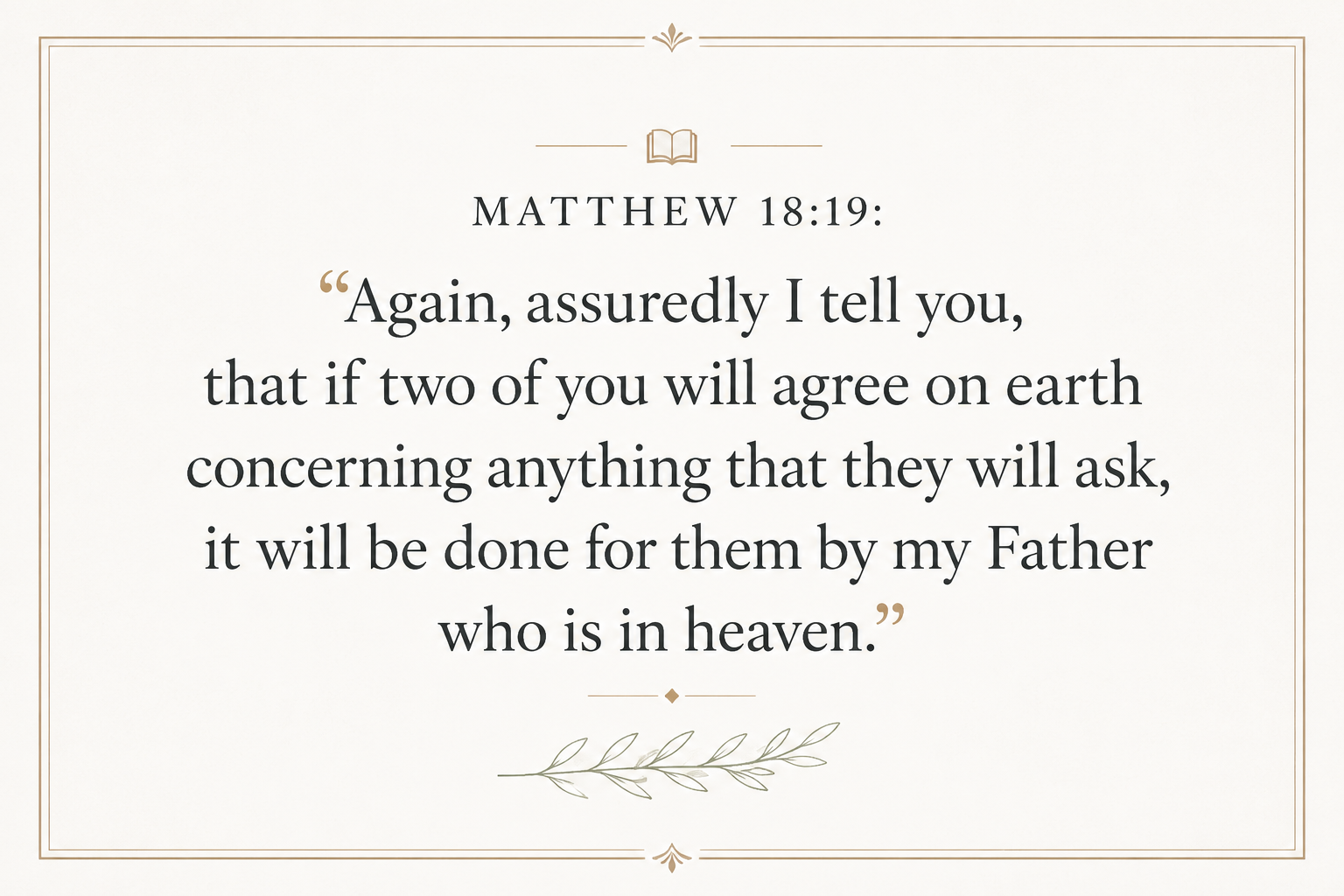
Matthew 18:19: “Again, assuredly I tell you, that if two of you will agree on earth concerning anything that they will ask, it will be done for them by my Father who is in heaven.”
Here συμφωνέω marks a shared stance between “two of you” that precedes and shapes a request made “on earth.” The agreement is not merely parallel desires; it is an expressed unity “concerning anything that they will ask.” Within the sentence, that unity becomes the condition attached to the promise that “it will be done for them,” locating the force of the verb in coordinated petition rather than isolated asking.
Matthew 20:2: “When he had agreed with the laborers for a denarius a day, he sent them into his vineyard.”
In this scene, συμφωνέω describes a settled understanding between the householder and the laborers, specifically “for a denarius a day.” The agreement functions as the basis for action: once the terms are mutually set, the workers are “sent… into his vineyard.” The verb therefore carries the sense of agreement as the social and practical mechanism that authorizes the day’s work.
Matthew 20:13: ““But he answered one of them, ‘Friend, I am doing you no wrong. Didn’t you agree with me for a denarius?”
Here the householder appeals to agreement as a standard of fairness: “I am doing you no wrong” is defended by “Didn’t you agree with me for a denarius?” συμφωνέω points to a prior concurrence that binds the relationship between employer and worker. The question assumes the agreement’s clarity and sufficiency—what was jointly accepted defines what counts as “no wrong” in the present complaint.
Luke 5:36: “He also told a parable to them. “No one puts a piece from a new garment on an old garment, or else he will tear the new, and also the piece from the new will not match the old.”
In this proverb-like picture, συμφωνέω is applied not to persons but to materials: “the piece from the new will not match the old.” Agreement is depicted as compatibility between what is “new” and what is “old.” The verb frames “match” as a kind of agreement: the two parts do not align in a way that produces a coherent whole. The force of the warning is sharpened by the paired outcome—damage (“he will tear the new”) and disharmony (“will not match the old”).
Acts 5:9: “But Peter asked her, “How is it that you have agreed together to tempt the Spirit of the Lord? Behold, the feet of those who have buried your husband are at the door, and they will carry you out.””
Here συμφωνέω is intensified by the wording “agreed together,” highlighting coordination between more than one person. The agreement is not neutral; it is directed “to tempt the Spirit of the Lord,” so the verb describes a deliberate shared plan. In Peter’s question, the shock lies in the very fact of their concurrence—agreement can make wrongdoing more pointed because it joins wills into a single, purposeful act.
Acts 15:15: “This agrees with the words of the prophets. As it is written,”
In this deliberative setting, συμφωνέω denotes correspondence between a present claim (“This”) and prior testimony: “the words of the prophets.” Agreement here is not negotiated between parties but recognized as alignment between what is being asserted and what has been spoken before. The phrase “As it is written,” immediately grounds the agreement in written prophetic words, presenting συμφωνέω as a way of asserting that an interpretation or decision is in harmony with authoritative speech.

Sense and Usage
Across these contexts, συμφωνέω consistently denotes agreement, but the scenes show how flexible the notion of agreement can be. In Matthew 18:19, agreement is interpersonal unity that shapes a request; the action is collective (“two of you”), and the agreement functions as a prerequisite for asking “concerning anything.” In Matthew 20:2 and 20:13, agreement is a settled arrangement, tied to specified terms (“for a denarius a day,” “for a denarius”) and invoked as a moral anchor in a dispute (“I am doing you no wrong”). In Acts 5:9, agreement becomes mutual complicity, a coordinated intention described as a joint act (“agreed together”) with a definite aim (“to tempt the Spirit of the Lord”). In Acts 15:15, agreement describes conceptual alignment, where a present conclusion is said to cohere with prior prophetic words.
These uses also show that συμφωνέω can take different kinds of subjects. It can describe people agreeing with each other (two on earth; a householder with laborers; conspirators together). It can also describe things agreeing: “the piece from the new will not match the old” casts agreement as fit and coherence between parts. Finally, it can describe statements agreeing: “This agrees with the words of the prophets” places agreement in the realm of testimony and interpretation, where one set of words is measured against another.
The verb’s contribution often lies in what agreement does in the narrative logic. Agreement can enable an outcome (the promise attached to united asking in Matthew 18:19; the sending into the vineyard in Matthew 20:2). It can settle what is just (the appeal to agreed wages in Matthew 20:13). It can expose culpability (the coordinated plan in Acts 5:9). It can validate a claim by showing its consonance with recognized prophetic speech (Acts 15:15). Even in Luke 5:36, the lack of agreement (“will not match”) is a way of teaching that incompatible elements produce harm and incoherence, so the absence of agreement becomes a warning expressed through everyday imagery.
Imagery and Texture
The passages attach agreement to vivid relational and material pictures. In Matthew, agreement ranges from the quiet solidarity of two people making a request to the public clarity of a wage arrangement, where a single coin amount becomes the concrete content of what was agreed. Luke’s parable turns agreement into a tactile mismatch: cloth from a “new garment” refuses to align with what is “old,” and the result is tearing rather than wholeness. Acts portrays agreement as either the dark unity of a shared scheme (“agreed together to tempt the Spirit of the Lord”) or the reassuring unity between present decisions and “the words of the prophets.” Together these scenes show συμφωνέω as a verb of alignment—of persons, parts, and pronouncements—whose moral weight depends on what the aligned parties set themselves to do.
Sources: Lexical data from Strong’s Exhaustive Concordance and the Translators Brief Lexicon of Extended Strongs for Greek (STEPBible, CC BY). Occurrence data from the Translators Amalgamated Greek New Testament (STEPBible, CC BY). Scripture quotations from the World English Bible (public domain).