
Exploring the Meaning of Sumboulion in Greek
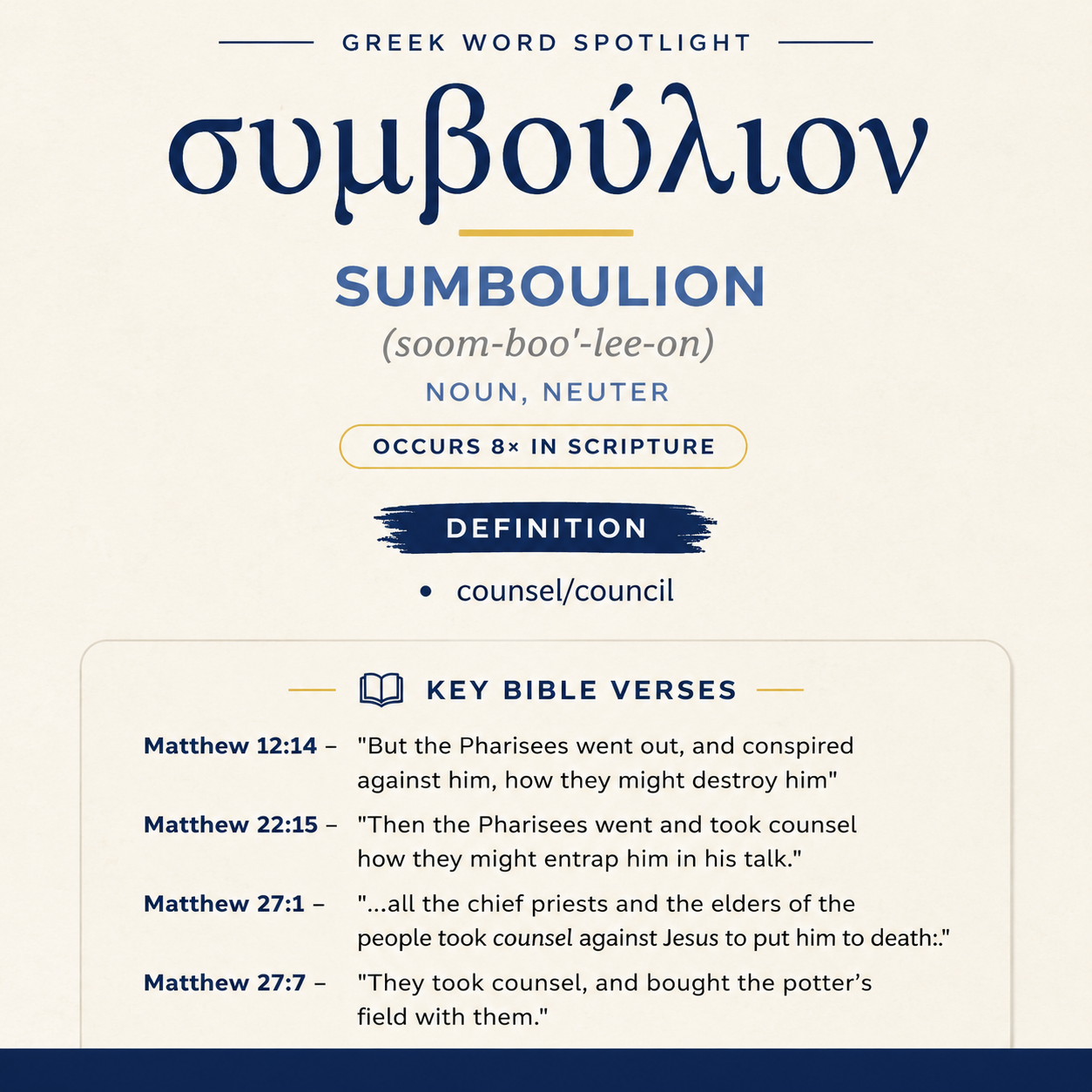
συμβούλιον means counsel/council and appears 8 times in Scripture, in Matthew, Mark, and Acts.
Core Meaning
συμβούλιον denotes counsel or a council. In the listed passages it involves deliberation and decision-making.
Learn More →Gospel Usage
In Matthew and Mark, it appears in scenes where Pharisees, chief priests, and elders take counsel or conspire against Jesus. It also describes taking counsel about actions such as purchasing the potter’s field.
Learn More →Acts Usage
In Acts 25:12, Festus confers with the council before answering Paul’s appeal to Caesar. The word marks an official consultation preceding a legal decision.
Learn More →συμβούλιον refers to counsel or a council, and it appears in a cluster of Gospel scenes where religious leaders coordinate action against Jesus, as well as in legal-administrative settings where officials consult together before making a formal response. Across its uses, it marks deliberate consultation—either as a decision-making gathering or as the act of taking counsel that results in a concrete next step.
Occurrences
Matthew 12:14 But the Pharisees went out, and conspired against him, how they might destroy him.
Here συμβούλιον frames the Pharisees’ response as coordinated counsel rather than an impulsive reaction. The verse emphasizes both the setting (“went out”) and the aim (“how they might destroy him”): the counsel is purposeful planning directed toward an outcome.
Matthew 22:15 Then the Pharisees went and took counsel how they might entrap him in his talk.
In this scene, the counsel is explicitly tactical: it is taken “how they might entrap him in his talk.” The word highlights the shift from disagreement to strategy, where speech becomes the battleground and the group’s deliberation aims to engineer a verbal snare.
Matthew 27:1 Now when morning had come, all the chief priests and the elders of the people took counsel against Jesus to put him to death:
συμβούλιον is tied to formal leadership (“all the chief priests and the elders of the people”) and to a decisive, lethal objective (“to put him to death”). The time marker “when morning had come” gives the counsel a scheduled, official feel: it is a morning deliberation that moves toward an irreversible sentence.
Matthew 27:7 They took counsel, and bought the potter’s field with them, to bury strangers in.
Here the counsel results in a financial and administrative decision: “bought the potter’s field.” The word points to a collective resolution about what to do “with them,” and the stated purpose (“to bury strangers in”) shows counsel functioning as practical governance, assigning resources toward a public outcome.
Matthew 28:12 When they were assembled with the elders, and had taken counsel, they gave a large amount of silver to the soldiers,
This occurrence explicitly combines assembly and deliberation: they are “assembled with the elders” and then “had taken counsel.” The counsel culminates in a concrete inducement—“a large amount of silver”—so the word marks the decision point that authorizes a payment and sets a course of action.
Mark 3:6 The Pharisees went out, and immediately conspired with the Herodians against him, how they might destroy him.
As in Matthew 12:14, counsel is presented as coordinated planning toward destruction, but Mark adds the alliance: “with the Herodians.” συμβούλιον here carries the force of coalition counsel—different parties joining in a shared plan, and doing so “immediately,” underscoring urgency and resolve.
Mark 15:1 Immediately in the morning the chief priests, with the elders and scribes, and the whole council, held a consultation, bound Jesus, carried him away, and delivered him up to Pilate.
This is the most institutionally explicit use: “the whole council” is named, and the counsel is described as a “consultation” within a broad leadership group (“chief priests… elders and scribes”). The word stands at the head of a sequence of official actions—“bound… carried… delivered”—so the consultation functions as the deliberative gateway that authorizes arrest-like handling and transfer to Pilate.
Acts 25:12 Then Festus, when he had conferred with the council, answered, “You have appealed to Caesar. To Caesar you shall go.”
In Acts, συμβούλιον appears in a provincial judicial setting. Festus “conferred with the council” before answering, and the answer is a formal ruling directed to an appeal: “To Caesar you shall go.” The word highlights due deliberation with advisers, a consultative step preceding an official pronouncement.

Sense and Usage
Across these passages, συμβούλιον consistently marks counsel that is collective and outcome-oriented. Whether the emphasis falls on the act (“took counsel,” “conspired,” “held a consultation,” “conferred”) or on the assembled body (“the whole council”), the word operates in scenes where a group moves from discussion to decision and then to implementation.
The Gospel occurrences show counsel functioning as coordinated opposition: the deliberations are not merely private opinions but shared strategies aimed at shaping events. In Matthew 22:15, the object of counsel is a method—how to “entrap… in his talk”—showing counsel as planning the means. In Matthew 27:1 and Mark 15:1, counsel accompanies formal leadership groupings and initiates actions with legal and political consequences: decisions lead to binding, delivering, and pursuit of death. Even where the result is not directly punitive (Matthew 27:7), counsel still governs communal action, directing money and property toward a public purpose (“to bury strangers in”). In Matthew 28:12, counsel authorizes a payment, portraying deliberation as the mechanism through which leaders align on a response and then finance it.
Acts 25:12 illustrates that the same counsel/council language can describe administrative procedure rather than hostility. Festus does not act in isolation: he consults and then issues a binding answer. This use places συμβούλιον within the rhythms of governance—consultation with a council as part of reaching a decision that carries official weight.
Taken together, these passages give συμβούλιον a distinct profile: it is counsel that is corporate, purposeful, and effective—counsel that does something. It appears where deliberation is consequential, because it leads directly to choices that shape outcomes, whether in plotting, purchasing, paying, or pronouncing judgment.
Implied Imagery
The word often evokes the picture of leaders gathering, conferring, and then setting tangible actions in motion: going out to coordinate plans, assembling with elders, holding a morning consultation, and then moving from decision to deeds—binding, delivering, paying silver, buying a field, or issuing a legal directive. In these scenes, counsel is not abstract thought; it is the organized moment where collective intent becomes a determined course of action.
Sources: Lexical data from Strong’s Exhaustive Concordance and the Translators Brief Lexicon of Extended Strongs for Greek (STEPBible, CC BY). Occurrence data from the Translators Amalgamated Greek New Testament (STEPBible, CC BY). Scripture quotations from the World English Bible (public domain).




