Exploring the Meaning of Sumbouleuo in Greek
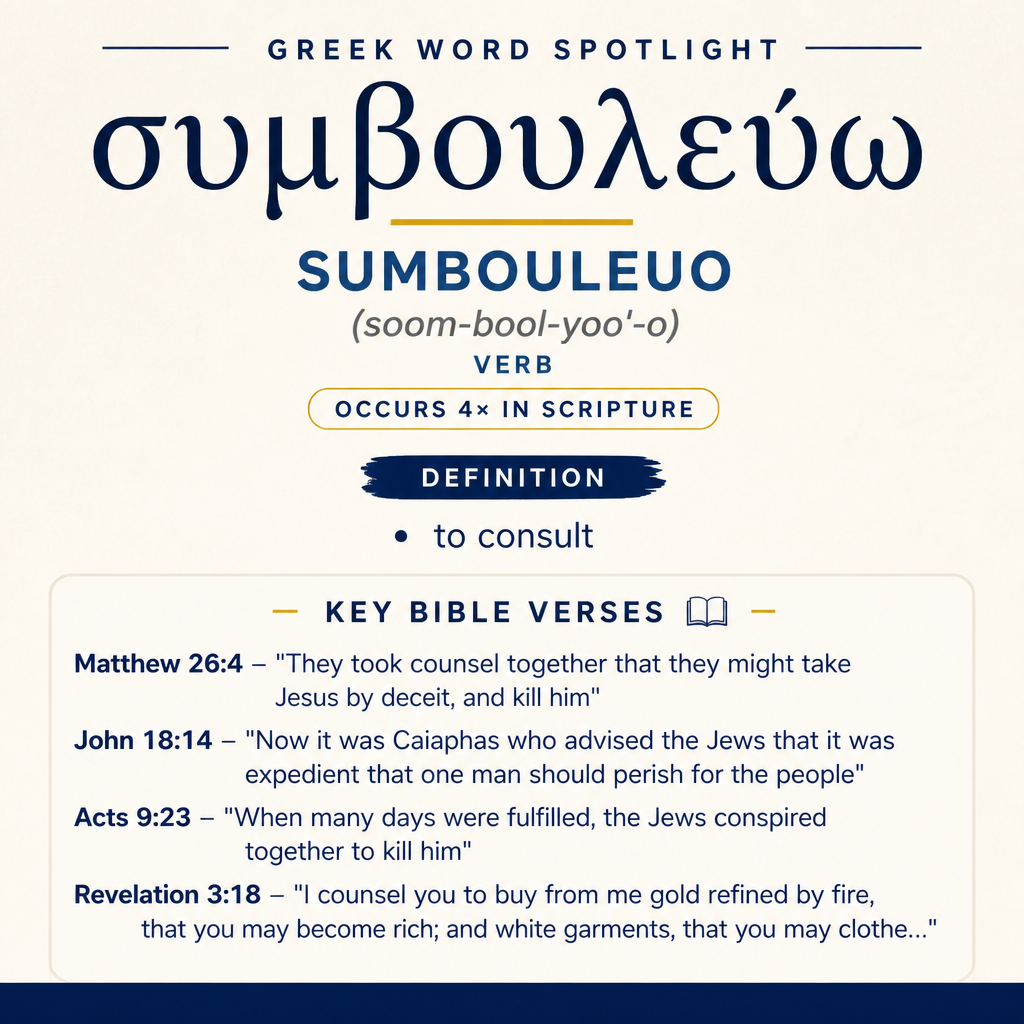
συμβουλεύω means “to consult” and appears four times in Scripture: Matthew 26:4, John 18:14, Acts 9:23, and Revelation 3:18.
Core Meaning
συμβουλεύω means “to consult.” In its Scripture occurrences, it is used for giving or taking counsel.
Learn More →Narrative Scenes
It describes counsel taken to kill Jesus (Matthew 26:4) and advice given by Caiaphas (John 18:14). It also appears for a conspiracy to kill (Acts 9:23).
Learn More →Exhortation
In Revelation 3:18, the speaker says, “I counsel you” to buy refined gold and white garments. The word frames a direct call to action.
Learn More →συμβουλεύω means “to consult.” It appears in narratives of coordinated action against Jesus and Paul, and also in a direct exhortation addressed to a church.
Root and Related Words
συμβουλεύω (Sumbouleuo) corresponds to a verb formed with σύν (syn), “with” (Strong’s G4862), and βουλεύω (bouleuo), “to plan” (Strong’s G1011). The combination presents consultation as something done together—planning that is shared rather than solitary.

Occurrences
“They took counsel together that they might take Jesus by deceit, and kill him.” (Matthew 26:4)
Here συμβουλεύω frames a deliberate, collective decision-making process: “They took counsel together.” The content of the consultation is immediately supplied by two coordinated aims—first “that they might take Jesus by deceit,” and second “and kill him.” The wording binds the consultation to an agreed strategy; it is not merely exchanging opinions, but arriving at a united plan with method (“by deceit”) and outcome (“kill him”).

“Now it was Caiaphas who advised the Jews that it was expedient that one man should perish for the people.” (John 18:14)
In this scene the act of consulting is focused through a single figure: “Caiaphas who advised the Jews.” The consultation is presented as counsel given from one to many, with a specific rationale: “that it was expedient that one man should perish for the people.” The verse sets συμβουλεύω in the realm of policy-like judgment—advice that appeals to what is “expedient,” weighing one death against the welfare of “the people.” The verb therefore carries the feel of counsel that shapes communal action and justifies it.
“When many days were fulfilled, the Jews conspired together to kill him,” (Acts 9:23)
συμβουλεύω in this report is placed after a stretch of time: “When many days were fulfilled.” The consultation results in a settled conspiracy—“the Jews conspired together to kill him.” The verb again marks consultation as coordinated intent, now directed toward Paul (“him”). The time marker suggests that the counsel was not impulsive; the conspiracy belongs to a period of sustained opposition that reaches a decision to act.
“I counsel you to buy from me gold refined by fire, that you may become rich; and white garments, that you may clothe yourself, and that the shame of your nakedness may not be revealed; and eye salve to anoint your eyes, that you may see.” (Revelation 3:18)
In Revelation, συμβουλεύω appears as direct address: “I counsel you.” The consultation is not portrayed as a plot among peers, but as authoritative counsel given to the hearer for their benefit. The advice is concrete and expressed in a sequence of purchases—“gold refined by fire,” “white garments,” and “eye salve.” Each item is paired with a purpose clause: “that you may become rich,” “that you may clothe yourself, and that the shame of your nakedness may not be revealed,” and “that you may see.” The verb introduces counsel that aims at remedying lack and exposure, moving from condition (“nakedness”) to covering (“garments”), and from impaired perception to sight (“that you may see”).
Sense and Usage
Across these four passages, συμβουλεύω consistently functions as speech that guides action—consultation that leads to a chosen course. In Matthew 26:4 and Acts 9:23 the consultation is mutual and closed among a group: people “took counsel together” or “conspired together,” and the shared counsel terminates in a decision to kill. The verb in these contexts highlights the social nature of the decision: responsibility is distributed across the consultative body, and the resulting act is presented as the fruit of agreement rather than a spontaneous outburst.
John 18:14 shows the same dynamic of action-guiding speech, but with a different shape: one adviser counseling a larger community (“Caiaphas…advised the Jews”). The content of counsel is framed as an argument about what is “expedient,” giving the consultation a calculating, justificatory quality. Rather than describing the mechanics of how the killing will occur (as Matthew does with “by deceit”), John’s phrasing emphasizes the reasoning that makes the action seem acceptable to its audience.
Revelation 3:18 contrasts sharply with the earlier hostile consultations. The verb still introduces counsel that points toward a concrete course of action, but the desired outcome is restoration rather than harm. The counsel is directed toward the hearer’s state—poverty versus riches, nakedness versus clothing, blindness versus sight—and it moves by imperative-like instruction (“buy…”) tied to intended results (“that you may…”). In this setting, συμβουλεύω carries the sense of practical guidance: advice that addresses specific needs with specific remedies.
Imagery in Context
The passages pair συμβουλεύω with vivid outcomes that give the consultation moral weight. In Matthew 26:4 counsel is bound to “deceit” and death; in Acts 9:23 it matures over “many days” into a conspiracy; in John 18:14 it is clothed in the language of expedience and sacrifice—“one man…perish for the people.” Revelation 3:18, however, links counsel to refined gold, clean garments, and healing salve—images of value, covering, and restored vision—showing counsel as a means of rescue when it is aimed toward what heals rather than what destroys.
Sources: Lexical data from Strong’s Exhaustive Concordance and the Translators Brief Lexicon of Extended Strongs for Greek (STEPBible, CC BY). Occurrence data from the Translators Amalgamated Greek New Testament (STEPBible, CC BY). Scripture quotations from the World English Bible (public domain).