
Exploring the Meaning of Suke in Greek
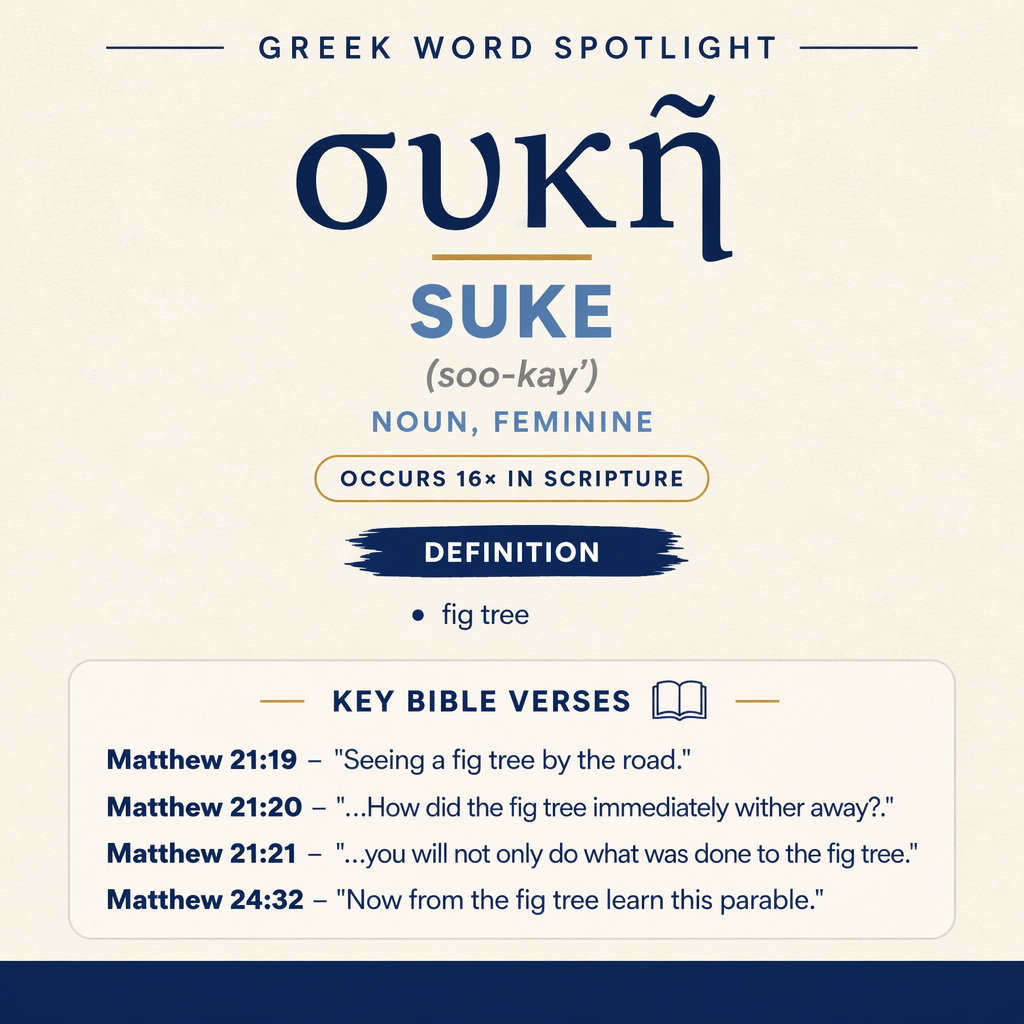
συκῆ means “fig tree” in Greek and occurs 16 times in Scripture, including passages in Matthew and Mark.
Gospel Scenes
In Matthew 21:19–21, Jesus speaks to a fig tree with leaves but no fruit, and it withers. In Mark 11:13, 11:20–21, the withered fig tree is observed and remembered.
Learn More →Parable Context
In Matthew 24:32 and Mark 13:28, Jesus teaches a parable drawn from the fig tree and its branch producing leaves.
Learn More →συκῆ names a “fig tree,” a concrete fruit tree that appears in Gospel scenes ranging from a roadside encounter to parables about fruitfulness and seasonal signs. In these passages it functions as an observable tree—seen, approached, planted, shaded beneath, or used as an object lesson—whose visible condition carries the point of the moment.
Occurrences
Matthew 21:19 — “Seeing a fig tree by the road, he came to it, and found nothing on it but leaves. He said to it, “Let there be no fruit from you forever!” Immediately the fig tree withered away.”
Here the fig tree stands “by the road,” close enough to be approached. The narrative stresses what can be observed on it—“nothing on it but leaves”—and the tree becomes the direct addressee of Jesus’ spoken word. συκῆ is the object that visibly changes in response: it “withered away,” making the tree itself the public, physical outcome of the pronouncement.

Matthew 21:20 — “When the disciples saw it, they marveled, saying, “How did the fig tree immediately wither away?””
In the disciples’ reaction, the fig tree is the focus of astonishment. The question centers on the immediacy of the tree’s withering, treating συκῆ as a visible indicator that prompts inquiry. The tree’s change is not private or symbolic in the abstract; it is something “the disciples saw.”
Matthew 21:21 — “Jesus answered them, “Most certainly I tell you, if you have faith, and don’t doubt, you will not only do what was done to the fig tree, but even if you told this mountain, ‘Be taken up and cast into the sea,’ it would be done.”
συκῆ functions as the concrete reference point for “what was done,” anchoring Jesus’ explanation in a specific, recent event. The fig tree episode supplies the baseline example before the larger comparison to commanding a mountain. The tree is thus a remembered object lesson: a real plant whose altered condition provides the example under discussion.
Matthew 24:32 — ““Now from the fig tree learn this parable. When its branch has now become tender, and produces its leaves, you know that the summer is near.”
In this parable, the fig tree is an everyday seasonal marker. Attention falls on its “branch” becoming “tender” and on the production of “leaves,” observable changes that lead to knowledge: “you know that the summer is near.” συκῆ is therefore presented as a reliable, visible sign in the natural world, used to illustrate recognizing what is near based on what is seen.
Mark 11:13 — “Seeing a fig tree afar off having leaves, he came to see if perhaps he might find anything on it. When he came to it, he found nothing but leaves, for it was not the season for figs.”
This scene emphasizes distance (“afar off”), appearance (“having leaves”), approach, inspection, and the result (“nothing but leaves”). The mention that “it was not the season for figs” frames the search and the discovery within time and season. συκῆ here is a tree that invites expectation because of its leaves, yet yields no fruit when examined closely.
Mark 11:20 — “As they passed by in the morning, they saw the fig tree withered away from the roots.”
The fig tree reappears as a landmark encountered again: “as they passed by.” The withering is described with a vivid scope—“from the roots”—highlighting the extent of the tree’s condition. συκῆ functions as a visible, enduring result observed on the next morning, not merely a momentary effect.
Mark 11:21 — “Peter, remembering, said to him, “Rabbi, look! The fig tree which you cursed has withered away.””
Here the fig tree is tied to memory and to Jesus’ prior action: “which you cursed.” Peter’s “look!” points to an observable reality in the present, and the clause “has withered away” summarizes the state of the tree. συκῆ serves as the concrete object that links a spoken word in the past to a visible state in the present.
Mark 13:28 — ““Now from the fig tree, learn this parable. When the branch has now become tender, and produces its leaves, you know that the summer is near;”
As in Matthew, the fig tree is a teaching instrument grounded in seasonal observation. The tree’s branch and leaves provide the pattern: certain visible developments correspond to the nearness of summer. συκῆ is presented as familiar and instructive, the sort of tree whose changes can be “learned” from in parable form.
Luke 13:6 — “He spoke this parable. “A certain man had a fig tree planted in his vineyard, and he came seeking fruit on it, and found none.”
In Luke’s parable, the fig tree is deliberately cultivated: “planted in his vineyard.” The owner’s purpose is explicit—he comes “seeking fruit on it”—and the tree’s failure is stated plainly: “found none.” συκῆ is thus characterized by its expected productivity within an agricultural setting, where fruit is the sought outcome.
Luke 13:7 — “He said to the vine dresser, ‘Behold, these three years I have come looking for fruit on this fig tree, and found none. Cut it down. Why does it waste the soil?’”
The fig tree remains central, now in a longer timeframe: “these three years.” The repeated search (“I have come looking for fruit”) and repeated result (“found none”) lead to a decision: “Cut it down.” The closing question, “Why does it waste the soil?” places the fig tree in relation to the ground it occupies, highlighting its impact on the vineyard’s resources and space.
Luke 21:29 — “He told them a parable. “See the fig tree and all the trees.”
Here συκῆ appears as part of a broader comparison set: “the fig tree and all the trees.” The imperative “See” points to observation, inviting the listeners to look at the natural world as a teaching aid. The fig tree is singled out yet grouped with other trees, suggesting it is a representative example within a wider category of visible, seasonal growth.
John 1:48 — “Nathanael said to him, “How do you know me?” Jesus answered him, “Before Philip called you, when you were under the fig tree, I saw you.””
In John, the fig tree functions as a location marker: Nathanael had been “under the fig tree.” The tree provides shade or cover implied by being “under” it, and it anchors a specific moment “before Philip called you.” συκῆ thus serves as a concrete setting in personal narrative, identifying where Nathanael was when Jesus says he saw him.

Sense and Usage
Across these passages, συκῆ retains its straightforward reference to a fig tree, yet it is used in several distinct narrative roles. First, it can be an object encountered and inspected in the course of travel (Matthew 21:19; Mark 11:13). In such scenes, the tree’s visible features—especially “leaves” and the sought “fruit”—are contrasted. Leaves are repeatedly what is seen; fruit is what is looked for. The tension between appearance and outcome is carried by the tree’s condition itself, because it is something that can be approached, examined, and later revisited.
Second, συκῆ can be the subject of an enacted, visible consequence (“withered away,” “withered away from the roots”) that is noticed by followers and discussed afterward (Matthew 21:20–21; Mark 11:20–21). The repeated noticing and remembering show that the tree is not merely background scenery; it becomes a stable reference point in conversation and teaching because its changed state persists and can be pointed out.
Third, the fig tree serves as an everyday example for parabolic instruction about recognizing what is near. In Matthew 24:32 and Mark 13:28, the emphasis falls on the tree’s seasonal development: a tender branch and the emergence of leaves function as observable indicators that “the summer is near.” In Luke 21:29 the fig tree is paired with “all the trees,” placing it within the larger pattern of paying attention to what trees do in their seasons. In these sayings, the fig tree is chosen as something ordinary enough that its growth pattern can be treated as common knowledge and used as a shared point of reference.
Fourth, in Luke 13:6–7, the fig tree is planted within a managed agricultural space (“his vineyard”), making fruitfulness an explicit expectation. The owner’s repeated visits over “three years” and the proposed cutting down frame the tree in terms of cultivation, accountability, and the practical value of land. The tree is not wild or incidental; it occupies “soil” that could serve other productive purposes.
Finally, in John 1:48, the fig tree is neither a sign of seasons nor an object of inspection, but a concrete place in a remembered moment: being “under the fig tree” locates Nathanael in a specific setting. Even here the word’s force is still its concreteness: it identifies a real tree that situates the scene in time (“Before Philip called you”) and space (“under the fig tree”).
Imagery
The fig tree imagery in these verses is consistently physical and observable: leaves, branches, fruit, roots, soil, and shade. Whether the tree is roadside, within a vineyard, or simply among “all the trees,” συκῆ supplies a stable, familiar element of the landscape that can be examined for fruit, read for seasonal change, or remembered as a place where someone once sat.
Sources: Lexical data from Strong’s Exhaustive Concordance and the Translators Brief Lexicon of Extended Strongs for Greek (STEPBible, CC BY). Occurrence data from the Translators Amalgamated Greek New Testament (STEPBible, CC BY). Scripture quotations from the World English Bible (public domain).




