Exploring the Meaning of Sukaminos in Greek
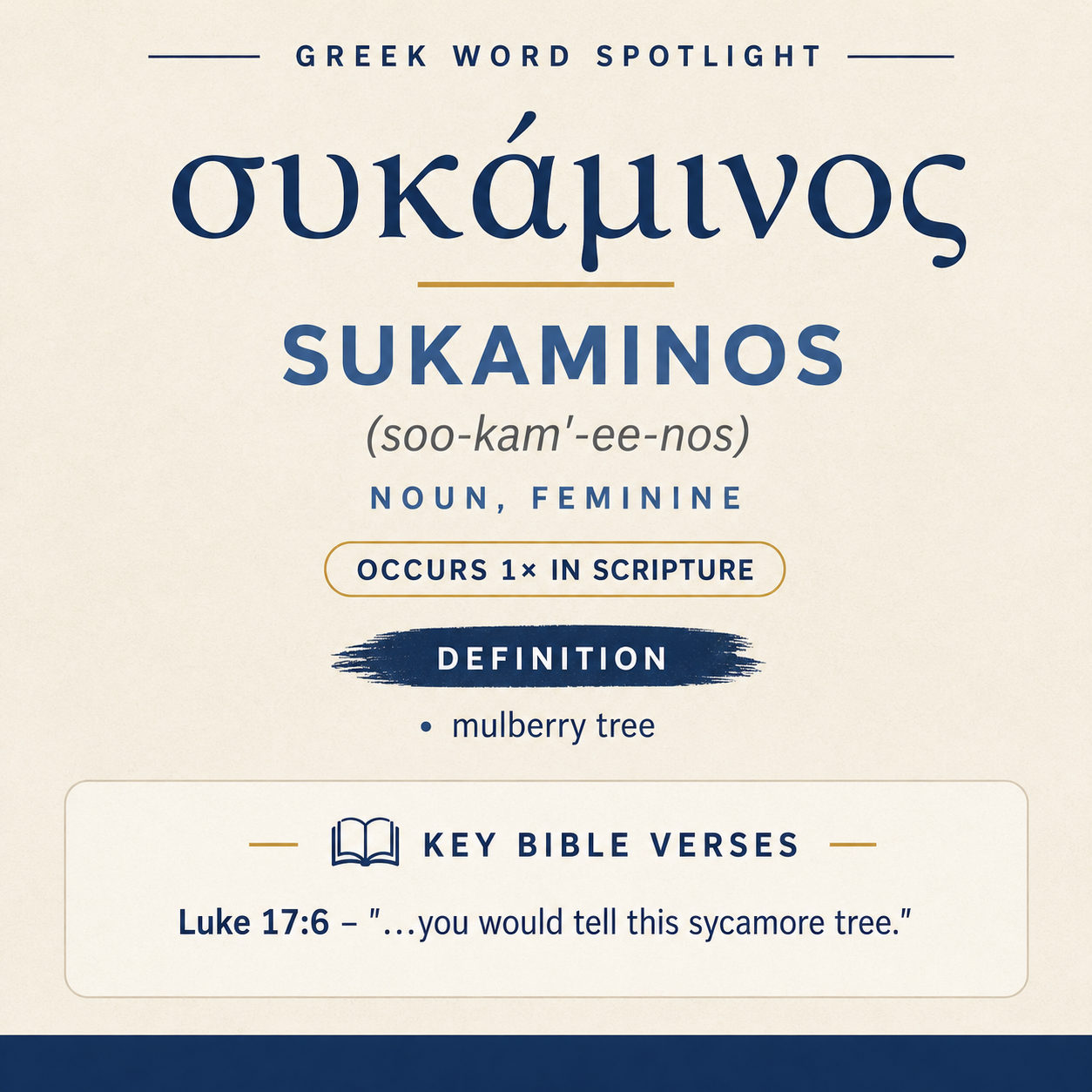
συκάμινος means “mulberry tree” and appears in Luke 17:6.
συκάμινος means “mulberry tree” and appears once in the New Testament, in Jesus’ saying about commanding a tree to be uprooted and planted in the sea. In that setting it functions as a concrete, familiar object pressed into service as a vivid image for what is commanded.
Root and Related Words
συκάμινος (Sukaminos) is connected with the related word συκομωραία (sykomoraia), “sycamore tree” (Strong’s G4809), identified as the word from which it derives.

Occurrences
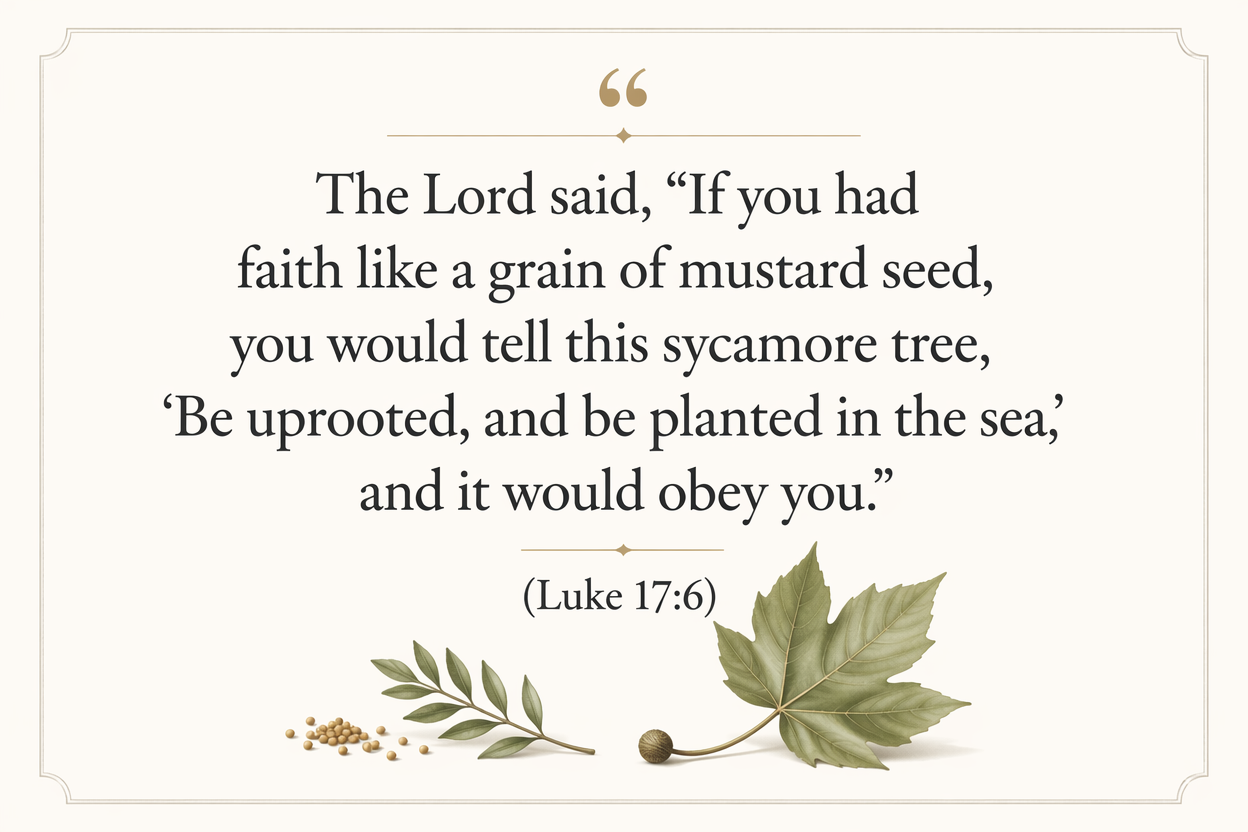
“The Lord said, “If you had faith like a grain of mustard seed, you would tell this sycamore tree, ‘Be uprooted, and be planted in the sea,’ and it would obey you.” (Luke 17:6)
Here συκάμινος refers to a particular tree singled out for address: “this sycamore tree.” The tree is not part of a description of landscape for its own sake; it is a commanded object in direct speech. The sentence sets up a conditional scenario (“If you had faith like a grain of mustard seed”) and then moves immediately to an imagined act of speaking (“you would tell…”) in which the tree becomes the target of an imperative: “Be uprooted, and be planted in the sea.”
In this scene the mulberry tree functions as something fixed and established—an object that normally remains where it is rooted. The command given to it expresses a complete reversal of what trees ordinarily do: it is told to be “uprooted” (removed from its place of growth) and “planted in the sea” (relocated to an environment presented as the opposite of a normal planting place). The verse finishes by assigning the tree a response proper to a personal agent: “and it would obey you.” The noun, therefore, does more than name a plant; it anchors the saying in a tangible, visible item that can be pointed to (“this”) and treated as though it could respond to human speech.
Sense and Usage
The definition “mulberry tree” is realized in Luke 17:6 through concrete deixis (“this”) and through the physical actions named in the quotation (“Be uprooted,” “be planted”). As a noun for a tree, συκάμινος brings with it a set of ordinary expectations: trees grow from roots, remain in place, and are moved only with difficulty. The saying depends on those expectations without needing to spell them out; the command is striking precisely because it names an established plant and then orders it to undergo a radical displacement.
The immediate co-text shows how συκάμινος works as an image rather than as botany. The tree stands in a sentence whose other concrete terms are small (“a grain of mustard seed”) and immense (“the sea”). The tree sits between them as a medium-scale, everyday object—substantial enough to make the command feel weighty, yet ordinary enough to be imaginable in a lived environment. In that way, the noun serves as a bridge between the small measure of faith mentioned and the large, unnatural result described. The line “it would obey you” confirms that the point is not the tree as a species but the tree as a representative, touchable instance of the physical world being addressed and responding.
The wording also shows that συκάμινος is used with specificity rather than as a generic category (“this sycamore tree”), turning the tree into an almost demonstrative prop within the saying. It is something one can indicate and speak to. The commands attached to it are paired imperatives: first removal (“Be uprooted”), then re-establishment elsewhere (“be planted in the sea”). The mulberry tree is thus depicted as an object that can be relocated and replanted by command, and its “obedience” completes the picture of responsiveness. Within the logic of the sentence, the tree’s compliance is the narrated outcome, and the noun supplies the stable object whose compliance makes the outcome vivid.
Because συκάμινος occurs here as the direct object of speech (“you would tell this sycamore tree”), its sense is framed by interpersonal language: speaking, commanding, and obeying. The tree is grammatically and imaginatively placed in a position normally occupied by a listener. That placement makes the mulberry tree a sharp example of the kind of entity that does not ordinarily respond to human words. The image depends on the concreteness of the referent: a mulberry tree is not an abstraction but a specific, rooted organism. The contrast between what the noun denotes and what the sentence asks it to do underlines the extremity of the imagined act.
Imagery
Luke 17:6 attaches to συκάμινος the imagery of deep roots, sudden removal, and improbable replanting. The verse’s picture is simple and forceful: a tree addressed, uprooted, and set into the sea, with the final note that it “would obey.” The noun contributes the weight of something firmly established in the earth, so that the imagined relocation is felt as a dramatic overturning of the normal order described in the command.
Sources: Lexical data from Strong’s Exhaustive Concordance and the Translators Brief Lexicon of Extended Strongs for Greek (STEPBible, CC BY). Occurrence data from the Translators Amalgamated Greek New Testament (STEPBible, CC BY). Scripture quotations from the World English Bible (public domain).