Exploring the Meaning of Stratopedarches in Greek
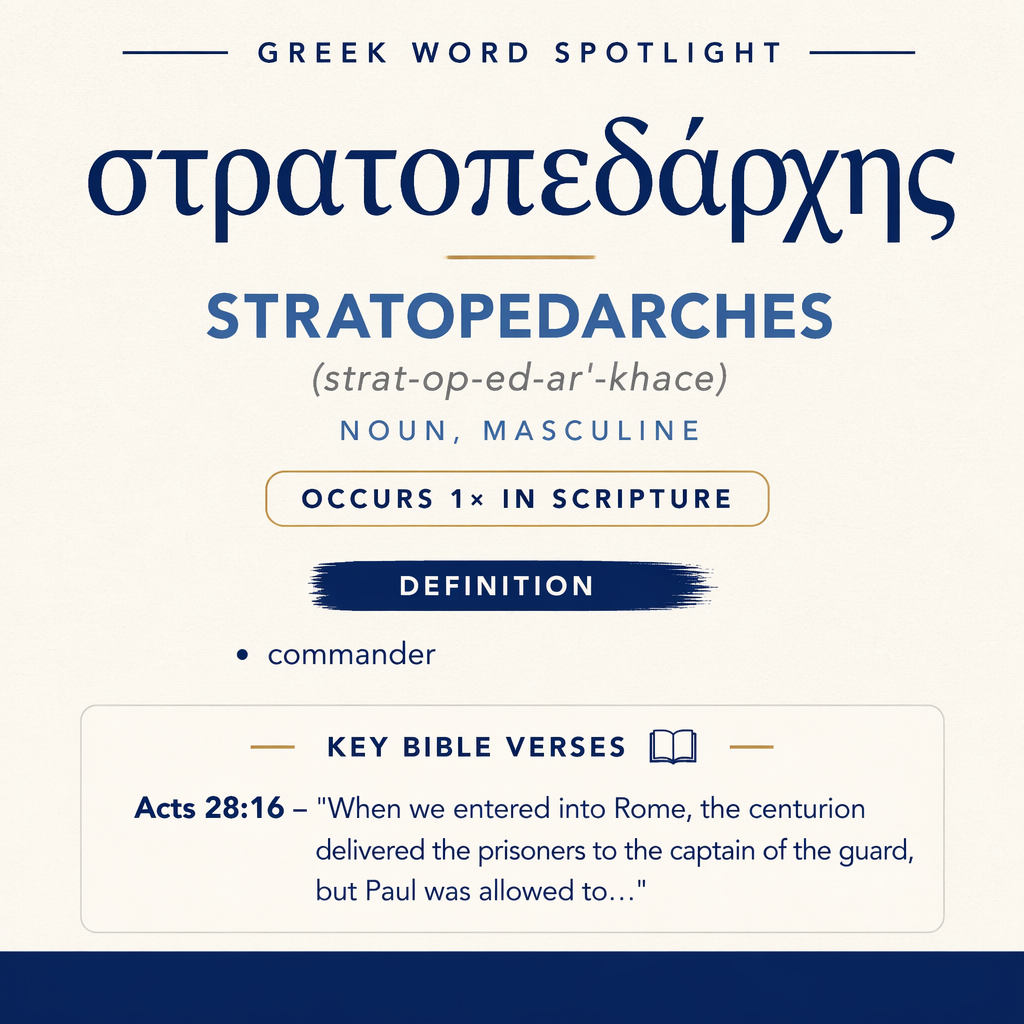
στρατοπεδάρχης means “commander” and appears once in Scripture, in Acts 28:16.
Scripture Occurrence
It occurs 1 time in Scripture. Its single occurrence is in Acts 28:16.
Learn More →Context in Acts
In Acts 28:16, the centurion delivered the prisoners to the captain of the guard.
Learn More →στρατοπεδάρχης means “commander” and appears once in the New Testament, in the account of Paul’s arrival in Rome. In that scene it names the official to whom prisoners are formally handed over when the party enters the city.
Root and Related Words
στρατοπεδάρχης is derived, per Strong’s, from stratopedon (στρατόπεδον), “army camp” (Strong’s G4760), and archō (ἄρχω), “be first” (Strong’s G757). The combination places the term within a military-administrative setting: it draws on the vocabulary of encampment and command, and thus naturally fits contexts where custody, units, and hierarchy are in view.

Occurrences
“When we entered into Rome, the centurion delivered the prisoners to the captain of the guard, but Paul was allowed to stay by himself with the soldier who guarded him.” (Acts 28:16)
In Acts 28:16, στρατοπεδάρχης designates the receiving authority in a chain of custody. The verse sets out a sequence of responsibility: entry into Rome, the centurion’s delivery of “the prisoners” to a superior official, and then a particular arrangement for Paul. The term marks the point at which the centurion’s immediate oversight gives way to a higher level of command associated with guarding and detention, since the delivery is specifically “to the captain of the guard.”
The wording frames the commander’s role as administrative as well as supervisory. “Delivered the prisoners” implies an official transfer rather than an informal escort; the commander stands as the one authorized to accept custody within the Roman setting. That authority is immediately relevant to Paul’s situation, because the same verse records an exception or special allowance: “but Paul was allowed to stay by himself with the soldier who guarded him.” The presence of a named command figure helps explain how such an arrangement can be granted without dissolving custody; a soldier still guards Paul, yet Paul’s lodging differs from the rest of the prisoners. In this scene, then, στρατοπεδάρχης anchors the narrative in formal military order: prisoners are not merely watched, they are assigned, transferred, and guarded under a recognized commander.
Sense and Usage
The sense “commander” in this passage functions as a title of office tied to organized security. The term is not used to describe a general leadership quality or a casual leader; it appears as part of a concrete procedural moment—an officer (the centurion) hands prisoners over to another official identified by command. The commander is therefore presented as someone who stands above the centurion in the relevant sphere, receiving prisoners and overseeing their guard.
The immediate co-text adds clarity to the kind of command in view. First, the commander’s title is coupled with guarding: “captain of the guard.” This links command to custody and protection, not to battlefield tactics or civic governance in general. Second, the commander’s role is implied by the pairing of “prisoners” and “guarded.” The verse does not narrate the commander speaking or acting directly; instead, the commander’s significance lies in being the official endpoint of the centurion’s delivery. In narrative terms, στρατοπεδάρχης supplies a point of institutional contact between an arriving military escort and the city’s established system for handling detainees.
The allowance made for Paul highlights how command can coexist with constraint. Paul is not released; he remains “with the soldier who guarded him.” Yet his circumstances are distinguished from those of “the prisoners” as a group. By naming the commander at the moment custody is transferred, the text situates Paul’s unique arrangement within legitimate authority rather than disorder or neglect. The word thus carries the practical weight of recognized command: it signals who has the standing to receive prisoners and under whose system a guarded but more private confinement can occur.
Imagery
Acts 28:16 evokes the imagery of ordered movement through military channels: an escorted group enters a major city, prisoners are formally handed over, and a guard remains stationed with a particular detainee. Within that scene, στρατοπεδάρχης calls to mind command exercised in structured custody—an official presence implied at the receiving end of the transfer, where security is maintained through rank, assignment, and supervision.
Sources: Lexical data from Strong’s Exhaustive Concordance and the Translators Brief Lexicon of Extended Strongs for Greek (STEPBible, CC BY). Occurrence data from the Translators Amalgamated Greek New Testament (STEPBible, CC BY). Scripture quotations from the World English Bible (public domain).