Exploring the Meaning of Sterigmos in Greek
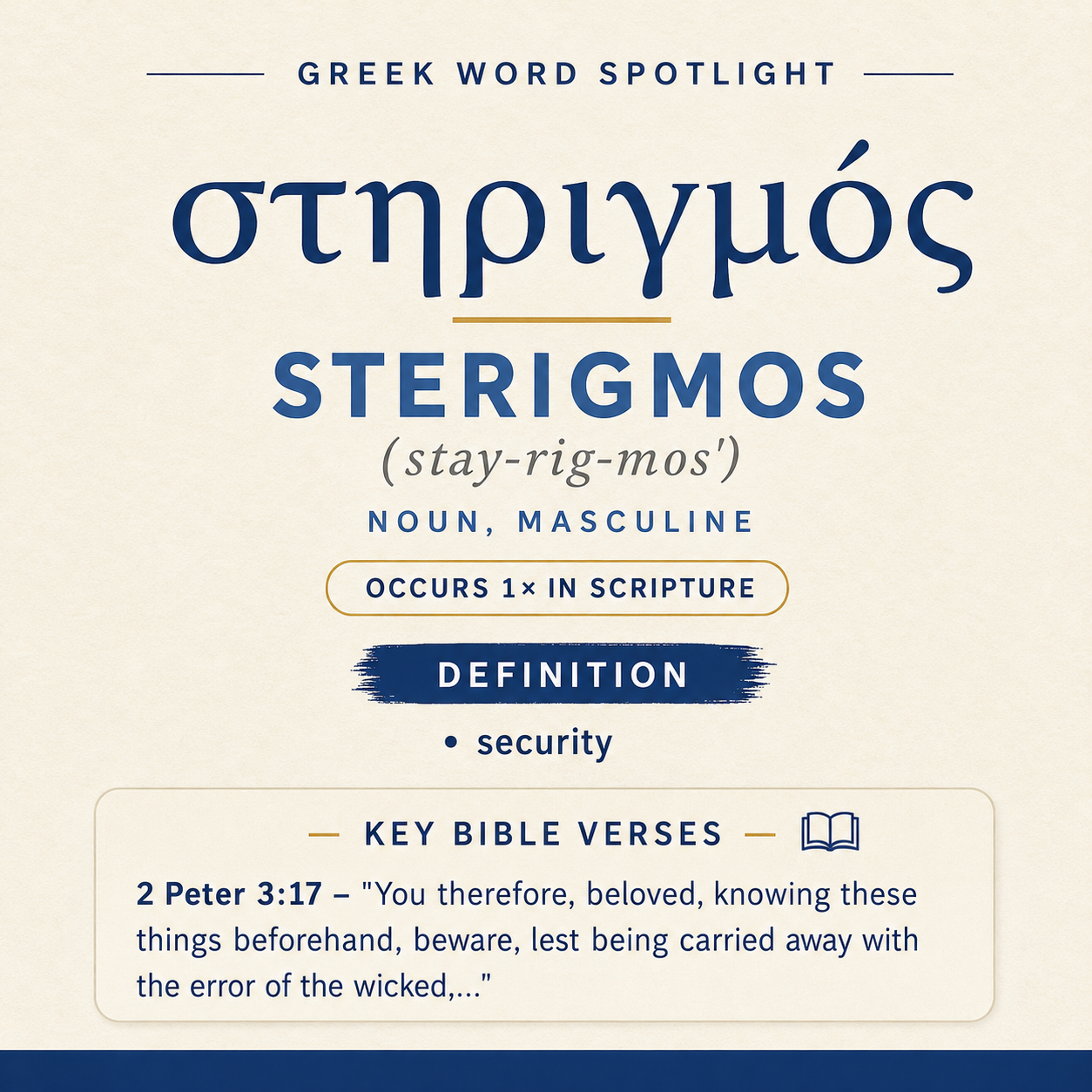
στηριγμός (Sterigmos) means “security” and appears once in Scripture, in 2 Peter 3:17.
Scripture Occurrence
It occurs 1 time in Scripture. The occurrence is in 2 Peter 3:17.
Learn More →Verse Context
In 2 Peter 3:17, the verse warns believers to beware of being carried away with error.
Learn More →στηριγμός means “security” and appears in the New Testament once, in 2 Peter 3:17. In that warning, it names what can be lost when someone is swept along by deceptive influence.
Root and Related Words
στηριγμός is related to the verb sterizo (στηρίζω), “to establish” (Strong’s G4741). The connection to a verb of establishing frames the noun as a state that results from being set on a firm footing.

Occurrences
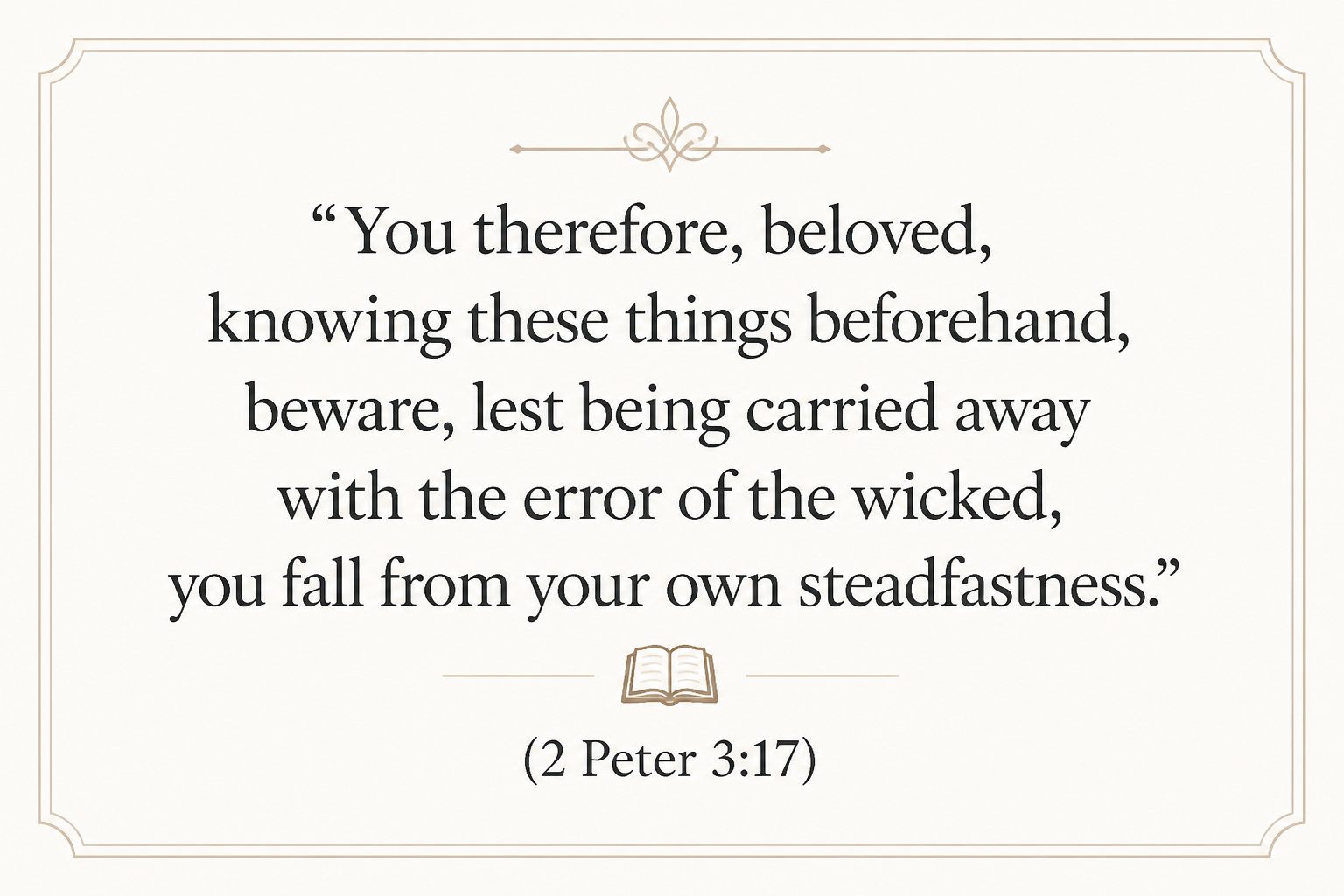
“You therefore, beloved, knowing these things beforehand, beware, lest being carried away with the error of the wicked, you fall from your own steadfastness.” (2 Peter 3:17)
In this sentence, the writer addresses “beloved” readers who “know[] these things beforehand,” and the knowledge is meant to produce watchfulness: “beware.” The danger is described with two vivid movements. First, there is a passive drift: “being carried away with the error of the wicked.” Second, there is a decisive drop: “you fall from your own steadfastness.” Within that sequence, στηριγμός (“security”) functions as the named point of stability that is endangered—something belonging to the readers (“your own”) that can be departed from by a fall.
The grammar of the warning makes security the counterweight to “error.” “Error” is not presented as a neutral mistake but as something with moral direction (“of the wicked”) and a kind of force that can carry a person along. Against that current stands the readers’ security: it is pictured not as something that pushes outward but as a position one occupies. The key verb “fall” places the emphasis on loss of position rather than mere internal feeling. Security here is not simply the absence of fear; it is the state of being held in place such that a “fall” would represent leaving that state.
The phrase “from your own steadfastness” (where στηριγμός stands in the underlying Greek) also sets security in a personal frame. It is not described as borrowed from others in the moment of temptation, nor as an external safeguard imposed on them, but as something that is already theirs and therefore something they are responsible to keep. The warning presumes that security can be possessed meaningfully enough to be the object of loss, and that losing it is not an abstract event but the outcome of being drawn into a path characterized by “the error of the wicked.”
Sense and Usage
As used in 2 Peter 3:17, “security” is the stable condition from which one can “fall,” contrasted with instability produced by being “carried away.” The verse gives security a practical profile: it is the opposite of being swept along; it is what remains when a person is not moved by corrupting influences. The author’s concern is not merely that the readers might encounter misleading ideas, but that such exposure could dislodge them—so that security is conceived as a settled standing that can be forfeited through misdirection.
The immediate context inside the verse also clarifies how security operates. It is linked with alertness (“beware”) and with acting in line with foreknowledge (“knowing these things beforehand”). Security is therefore not portrayed as a static possession that makes vigilance unnecessary; rather, it is what vigilance aims to preserve. In the logic of the warning, knowledge without watchfulness leaves open the possibility of being carried away, and being carried away places security at risk. Security is the threatened asset, and the verse defines the threat in terms of motion—carried away, fall—making stability its central implied feature.
The contrast between “carried away” and “fall” also shades the sense of security. “Carried away” suggests a process where one’s direction is influenced by an external force; “fall” suggests the result in relation to one’s previous position. Security, then, is not merely a momentary safe feeling but a standing that can be left behind through a process of being moved. The verse’s structure implies that security is something one stands in, and the failure is not simply that one becomes uncertain but that one is displaced.
Finally, the wording “your own” adds a nuance of possession and identity. Security is not treated as a generic ideal; it is individualized. The readers have a security that is recognizably theirs—something that can be spoken of as belonging to them and therefore something they can lose in a way that is personal. That personal framing intensifies the exhortation: the risk is not merely doctrinal confusion in the abstract but a destabilization of the readers’ own settled position.
Imagery
The verse casts security in spatial and kinetic imagery: to possess it is to stand; to lose it is to fall; to be threatened is to be carried along by a current of “error.” In that picture, security is the firm place from which the reader must not be dislodged, and the warning presses the reader to resist the pulling force that would move them away from that stable standing.
Sources: Lexical data from Strong’s Exhaustive Concordance and the Translators Brief Lexicon of Extended Strongs for Greek (STEPBible, CC BY). Occurrence data from the Translators Amalgamated Greek New Testament (STEPBible, CC BY). Scripture quotations from the World English Bible (public domain).