Exploring the Meaning of Stereos in Greek
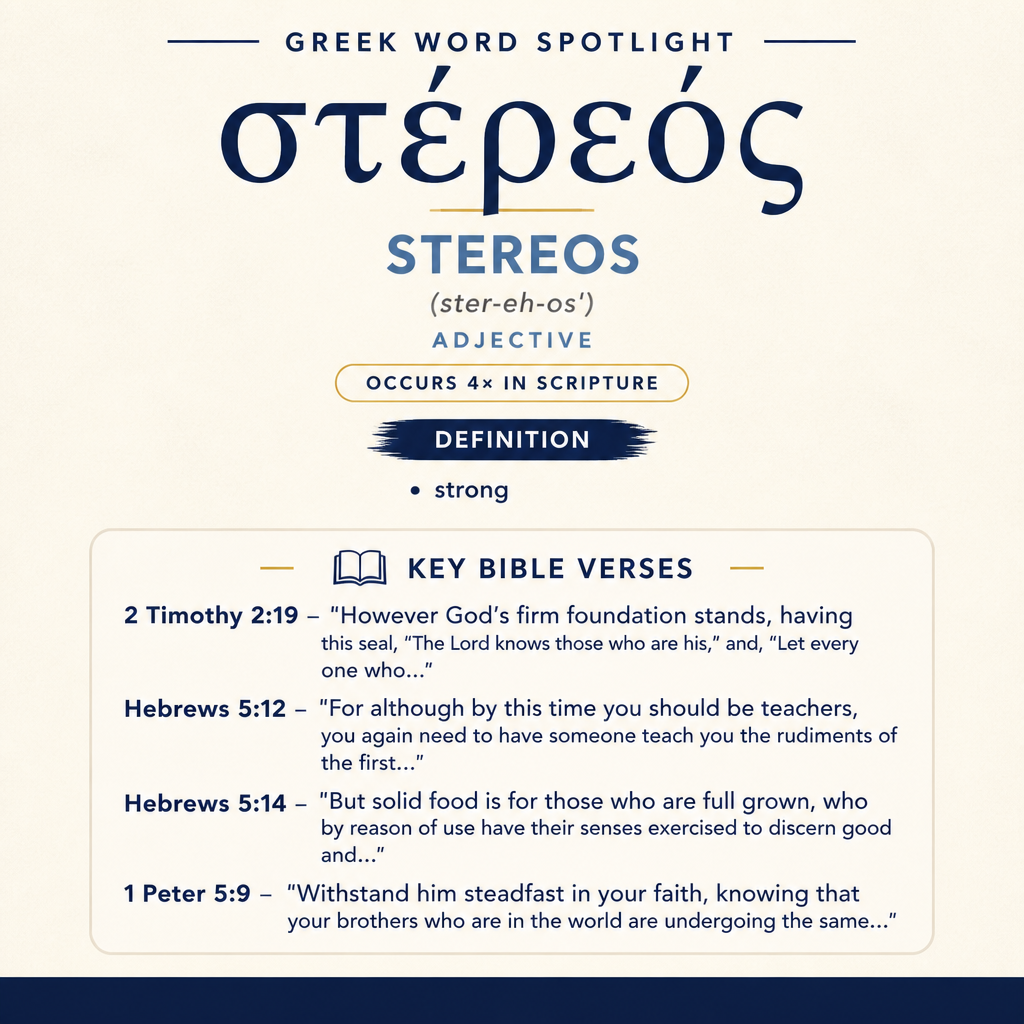
στερεός means “strong” and appears 4 times in Scripture: 2 Timothy 2:19; Hebrews 5:12, 5:14; and 1 Peter 5:9.
Where It Appears
It occurs 4 times in Scripture: 2 Timothy 2:19; Hebrews 5:12, 5:14; and 1 Peter 5:9.
Learn More →Context Snapshots
It is used of God’s firm foundation (2 Timothy 2:19), solid food (Hebrews 5:14), and steadfast faith (1 Peter 5:9).
Learn More →στερεός expresses the idea of strength as firmness, solidity, and steadiness. In the New Testament it appears in contexts that range from a “firm foundation,” to “solid food,” to a call to resist with steadfastness in faith.
Root and Related Words
στερεός derives from histemi (ἵστημι), “to stand” (Strong’s G2476). The relationship highlights strength as something that stands—fixed in place, not easily shifted.

Occurrences
“However God’s firm foundation stands, having this seal, “The Lord knows those who are his,” and, “Let every one who names the name of the Lord depart from unrighteousness.”” (2 Timothy 2:19)
Here στερεός modifies “foundation,” portraying God’s foundation as strong in the specific sense that it “stands.” The sentence pairs that standing firmness with a “seal” containing two declarations: divine recognition (“The Lord knows those who are his”) and a moral consequence (“Let every one who names the name of the Lord depart from unrighteousness”). In this setting, the word does more than describe stability in the abstract; it frames the entire statement as something reliable and enduring—firm enough to carry both assurance and obligation without wobbling. The foundation’s strength is not pictured as aggressive force but as settled permanence: it stands, it bears a seal, and it remains the ground on which identity (“those who are his”) and conduct (“depart from unrighteousness”) are set.

“For although by this time you should be teachers, you again need to have someone teach you the rudiments of the first principles of the revelations of God. You have come to need milk, and not solid food.” (Hebrews 5:12)
In Hebrews 5:12 στερεός describes “food,” contrasting “milk” with what is “solid.” The verse places this contrast inside a rebuke: people who “by this time” should be able to teach have instead regressed to needing instruction in “the rudiments of the first principles.” The adjective contributes a concrete, bodily image for maturity and capacity. “Milk” fits infancy and dependence; “solid food” fits a condition in which basic nourishment is no longer sufficient. Within the logic of the sentence, the need for milk is evidence of a stalled readiness—an inability to receive what is strong in the sense of being substantial and requiring more developed powers to take in.
“But solid food is for those who are full grown, who by reason of use have their senses exercised to discern good and evil.” (Hebrews 5:14)
This verse completes the contrast introduced in 5:12 and defines the kind of person for whom στερεός “food” is appropriate: “those who are full grown.” The strength of the food corresponds to a matured state, marked not merely by time but by trained faculties—“by reason of use” their “senses” have been “exercised” for discernment. στερεός thus functions as a label for what matches adult capacity: nourishment that fits a life practiced in distinguishing “good and evil.” The word’s contribution is to set a qualitative boundary: there is a kind of provision that assumes growth, practice, and an ability to handle what is more demanding.
“Withstand him steadfast in your faith, knowing that your brothers who are in the world are undergoing the same sufferings.” (1 Peter 5:9)
In 1 Peter 5:9 στερεός characterizes the stance taken in resistance: “Withstand him steadfast in your faith.” The verse is imperative and communal in tone; it ties steadfast resistance to awareness that “your brothers who are in the world are undergoing the same sufferings.” The word strengthens the verb “withstand” by specifying the manner of resisting: not frantic or shifting, but strong as a steady posture within faith. The mention of shared sufferings places this steadiness under pressure; steadfastness is pictured as endurance that holds its ground while hardship is real and widespread. The strength conveyed here is therefore practical and lived—firmness maintained in the midst of opposition and pain, supported by the knowledge of solidarity with other believers.
Sense and Usage
Across these passages, στερεός (“strong”) consistently speaks of strength as something that holds. In 2 Timothy it attaches to a “foundation” that “stands,” so strength is the settled stability of what bears weight without shifting. In Hebrews it moves from architecture to nourishment, yet the same core idea persists: “solid food” is strong in that it is substantial—something one can only take in when one has moved beyond beginnings and has grown into practiced discernment. In 1 Peter it is not a foundation or food but a manner of action: steadfastness in faith, a strong posture that resists without yielding.
The word’s range within these verses is unified by the imagery of firmness. A foundation is strong because it stands beneath and supports; food is strong because it is solid and demanding; resistance is strong because it is steadfast and unshaken. Each context supplies a different arena—confessional and ethical life (2 Timothy), learning and maturity (Hebrews), and suffering and opposition (1 Peter)—yet the adjective draws them together by portraying strength as stable capacity. Even where the settings differ, the adjective repeatedly implies a contrast: firm foundation rather than something unstable; solid food rather than milk; steadfast resistance rather than yielding. The result is a portrait of strength that is not merely raw power but durability: what remains standing, what sustains growth, and what holds its line under strain.
Imagery in Context
The passages that use στερεός lean on everyday images to make strength visible. A “firm foundation” evokes what is fixed and load-bearing; “solid food” evokes what requires maturity to digest; “steadfast” resistance evokes a stance that does not retreat. Together these images bind strength to steadiness—something that stands, something substantial, and someone who withstands.
Sources: Lexical data from Strong’s Exhaustive Concordance and the Translators Brief Lexicon of Extended Strongs for Greek (STEPBible, CC BY). Occurrence data from the Translators Amalgamated Greek New Testament (STEPBible, CC BY). Scripture quotations from the World English Bible (public domain).