Exploring the Meaning of Stephanoo in Greek
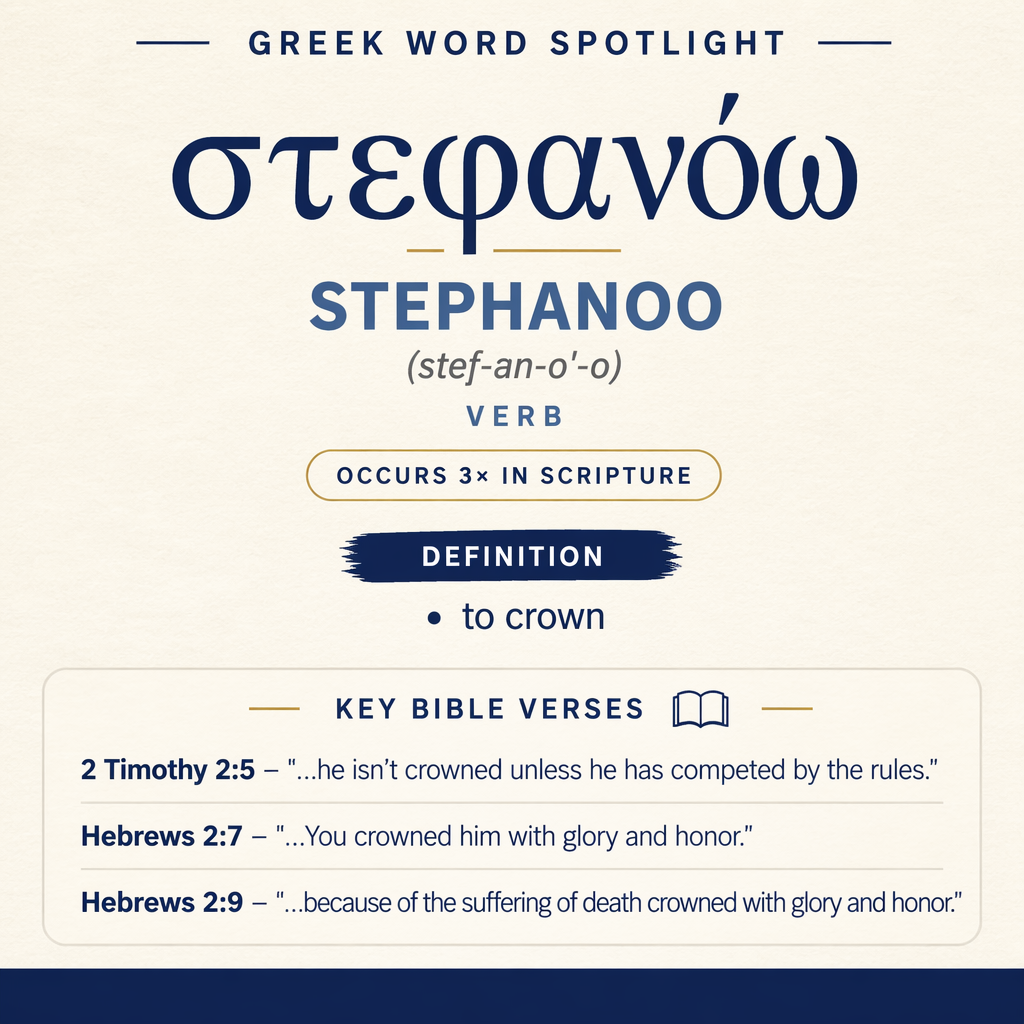
στεφανόω means “to crown” and appears three times in Scripture: 2 Timothy 2:5, Hebrews 2:7, and Hebrews 2:9.
Scripture Occurrences
This verb occurs 3 times in Scripture: 2 Timothy 2:5; Hebrews 2:7; Hebrews 2:9.
Learn More →Context Examples
In 2 Timothy 2:5, an athlete is not crowned unless he competes by the rules. In Hebrews 2:7 and 2:9, crowning is linked with glory, honor, and Jesus’ suffering of death.
Learn More →στεφανόω means “to crown,” using the vivid action of placing a crown on someone as a way of speaking about recognition and bestowal. It appears in an athletic illustration in 2 Timothy and in two closely linked statements in Hebrews about being crowned “with glory and honor.”
Root and Related Words
στεφανόω (Stephanoo) derives from the noun στέφανος (stephanos), “crown” (Strong’s G4735). The verb form turns the object “crown” into an act: to place a crown on someone.

Occurrences
“Also, if anyone competes in athletics, he isn’t crowned unless he has competed by the rules.” (2 Timothy 2:5)
Here στεφανόω is set in the world of athletic competition. The verse frames crowning as the decisive outcome that follows a contest: an athlete is “crowned” as a mark of winning or recognition. Yet the sentence immediately qualifies the act with a condition—“unless he has competed by the rules.” στεφανόω therefore does more than describe a ceremonial moment; it anchors a comparison in which crowning functions as the visible confirmation that the contest has been rightly run. The word carries the force of an award conferred, and the verse ties that award to conformity with established boundaries (“the rules”), not merely to effort or participation.

“You made him a little lower than the angels. You crowned him with glory and honor.” (Hebrews 2:7)
In Hebrews 2:7, στεφανόω moves from the athletic arena to a statement about status. The crowning is expressed with a direct object plus the materials, so to speak, of the crowning: “with glory and honor.” The crowning is set beside another act—being made “a little lower than the angels”—so the verse presents a movement in which lowered rank and bestowed distinction stand in close proximity. στεφανόω contributes the idea of conferment: glory and honor are not described as self-attained but as placed upon the one addressed (“You crowned him”). The verb gives “glory and honor” a concrete shape by portraying them as something set upon the person like a crown.
“But we see him who has been made a little lower than the angels, Jesus, because of the suffering of death crowned with glory and honor, that by the grace of God he should taste of death for everyone.” (Hebrews 2:9)
Hebrews 2:9 repeats the crowning language but identifies the one crowned: “Jesus.” The verse also inserts a rationale and a sequence: “because of the suffering of death” he is “crowned with glory and honor,” and this is connected with the purpose “that by the grace of God he should taste of death for everyone.” στεφανόω here marks a bestowed outcome associated with suffering, and the crowning is not isolated from that suffering but stated in relation to it. The verb helps the verse hold together abasement (“made a little lower than the angels”), suffering (“the suffering of death”), and honor (“crowned with glory and honor”) as parts of a single portrait. By choosing “crowned,” the text presents glory and honor as something conferred upon Jesus in a way that can be spoken of as visible and declarative, like a crown placed on a victor or a figure of high standing.
Sense and Usage
Across these three passages, στεφανόω consistently depicts crowning as an act performed upon someone, not merely a description of an internal condition. The action has a public, declarative feel: it is the placing of a crown, a concrete gesture that signals recognition. In 2 Timothy 2:5 the focus rests on the conditions under which crowning is granted—an athletic award that follows “competed by the rules.” The word thereby supports a moral logic: crowning corresponds to an evaluated course, not a vague wish for reward.
In Hebrews 2:7 and 2:9, the same action is paired with the specific content of the crown: “glory and honor.” Because these are named as what one is crowned with, the verb allows the writer to speak of intangible realities in tangible terms. The crowning functions as an elevation of standing, set against the earlier phrase “made…a little lower than the angels.” That tension gives στεφανόω a particular weight in Hebrews: the act of crowning is spoken of in the same breath as being lowered, so the crowning is understood as a deliberate bestowal of honor within a larger movement that includes humility and suffering.
The two Hebrews occurrences also show στεφανόω used in close verbal parallel: Hebrews 2:7 states directly, “You crowned him with glory and honor,” while Hebrews 2:9 states, “Jesus…crowned with glory and honor.” The repetition strengthens the idea that this crowning is not an isolated metaphor but a central way Hebrews expresses the granting of honor. The verb’s imagery fits both contexts it appears in: the athletic analogy where crowning is the recognized outcome of a contest, and the Christological statement where crowning conveys conferred distinction following suffering and in connection with a saving purpose.
Imagery
The imagery carried by στεφανόω in these verses is the moment of a crown being placed—an enacted declaration that someone has been honored. In 2 Timothy 2:5, that moment belongs to the athletic arena and is inseparable from rules and rightful competition. In Hebrews 2:7 and 2:9, the same gesture is filled with “glory and honor,” so that the crowning image communicates not only recognition but an elevation of status that stands alongside language of being made “a little lower than the angels,” and, in the case of Jesus, alongside “the suffering of death.”
Sources: Lexical data from Strong’s Exhaustive Concordance and the Translators Brief Lexicon of Extended Strongs for Greek (STEPBible, CC BY). Occurrence data from the Translators Amalgamated Greek New Testament (STEPBible, CC BY). Scripture quotations from the World English Bible (public domain).