
Exploring the Meaning of Stenochoria in Greek
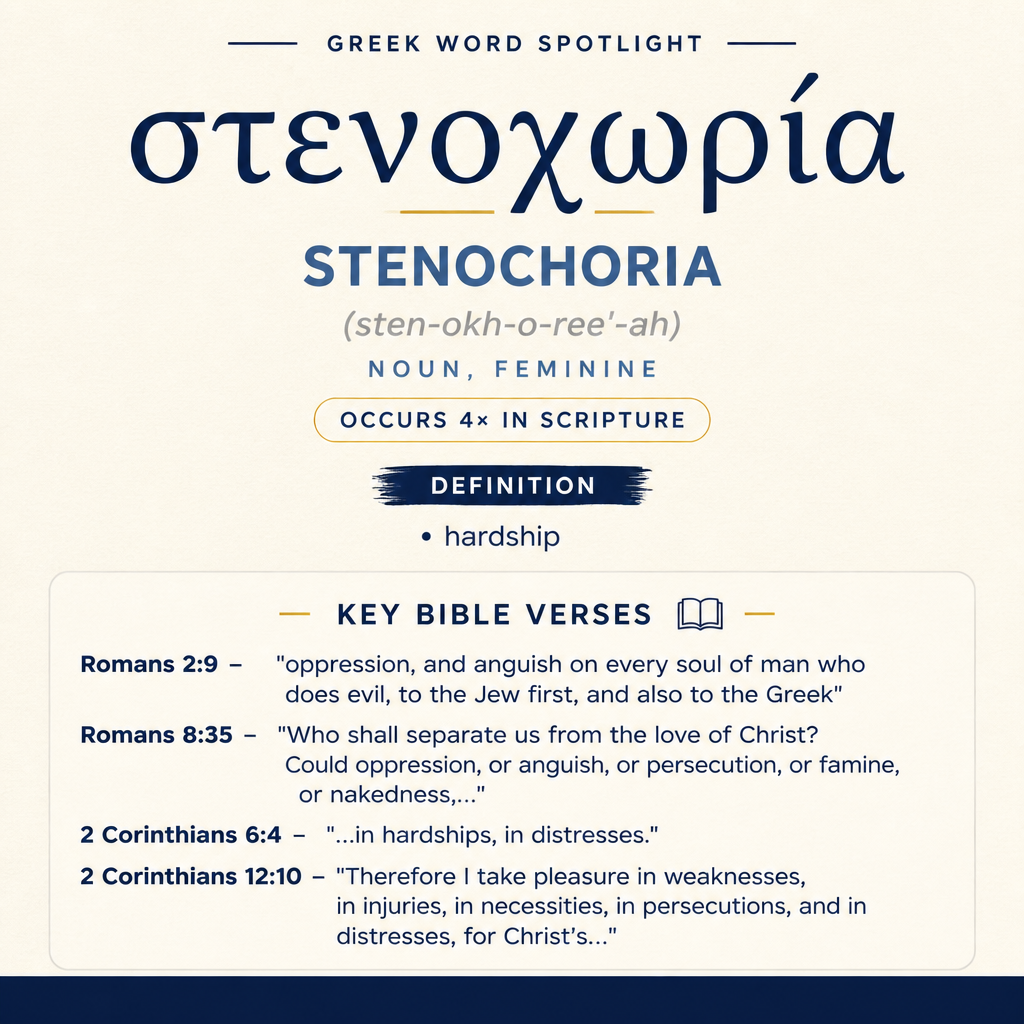
στενοχωρία (Stenochoria) means hardship and appears four times: Romans 2:9; Romans 8:35; 2 Corinthians 6:4; 2 Corinthians 12:10.
New Testament Occurrences
It occurs four times in Scripture: Romans 2:9; Romans 8:35; 2 Corinthians 6:4; 2 Corinthians 12:10.
Learn More →Context in Verses
It is rendered with terms like “anguish,” “hardships,” and “distresses” in the listed passages.
Learn More →στενοχωρία refers to hardship, appearing in Paul’s letters where it is paired with other pressures and sufferings and weighed against God’s righteous judgment or Christ’s sustaining love. Across its four uses, it names a concrete kind of trouble that can be listed alongside many other painful realities without becoming the last word.
Root and Related Words
Stenochoria is connected with stenos (στενός), “narrow,” and chora (χώρα), “country.”

Occurrences
“oppression, and anguish on every soul of man who does evil, to the Jew first, and also to the Greek.” (Romans 2:9)
Here στενοχωρία stands within a judicial warning. The line speaks of “oppression, and anguish” coming “on every soul of man who does evil,” and it is applied without ethnic exception: “to the Jew first, and also to the Greek.” In this setting the word functions as part of a pair of burdens placed upon the person who persists in evil. The emphasis falls on universality (“every soul”) and moral causality (“who does evil”), so the hardship is not treated as random misfortune but as an element of the distress bound up with divine recompense.
“Who shall separate us from the love of Christ? Could oppression, or anguish, or persecution, or famine, or nakedness, or peril, or sword?” (Romans 8:35)
In Romans 8:35 the word appears in a rhetorical question designed to deny the power of suffering to break a particular bond: “the love of Christ.” στενοχωρία is placed among a chain of threats—“oppression, or anguish, or persecution, or famine, or nakedness, or peril, or sword”—each introduced as a possible candidate for what might “separate.” The verse treats hardship as a force that feels as though it could drive a wedge between believer and Christ, yet its placement inside the question (“Who shall…? Could…?”) frames it as ultimately unable to accomplish that separation. The word thus contributes a severe, inwardly felt pressure to the catalog, alongside outward dangers like “peril” and violent threat like “sword.”
“but in everything commending ourselves, as servants of God, in great endurance, in afflictions, in hardships, in distresses,” (2 Corinthians 6:4)
In 2 Corinthians 6:4 στενοχωρία serves a different rhetorical purpose: it helps describe the texture of apostolic ministry. The line begins, “but in everything commending ourselves, as servants of God,” and then grounds that commendation in “great endurance” expressed “in afflictions, in hardships, in distresses.” Hardship is not presented as disqualifying, nor as evidence of failure, but as part of the environment in which endurance is displayed. The surrounding phrase “in everything” gives the list a comprehensive feel; στενοχωρία is one of the representative pressures through which servants of God are shown to be genuine, because their service persists amid such conditions.
“Therefore I take pleasure in weaknesses, in injuries, in necessities, in persecutions, and in distresses, for Christ’s sake. For when I am weak, then am I strong.” (2 Corinthians 12:10)
In 2 Corinthians 12:10 the word appears inside a striking statement of disposition: “Therefore I take pleasure in weaknesses… and in distresses, for Christ’s sake.” The list moves through several kinds of suffering—“weaknesses… injuries… necessities… persecutions… distresses”—and culminates in a paradox: “For when I am weak, then am I strong.” Within that cluster, στενοχωρία marks a form of trouble that Paul includes among the experiences he can “take pleasure in,” not for its own sake but “for Christ’s sake,” because it belongs to the arena where the weakness/strength reversal is learned and displayed. The word thus participates in the argument that hardship can be a setting in which divine strength is recognized precisely when human resources are reduced.
Sense and Usage
Across these passages, στενοχωρία names hardship as an experience that can press upon a person in multiple dimensions. In Romans 2:9 it is aligned with punitive consequences—hardship as part of the “oppression, and anguish” that comes “on every soul” practicing evil—so it stands under the category of judgment. In Romans 8:35 it is treated as a severe trial that might seem capable of rupturing fidelity or assurance; yet the question format places it among realities that cannot succeed in separating from Christ’s love.
In 2 Corinthians, the term is folded into two different ministry-centered lists. In 6:4 it functions as a credential of authenticity: servants of God are “commending ourselves” through “great endurance” that is observable precisely because it is sustained “in afflictions, in hardships, in distresses.” Hardship there is not an isolated episode but one thread in a larger fabric of pressures that call for endurance. In 12:10 it is joined to a theology of weakness: hardship is one of the conditions that can be embraced “for Christ’s sake” because it belongs to the sphere where the paradox “when I am weak, then am I strong” becomes experientially true.
These four uses together keep the word from being flattened into a single emotional color. It can describe the crushing side of divine recompense (Romans 2:9), the felt pressure of trials that threaten security (Romans 8:35), the demanding circumstances that accompany faithful service (2 Corinthians 6:4), and the lived context in which weakness becomes the stage for strength (2 Corinthians 12:10). In every case it is part of a list—paired or clustered with other hardships—which gives it a cumulative force: hardship is one member of a larger array of troubles rather than a solitary, undefined suffering.
Imagery in Context
Although the passages speak in abstract nouns, the lists sketch vivid scenes: a soul under “oppression, and anguish” (Romans 2:9); threats ranging from “famine” and “nakedness” to “sword” (Romans 8:35); and a servant’s life marked by “great endurance” amid layered troubles (2 Corinthians 6:4). In 2 Corinthians 12:10, hardship sits beside “necessities” and “persecutions,” yet the concluding line—“For when I am weak, then am I strong”—casts στενοχωρία as a pressure that can expose weakness and, in that exposure, become the occasion where strength is known.
Sources: Lexical data from Strong’s Exhaustive Concordance and the Translators Brief Lexicon of Extended Strongs for Greek (STEPBible, CC BY). Occurrence data from the Translators Amalgamated Greek New Testament (STEPBible, CC BY). Scripture quotations from the World English Bible (public domain).




