
Exploring the Meaning of Steko in Greek
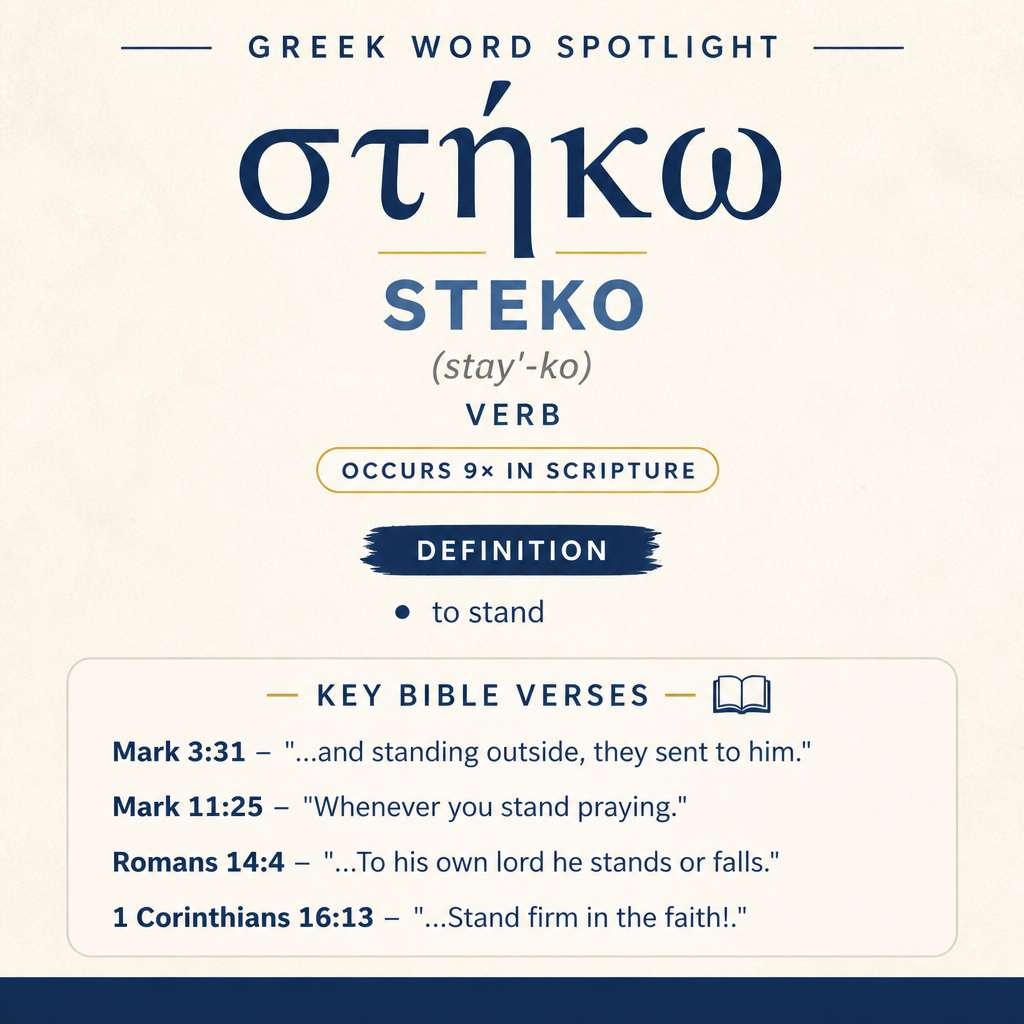
στήκω means “to stand” and occurs 9 times in Scripture, including Mark 3:31; Galatians 5:1; and Philippians 4:1.
Core Meaning
στήκω is defined as “to stand.” It appears in contexts of standing outside, standing praying, and standing firm.
Learn More →Gospel Occurrences
In Mark 3:31, Jesus’ family are “standing outside.” In Mark 11:25, it is used for standing while praying and forgiving.
Learn More →Letter Exhortations
Paul uses στήκω to urge believers to stand firm: in faith (1 Corinthians 16:13) and in liberty (Galatians 5:1).
Learn More →στήκω expresses the act of standing, whether in a literal posture or as a figurative stance taken in prayer, moral accountability, or communal loyalty. In the New Testament it appears in narrative settings and in exhortations, where “standing” becomes a vivid way to describe visible presence, persistence, and steadiness.
Occurrences
“His mother and his brothers came, and standing outside, they sent to him, calling him.” (Mark 3:31)
Here στήκω marks physical position: Jesus’ family is “standing outside.” The posture establishes distance and boundary—outside the space where Jesus is—and it frames their action of sending and calling as something done from that place of waiting. The word contributes a concrete scene: they are present, upright, and located, not merely arriving or passing by.
“Whenever you stand praying, forgive, if you have anything against anyone; so that your Father, who is in heaven, may also forgive you your transgressions.” (Mark 11:25)
Standing is the posture paired with praying, and the verse uses that moment—“whenever you stand praying”—as the setting for a command to forgive. στήκω supplies a recognizable snapshot: prayer offered while standing. That physical stance becomes the hinge for inner and relational action, since forgiveness is commanded precisely in the act of prayer.
“Who are you who judge another’s servant? To his own lord he stands or falls. Yes, he will be made to stand, for God has power to make him stand.” (Romans 14:4)
In this argument against judging another person’s servant, στήκω is used for a person’s standing in relation to “his own lord.” “Stands or falls” places standing opposite falling as outcomes of accountability, but the emphasis is not on the observer’s verdict; it is on the servant’s relation to his master. The statement “he will be made to stand” adds that standing can be granted, since “God has power to make him stand.” The verb thus supports the passage’s focus on responsibility and support within that lord-servant relationship.
“Watch! Stand firm in the faith! Be courageous! Be strong!” (1 Corinthians 16:13)
στήκω becomes a command placed alongside alertness and strength. The posture of standing is sharpened by “firm,” presenting standing as an active, maintained position rather than a momentary act. Because it is “in the faith,” the standing described is located within the sphere named by the verse, and it functions as a call to steadiness under pressure, in step with “Be courageous! Be strong!”
“Stand firm therefore in the liberty by which Christ has made us free, and don’t be entangled again with a yoke of bondage.” (Galatians 5:1)
The command to stand is tied to a specific circumstance: “in the liberty by which Christ has made us free.” Standing here is contrasted with being “entangled again with a yoke of bondage.” στήκω contributes the image of remaining upright and unmoved within freedom, resisting the pull back into an enslaving condition. The verb carries the force of holding one’s ground in a defined state, rather than drifting into another.
“Only let your way of life be worthy of the Good News of Christ, that whether I come and see you or am absent, I may hear of your state, that you stand firm in one spirit, with one soul striving for the faith of the Good News;” (Philippians 1:27)
Standing is presented as a reportable condition of the community: Paul hopes to “hear of your state.” στήκω is linked to unity—“in one spirit”—and coordinated effort—“with one soul striving.” The standing described is not isolated individual posture; it is communal steadiness that coheres with a “way of life” worthy of the message proclaimed. The verb helps depict a settled, stable togetherness that persists whether Paul is present or absent.
“Therefore, my brothers, beloved and longed for, my joy and crown, stand firm in the Lord in this way, my beloved.” (Philippians 4:1)
This direct appeal is relationally charged: “beloved and longed for,” “my joy and crown.” στήκω functions as a pastoral imperative—“stand firm in the Lord”—and the added phrase “in this way” points to a particular manner of standing connected to the surrounding exhortation implied by the wording. The standing is anchored “in the Lord,” giving the posture a defined attachment rather than leaving it as mere resilience.
“For now we live, if you stand fast in the Lord.” (1 Thessalonians 3:8)
στήκω is the condition that animates the speaker’s own sense of vitality: “For now we live, if you stand fast in the Lord.” The verb depicts the Thessalonians’ steadiness as something that directly affects the wellbeing and encouragement of the one speaking. “In the Lord” again locates this standing, and “stand fast” underscores persistence—standing that continues and holds.
“So then, brothers, stand firm and hold the traditions which you were taught by us, whether by word or by letter.” (2 Thessalonians 2:15)
The command to stand is paired with “hold,” and the object of holding is “the traditions which you were taught by us.” στήκω thus supports a picture of steadfast adherence: standing firm corresponds to maintaining a taught body of instruction received “by word or by letter.” The verb’s contribution is the stance of stability that enables holding on, rather than letting go under competing pressures.
Sense and Usage
Across these passages, στήκω operates on two interconnected levels. In the narrative of Mark 3:31 it is plainly locational and bodily: someone is upright and “outside,” and that physical placement shapes the action that follows. Mark 11:25 keeps the bodily posture but uses it as a repeated setting for prayer; standing becomes a recognizable moment in which the heart’s readiness to forgive is tested and commanded. These uses show how the verb can describe an ordinary stance while still carrying situational weight: where one stands and what one is doing while standing matter.
In the epistles, the word regularly appears with modifiers and prepositional phrases that specify the sphere in which standing takes place: “in the faith” (1 Corinthians 16:13), “in the liberty” (Galatians 5:1), “in one spirit” (Philippians 1:27), “in the Lord” (Philippians 4:1; 1 Thessalonians 3:8), and with the accompanying action of “hold[ing] the traditions” (2 Thessalonians 2:15). These expansions do not add a different basic idea; they make “standing” concrete by naming the ground on which one stands and the pressures that threaten to destabilize it—entanglement, absence of a leader, opposition requiring courage, or the risk of letting taught instruction slip.
Romans 14:4 shows a further development within the same core notion by setting “stands” alongside “falls” and by explicitly stating that standing can be effected: “he will be made to stand, for God has power to make him stand.” The verb still depicts a person upright rather than collapsed, but the passage uses that picture to speak about one’s status before the proper judge and about divine ability to uphold. This use harmonizes with the exhortations elsewhere: standing is not portrayed as mere stubbornness, but as a maintained position tied to lordship (“To his own lord he stands or falls”), community (“one spirit… one soul”), and received teaching (“hold the traditions”).
In several occurrences, στήκω is placed in imperative form (“Stand firm…”) and appears with short, urgent commands (“Watch!… Be courageous! Be strong!”). The verb’s imagery suits this rhetorical style: standing is a clear, bodily action that can be commanded, pictured, and assessed. Whether the context is individual conscience, communal unity, or adherence to instruction, the act of standing gives the writers a single, vivid verb for the steadiness they seek to evoke.
Imagery
στήκω gathers its force from the simple human experience of being upright and remaining in place. The family “standing outside” (Mark 3:31) and the worshiper “stand[ing] praying” (Mark 11:25) provide everyday scenes; the letters then extend that everyday picture to moral and communal life, calling readers to keep their footing “in the faith,” “in the liberty,” and “in the Lord.” In Romans 14:4, the contrast with falling intensifies the picture: standing becomes the emblem of being upheld and remaining answerable to the right master.
Sources: Lexical data from Strong’s Exhaustive Concordance and the Translators Brief Lexicon of Extended Strongs for Greek (STEPBible, CC BY). Occurrence data from the Translators Amalgamated Greek New Testament (STEPBible, CC BY). Scripture quotations from the World English Bible (public domain).




