Exploring the Meaning of Steiros in Greek
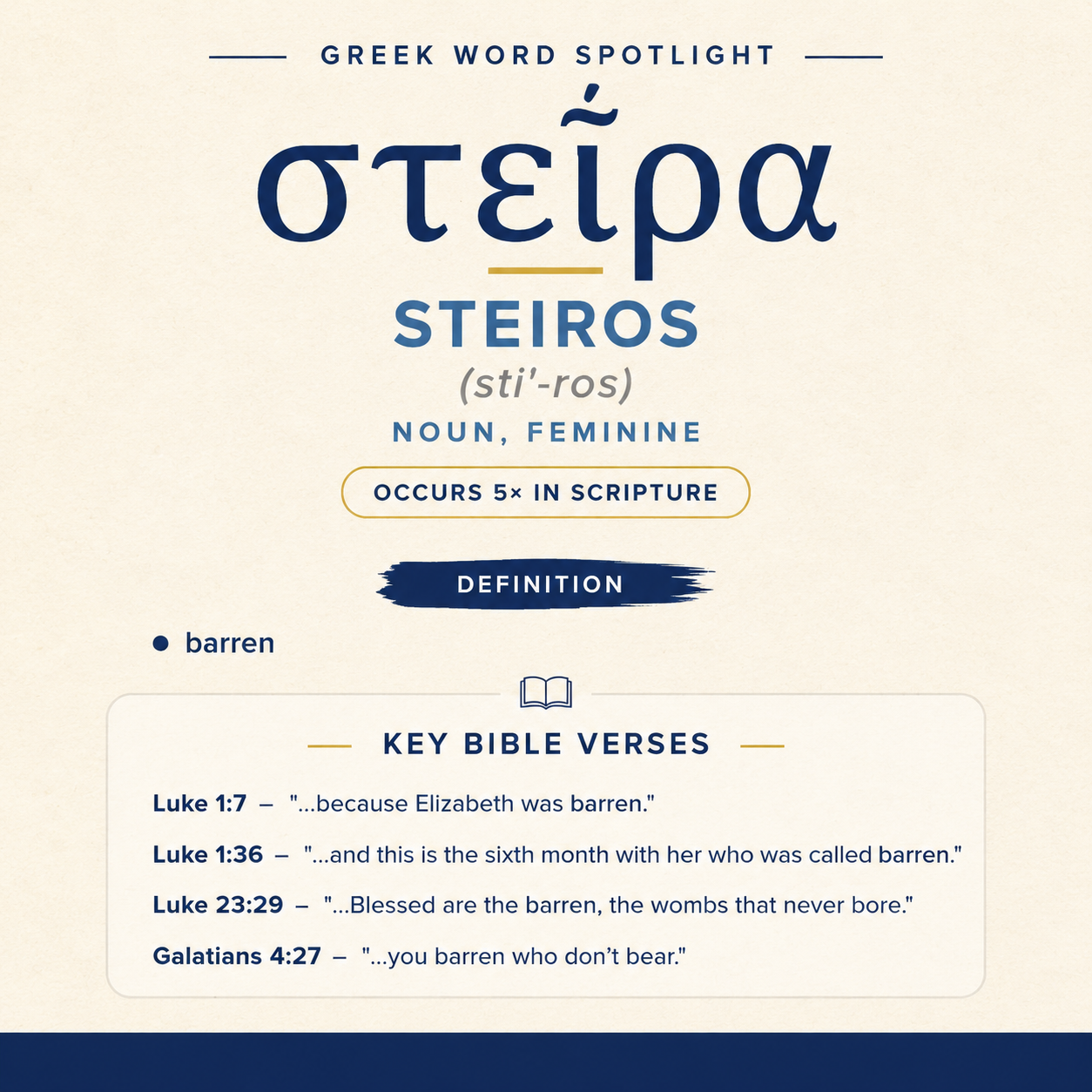
στεῖρα means “barren” and appears five times in Scripture: Luke 1:7, 1:36; Luke 23:29; Galatians 4:27; Hebrews 11:11.
Core Meaning
στεῖρα is defined as “barren.” It describes a woman who does not bear children.
Learn More →Gospel Contexts
In Luke 1:7 Elizabeth is called barren, and Luke 1:36 notes her conception in old age. Luke 23:29 speaks of days when the barren will be called blessed.
Learn More →Later References
Galatians 4:27 quotes, “Rejoice, you barren who don’t bear.” Hebrews 11:11 connects barrenness with Sarah’s faith and later conception.
Learn More →στεῖρα speaks of being “barren,” a condition described in narratives about childbirth and in sayings that reverse expected blessings. It appears in Luke’s account of Elizabeth, in Jesus’ warning about coming days, in Paul’s Scripture quotation in Galatians, and in the faith account concerning Sarah in Hebrews.
Root and Related Words
στεῖρα is linked with στερεός (stereos, “strong”; Strong’s G4731).

Occurrences
Luke 1:7 — “But they had no child, because Elizabeth was barren, and they both were well advanced in years.”
Here στεῖρα identifies the reason for an observable absence: “they had no child.” The word characterizes Elizabeth in a way that makes the couple’s situation plain and concrete, and Luke places it alongside another limiting circumstance—“they both were well advanced in years.” Within the sentence, barrenness is not an abstract label but an explanation tied directly to the family’s lack of offspring.
Luke 1:36 — “Behold, Elizabeth your relative also has conceived a son in her old age; and this is the sixth month with her who was called barren.”
In this announcement, στεῖρα is presented as a prior designation: Elizabeth “was called barren.” The word functions as a remembered identity from before the conception now reported—“has conceived a son in her old age.” The phrasing sets a before-and-after contrast within the same verse: one who carried that name is now six months into pregnancy. In this scene the term has a social dimension (“was called”) in addition to its physical description; it is something attached to her in how she was spoken of.
Luke 23:29 — “For behold, the days are coming in which they will say, ‘Blessed are the barren, the wombs that never bore, and the breasts that never nursed.’”
In Jesus’ saying, στεῖρα appears in a beatitude-like declaration that reverses ordinary expectations. “Blessed are the barren” is immediately explained by parallel phrases: “the wombs that never bore, and the breasts that never nursed.” The word is therefore framed by images of non-occurrence—no birth and no nursing—so that barrenness is pictured as the absence of childbearing and childrearing outcomes. The statement also points to a future situation (“the days are coming”) in which the condition named by στεῖρα will be spoken of as enviable, not pitiable, because circumstances will make the usual joys and burdens of parenting look different.
Galatians 4:27 — “For it is written, “Rejoice, you barren who don’t bear. Break out and shout, you who don’t travail. For the desolate have more children than her who has a husband.””
Paul quotes a written text in which στεῖρα is directly addressed: “Rejoice, you barren who don’t bear.” The word here stands in the vocative scene of a summons to joy, reinforced by imperatives: “Rejoice… Break out and shout.” The surrounding clauses spell out what “barren” looks like in lived experience: not bearing and not travailing. Yet the quoted promise overturns the expected implications of barrenness, declaring that “the desolate have more children than her who has a husband.” στεῖρα, placed at the start, sets up the shock of the outcome: the one defined by non-bearing becomes the addressee of exuberant celebration because of a future reversal expressed in family imagery (“more children”).
Hebrews 11:11 — “By faith, even Sarah herself received power to conceive, and she bore a child when she was past age, since she counted him faithful who had promised.”
This verse belongs to a chain of faith exemplars. στεῖρα names Sarah in the context of conception and birth, but the emphasis falls on what happened “by faith”: she “received power to conceive,” and the result is explicit—“she bore a child.” The temporal phrase “when she was past age” places the birth against the backdrop of human limitation. In this setting, the term does not stand alone as a static description; it is set within a narrative of change from inability to conception, with the reason traced to trust (“since she counted him faithful who had promised”).
Sense and Usage
Across these passages στεῖρα consistently marks a state defined in relation to children: the absence of having them (Luke 1:7), the reputation attached to that absence (Luke 1:36), and the embodied realities that accompany it (“the wombs that never bore, and the breasts that never nursed,” Luke 23:29). The word also operates as a pivot for reversal. In Luke 1:36, the one “called barren” is now pregnant, making the label part of a story that turns from long-standing lack to unexpected conception. In Hebrews 11:11, the same movement occurs with Sarah: the word’s force is felt in how it frames a birth as something granted rather than assumed, since the verse highlights reception of “power to conceive.”
Luke 23:29 shows another kind of reversal: not biological change but changed evaluation. The coming days will make people pronounce “Blessed are the barren,” and the verse spells out the meaning with bodily parallels—womb and breasts—so that the word evokes a whole life-pattern of not bearing and not nursing. Galatians 4:27, in turn, uses στεῖρα in an address that commands joy to the one who “don’t bear” and “don’t travail,” then sets that against a surprising abundance of children. In these texts barrenness is not treated merely as a medical condition; it is a condition with social labels (“was called”), with embodied consequences (no birth, no nursing), and with narrative and rhetorical power to highlight divine promise, coming judgment, or unexpected fruitfulness.
The distribution of uses also shows στεῖρα applied to an individual woman (Elizabeth; Sarah) and to a broader category (“the barren,” Luke 23:29) or a personified addressee in quotation (“you barren,” Galatians 4:27). That range allows the word to function both descriptively—explaining “they had no child”—and evocatively, summoning hearers to imagine a life without pregnancy, birth, and nursing, whether as a sorrowful identity, a surprising source of joy, or a condition reevaluated under crisis.
Imagery
στεῖρα repeatedly carries imagery of empty cradles and unfulfilled maternal processes, expressed plainly as “no child,” “wombs that never bore,” and “breasts that never nursed.” Yet the same passages also attach the word to scenes of sudden pregnancy (“has conceived a son”), to promised multiplication (“have more children”), and to birth after limitation (“she was past age”), so that the term becomes a backdrop against which conception and blessing—whether welcomed or feared—stand out with sharper contrast.
Sources: Lexical data from Strong’s Exhaustive Concordance and the Translators Brief Lexicon of Extended Strongs for Greek (STEPBible, CC BY). Occurrence data from the Translators Amalgamated Greek New Testament (STEPBible, CC BY). Scripture quotations from the World English Bible (public domain).