Exploring the Meaning of Soterion in Greek
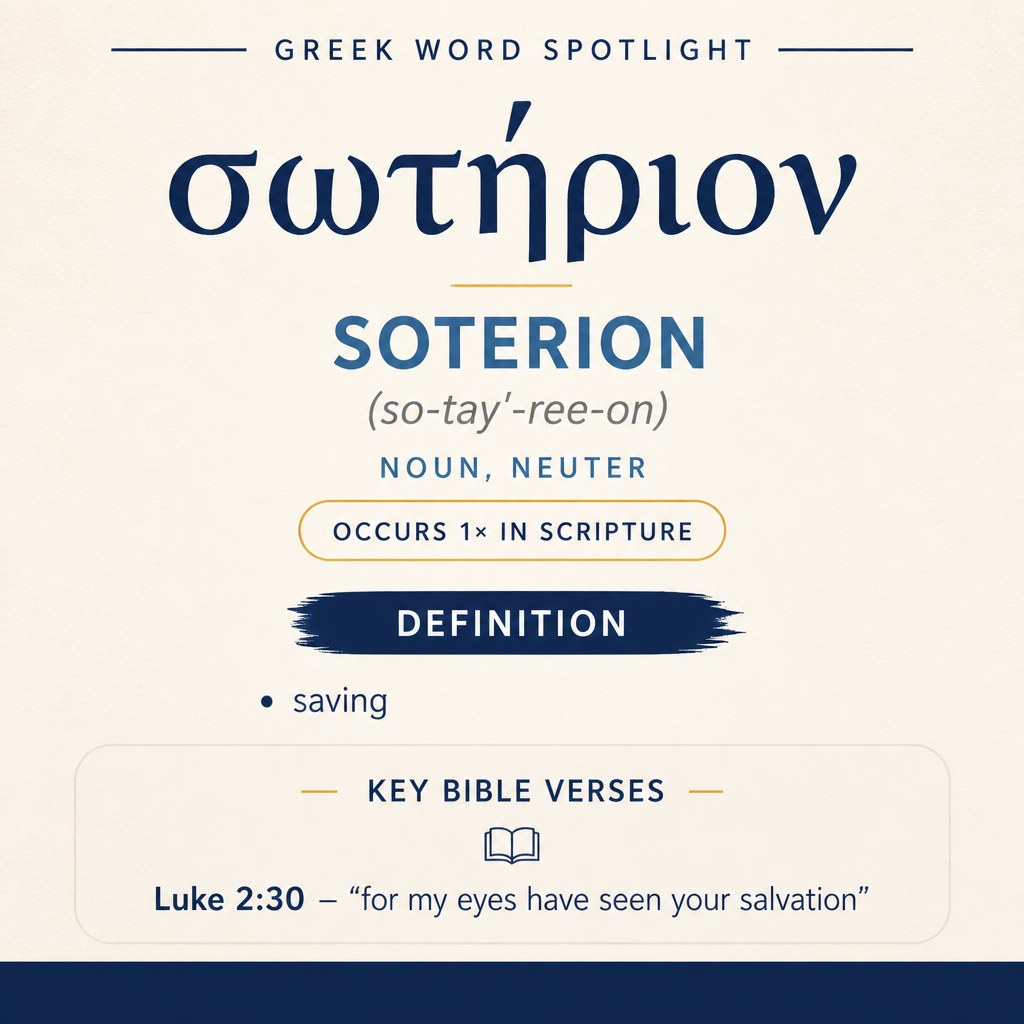
σωτήριον means “saving” and appears once in Scripture in Luke 2:30 (“for my eyes have seen your salvation,”).
Verse Context
In Luke 2:30, it is rendered “salvation” in the line: “for my eyes have seen your salvation,”.
Learn More →σωτήριον means “saving” and is used once in the New Testament, in Simeon’s words over the infant Jesus. In that single setting it is presented as something that can be truly seen, not merely discussed.
Root and Related Words
σωτήριον derives from soteria (σωτηρία), “salvation” (Strong’s G4991). The related noun names the broader idea; σωτήριον appears as a neuter form built from that word-family.

Occurrences
“for my eyes have seen your salvation,” (Luke 2:30)
In Luke 2:30, σωτήριον stands at the center of Simeon’s declaration: what he speaks of is something his eyes have seen. The line anchors “salvation” in the realm of perception and testimony—Simeon is not reporting a private opinion, but describing what he has personally witnessed. The possessive “your” places the saving work with God as its source, and the directness of “my eyes have seen” frames it as an evident reality within the scene rather than an abstract hope detached from the moment.
Sense and Usage
The definition “saving” comes into focus in how the word functions in this one sentence. Simeon does not say he has merely heard of something saving or reasoned it out; he speaks as someone confronted with it in a way that compels speech. The word is therefore used in a way that treats “saving” as something identifiable and present—something that can be pointed to as the content of vision (“my eyes have seen”). Even without additional occurrences, the phrasing shows that this “saving” is not portrayed as a vague quality but as a concrete reality that, in context, is bound up with what Simeon is looking at while he speaks. The grammar of the clause makes σωτήριον the object of sight, and that choice of expression gives the term a strong sense of immediacy: it is “saving” encountered in the here and now, credited to God (“your”), and affirmed through firsthand witness (“my eyes”).
Imagery
Luke 2:30 links “saving” with the simplest human image of recognition: eyes seeing. The word carries the quiet force of a moment in which deliverance is not argued for but perceived, and then confessed aloud.
Sources: Lexical data from Strong’s Exhaustive Concordance and the Translators Brief Lexicon of Extended Strongs for Greek (STEPBible, CC BY). Occurrence data from the Translators Amalgamated Greek New Testament (STEPBible, CC BY). Scripture quotations from the World English Bible (public domain).