Exploring the Meaning of Soter in Greek
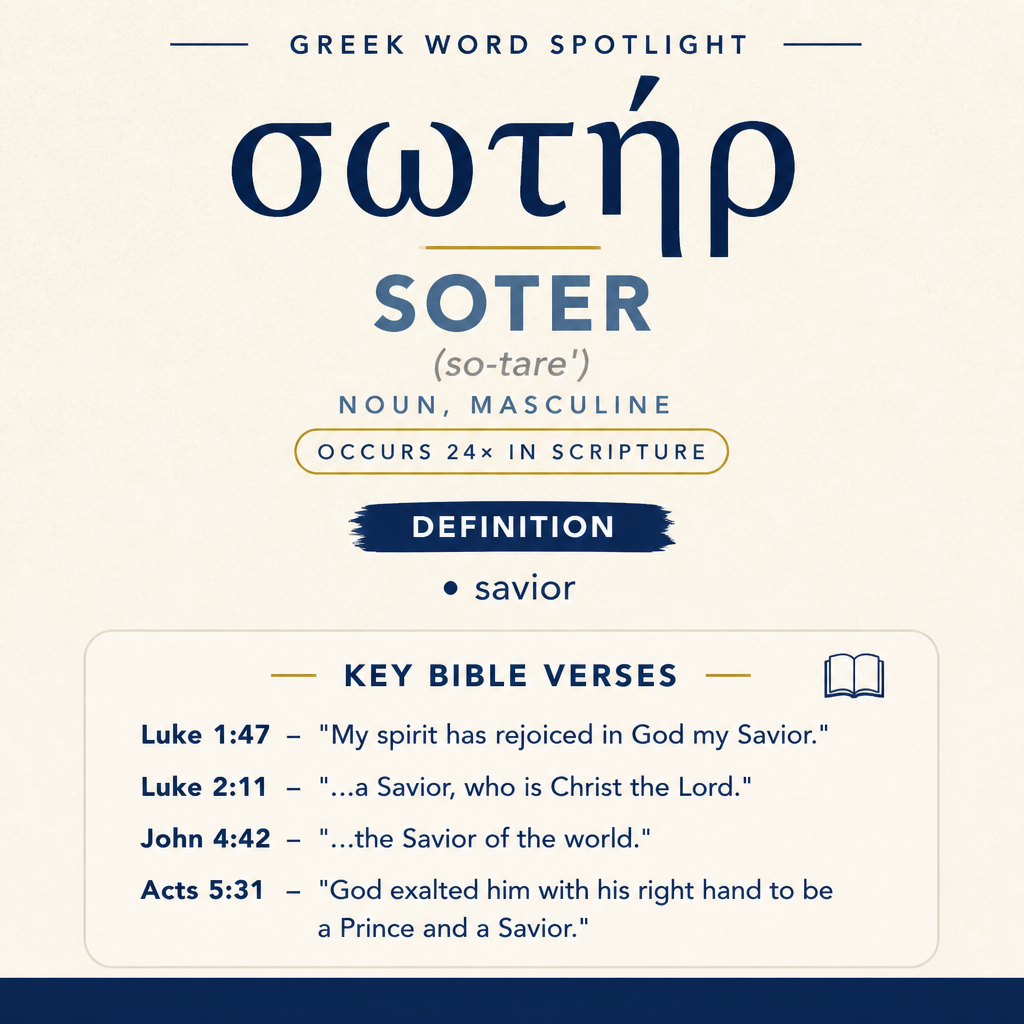
σωτήρ (Soter) means “savior” and occurs 24 times in Scripture, including Luke 1:47, Luke 2:11, John 4:42, Acts 5:31, and Philippians 3:20.
Core Meaning
σωτήρ means “savior.” The word is used of God and of Jesus Christ in the listed verses.
Learn More →Key Occurrences
Luke 1:47 speaks of “God my Savior,” and Luke 2:11 announces “a Savior, who is Christ the Lord.” Philippians 3:20 says believers wait for “a Savior, the Lord Jesus Christ.”
Learn More →Acts Emphasis
Acts 5:31 says God exalted him as “a Prince and a Savior” to give repentance and remission of sins. Acts 13:23 connects God bringing salvation to Israel according to his promise.
Learn More →σωτήρ names a “savior,” a title applied in these passages to God and to Christ. The occurrences range from personal praise and public proclamation to doctrinal summaries about repentance, forgiveness, and the hope set before believers.
Occurrences
Luke 1:47 — “My spirit has rejoiced in God my Savior,”
Here σωτήρ is part of direct worship. The speaker addresses God in the first person (“my Savior”), presenting salvation not as an abstract idea but as God’s saving identity toward the one rejoicing. The word functions as a divine title that grounds the joy of the speaker’s “spirit.”

Luke 2:11 — “For there is born to you today, in David’s city, a Savior, who is Christ the Lord.”
σωτήρ is announced with specificity of time (“today”) and place (“in David’s city”). The title is attached to the newborn and then further identified: “who is Christ the Lord.” In this setting, the word is part of a proclamation meant for hearers (“to you”), presenting the savior as a person given for others, not merely a role performed at a distance.
John 4:42 — “They said to the woman, “Now we believe, not because of your speaking; for we have heard for ourselves, and know that this is indeed the Christ, the Savior of the world.””
σωτήρ is the conclusion of a movement from secondhand report to direct knowledge: “we have heard for ourselves, and know.” The title is framed as something recognized (“know that this is indeed”) and is expanded beyond an individual or one group: “the Savior of the world.” The word carries the weight of a confession reached through personal encounter and communal agreement.
Acts 5:31 — “God exalted him with his right hand to be a Prince and a Savior, to give repentance to Israel, and remission of sins.”
σωτήρ is paired with a second title (“a Prince”), and both are linked to God’s action: “God exalted him.” The verse directly connects the savior’s role with concrete results—“to give repentance to Israel, and remission of sins.” In this scene, the word is not left undefined; it is explained in terms of what is granted to a people, emphasizing saving work expressed through repentance and forgiveness.
Acts 13:23 — “From this man’s offspring, God has brought salvation to Israel according to his promise,”
This verse uses “salvation” rather than the title σωτήρ in English, yet it belongs to the same saving concept in the narrative logic: God acts (“God has brought”) on behalf of a people (“to Israel”) in continuity with a commitment (“according to his promise”). Within that statement, the savior title elsewhere functions as the personal counterpart to this brought “salvation,” highlighting that saving is something God brings into history through lineage and promise.
Ephesians 5:23 — “For the husband is the head of the wife, as Christ also is the head of the assembly, being himself the savior of the body.”
σωτήρ is applied to Christ within an analogy about headship. The verse anchors the comparison (“as Christ also is the head of the assembly”) and then adds a distinct claim: Christ is “himself the savior of the body.” The title here describes Christ’s relation to “the body,” presented as a reality tied to his headship; the word supplies the saving dimension of that relationship.
Philippians 3:20 — “For our citizenship is in heaven, from where we also wait for a Savior, the Lord Jesus Christ,”
σωτήρ is the object of expectation: “we also wait for a Savior.” The waiting is located in a broader identity claim (“our citizenship is in heaven”) and a direction of coming (“from where”). The title is immediately specified as “the Lord Jesus Christ,” and it functions here as a forward-looking confession: salvation is associated with the awaited arrival of a particular person.
1 Timothy 1:1 — “Paul, an apostle of Jesus Christ according to the commandment of God our Savior and the Lord Jesus Christ our hope;”
σωτήρ is used as a title for God within an apostolic self-introduction. The commissioning is framed as obedience “according to the commandment of God our Savior,” placing saving identity alongside divine authority to command. In the same sentence, “the Lord Jesus Christ” is named as “our hope,” so the title “Savior” helps define God’s character as the one whose command grounds the apostolic mission.
1 Timothy 2:3 — “For this is good and acceptable in the sight of God our Savior,”
σωτήρ again titles God, here in a moral-evaluative setting: something is “good and acceptable” when seen “in the sight of God our Savior.” The word contributes a relational framing—God is not only judge of what is acceptable but is named by his saving identity. The title shapes how the “good and acceptable” is to be understood: it is assessed before the God who saves.
1 Timothy 4:10 — “For to this end we both labor and suffer reproach, because we have set our trust in the living God, who is the Savior of all men, especially of those who believe.”
σωτήρ is central to the motivation for endurance: labor and reproach are borne “because we have set our trust in the living God.” The verse then identifies that God as “the Savior of all men,” adding a further emphasis, “especially of those who believe.” In this context the title supports perseverance by connecting trust to God’s saving identity, while also distinguishing a particular focus on believers within the broader scope stated.
2 Timothy 1:10 — “but has now been revealed by the appearing of our Savior, Christ Jesus, who abolished death, and brought life and immortality to light through the Good News.”
σωτήρ is tied to revelation and appearance: what was hidden “has now been revealed by the appearing of our Savior.” The verse then describes effects associated with that savior—“who abolished death, and brought life and immortality to light through the Good News.” The title gathers these claims into a single identity: the savior is the one whose coming makes decisive change and illumination, expressed here in the language of death ended and life disclosed.
Titus 1:3 — “but in his own time revealed his word in the message with which I was entrusted according to the commandment of God our Savior;”
σωτήρ titles God within a statement about timing, revelation, and entrusted proclamation. God reveals “in his own time” and does so “in the message” given to the speaker; the entrusting is “according to the commandment of God our Savior.” The word contributes a theological signature to the act of commissioning: the God who commands the proclamation is characterized as the savior, linking the message’s authority with God’s saving identity.

Sense and Usage
Across these passages, σωτήρ functions primarily as a title that names who God is and who Christ is in relation to saving. In Luke 1:47 it is intimate and possessive (“my Savior”), a designation that fits personal rejoicing. Luke 2:11 moves the title into public announcement, placing it in a concrete birth setting and uniting it with “Christ the Lord,” so that “savior” is not a vague role but a named person given “to you.” John 4:42 broadens the confession to a communal verdict reached through hearing and knowing, and the scope becomes universal in phrasing (“of the world”).
Acts 5:31 provides the most explicit in-verse explanation of what saving looks like in these texts: the exalted one is savior “to give repentance to Israel, and remission of sins.” In Acts 13:23 the same saving theme is stated as something God “has brought…according to his promise,” pressing the idea that salvation is an act God brings about within his own pledged purpose. The Pastoral Epistles repeatedly use the title “God our Savior,” placing it beside “commandment” (1 Timothy 1:1; Titus 1:3) and “sight” (1 Timothy 2:3). In these frames, “savior” becomes a stable divine designation that supports authority, evaluation, and mission.
Several occurrences place the title within the life of the believing community. Philippians 3:20 sets it within waiting and heavenly citizenship; the savior is anticipated, and that expectation belongs to the community’s identity. Ephesians 5:23 uses the title to describe Christ’s relationship to “the body,” integrating saving with his headship toward the assembly. 1 Timothy 4:10 attaches the title to trust, labor, and endurance under reproach, naming the “living God” as savior with a breadth that includes “all men” and a pointed emphasis “especially of those who believe.” Finally, 2 Timothy 1:10 connects “our Savior, Christ Jesus” to appearing and revelation, with saving expressed in sweeping terms: death is abolished and life is brought to light through the Good News.
Imagery
The passages paint saving in several recurring scenes: joy directed to “God my Savior” (Luke 1:47), a birth announcement in “David’s city” (Luke 2:11), a village-level confession that expands outward to “the world” (John 4:42), and exaltation that results in repentance and forgiveness (Acts 5:31). In the letters, the title sits naturally alongside bodies and communities (Ephesians 5:23), waiting and citizenship (Philippians 3:20), trusting under reproach (1 Timothy 4:10), and an appearing that overturns death and brings life to light (2 Timothy 1:10). In each case, σωτήρ is not merely descriptive; it anchors the speaker’s worship, the church’s confession, and the apostles’ proclamation in the saving identity of God and of Christ.
Sources: Lexical data from Strong’s Exhaustive Concordance and the Translators Brief Lexicon of Extended Strongs for Greek (STEPBible, CC BY). Occurrence data from the Translators Amalgamated Greek New Testament (STEPBible, CC BY). Scripture quotations from the World English Bible (public domain).