
Exploring the Meaning of Sosthenes in Greek
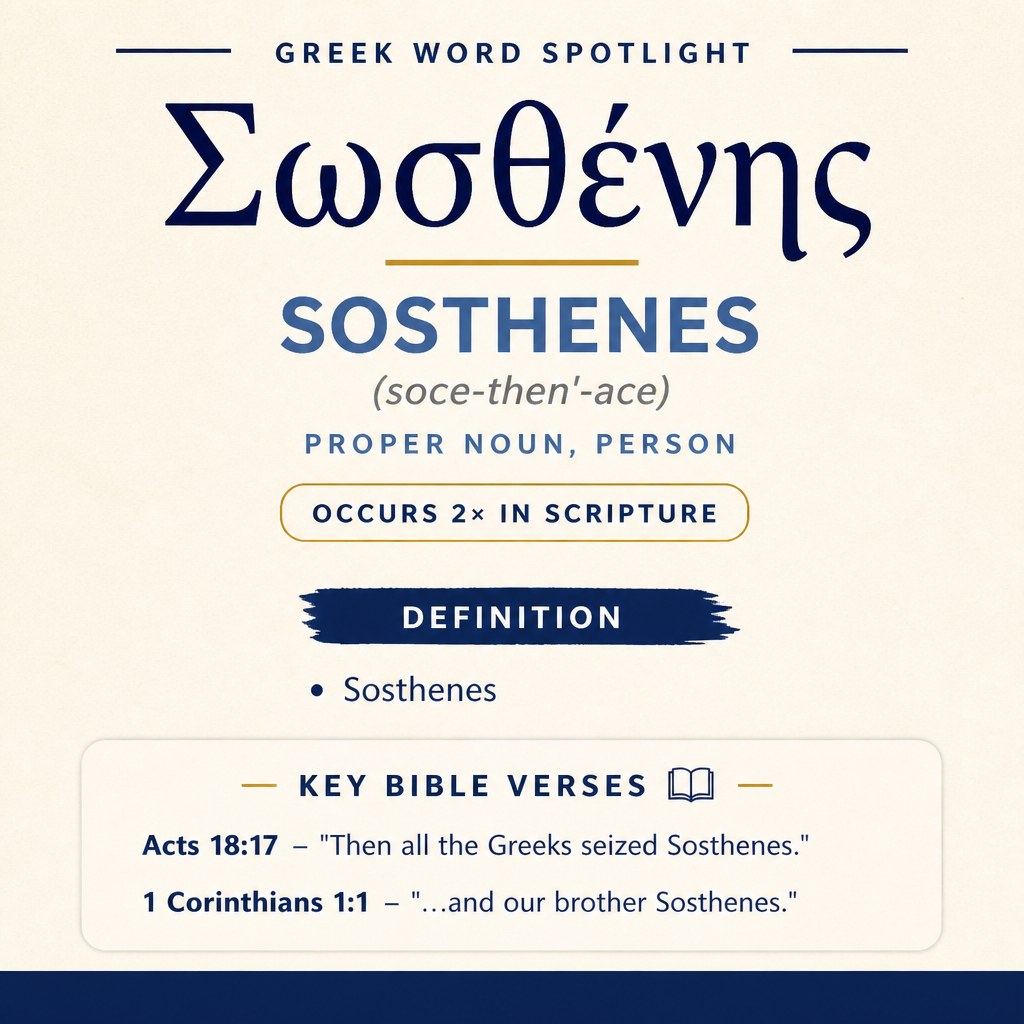
Σωσθένης (Sosthenes) means “Sosthenes” and appears in Acts 18:17 and 1 Corinthians 1:1.
Biblical Occurrences
This name occurs 2 times in Scripture: Acts 18:17 and 1 Corinthians 1:1.
Learn More →Context Snapshots
In Acts 18:17, Sosthenes is called the ruler of the synagogue and is beaten before the judgment seat. In 1 Corinthians 1:1, Paul calls him “our brother Sosthenes.”
Learn More →Σωσθένης (Sosthenes) is a personal name that appears in two New Testament passages: once in a public scene at the judgment seat in Corinth, and once in the opening greeting of a letter from Paul. In both places it functions to identify a specific man within a concrete social setting.
Root and Related Words
The name is associated with the Greek verb σθενόω (sthenoo), “to strengthen” (Strong’s G4599), and with the verb σῴζω (sozo), “to save” (Strong’s G4982).

Occurrences
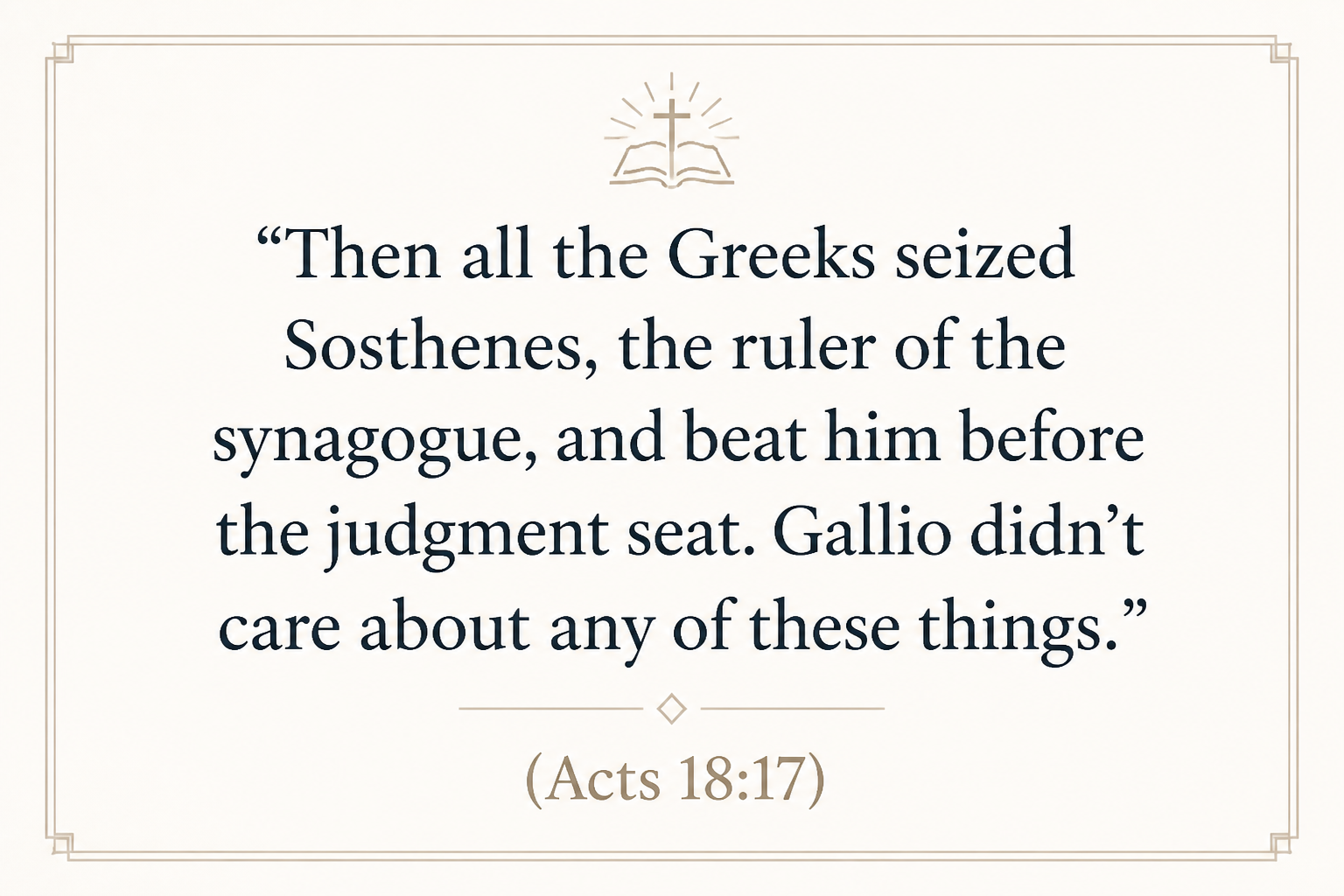
“Then all the Greeks seized Sosthenes, the ruler of the synagogue, and beat him before the judgment seat. Gallio didn’t care about any of these things.” (Acts 18:17)
Here Σωσθένης singles out the individual who becomes the target of a sudden, violent public action. The verse names him and immediately apposes a role—“the ruler of the synagogue”—placing him in a recognizable position of communal responsibility. The narrative moment is crowded with public markers: “all the Greeks,” the physical act of seizure, the beating, and the location “before the judgment seat,” which frames the scene as happening in the open, in proximity to civic authority. Within that setting, the name functions as more than a label; it anchors the description of disorder to an identifiable figure whose office makes the assault intelligible as an attack on someone with standing. The final line—“Gallio didn’t care about any of these things”—sharpens the effect: Σωσθένης is named as the one who suffers the beating, while the official in view chooses indifference, leaving the named victim exposed in a moment where one might expect intervention.
“Paul, called to be an apostle of Jesus Christ through the will of God, and our brother Sosthenes,” (1 Corinthians 1:1)
In this salutation, Σωσθένης appears not in a crowd scene but within the formal self-identification of the letter’s senders. The structure places two names side by side: “Paul… and our brother Sosthenes.” The name therefore contributes to the letter’s opening voice, presenting Sosthenes as aligned with Paul and included in the “we” implied by the greeting. The descriptor “our brother” supplies relational positioning rather than civic office: Sosthenes is introduced through a bond of shared belonging with the recipients rather than through a title tied to synagogue administration or public authority. In this context, the name functions to widen the personal frame of the correspondence—Paul is the primary authorial figure, but the greeting signals companionship and shared identity by attaching Sosthenes to the introduction.
Sense and Usage
As a proper name, “Sosthenes” does not describe an action or quality; it designates a person. The two contexts show how a single name can carry different kinds of narrative weight depending on the accompanying identifiers. In Acts 18:17, the name is immediately coupled with a public role (“the ruler of the synagogue”) and placed in a scene of conflict before an official forum (“the judgment seat”). The effect is to present Sosthenes as a visible, socially located figure, one whose identity is relevant to a crowd’s action and whose suffering is framed by a magistrate’s refusal to respond. The name thereby contributes concreteness: the violence is not anonymous but falls on a named individual whose position is specified.
In 1 Corinthians 1:1, the name operates within epistolary convention and communal vocabulary. The designation “our brother” signals standing within the Christian community, and its placement alongside Paul’s calling (“called to be an apostle of Jesus Christ through the will of God”) situates Sosthenes within the circle of those associated with the apostolic mission, at least as a recognized co-sender or companion at the time of writing. The name here contributes credibility and relational warmth to the greeting: the letter is not presented as a solitary voice but as coming with an acknowledged fellow believer.
Read together, the two uses demonstrate how the same named person can be portrayed through different social lenses—civic-public identification in one passage and familial-ecclesial identification in another. Even without adding details beyond what the verses state, the juxtaposition highlights a shift in how Sosthenes is introduced: first by office and public vulnerability, then by fraternity and shared authorship. The name thus serves as a stable referent across scenes that emphasize different dimensions of belonging—one tied to the synagogue and the city’s public space, the other tied to the community addressed by Paul.
Imagery
Σωσθένης evokes two sharply contrasting pictures. Acts 18:17 places the name in the dust and noise of a public beating “before the judgment seat,” with an uncaring official looking on. 1 Corinthians 1:1 places it in the quiet formality of a letter’s opening line, where the name stands beside Paul’s and is framed by the simple, communal phrase “our brother.”
Sources: Lexical data from Strong’s Exhaustive Concordance and the Translators Brief Lexicon of Extended Strongs for Greek (STEPBible, CC BY). Occurrence data from the Translators Amalgamated Greek New Testament (STEPBible, CC BY). Scripture quotations from the World English Bible (public domain).




