Exploring the Meaning of Sthenoo in Greek
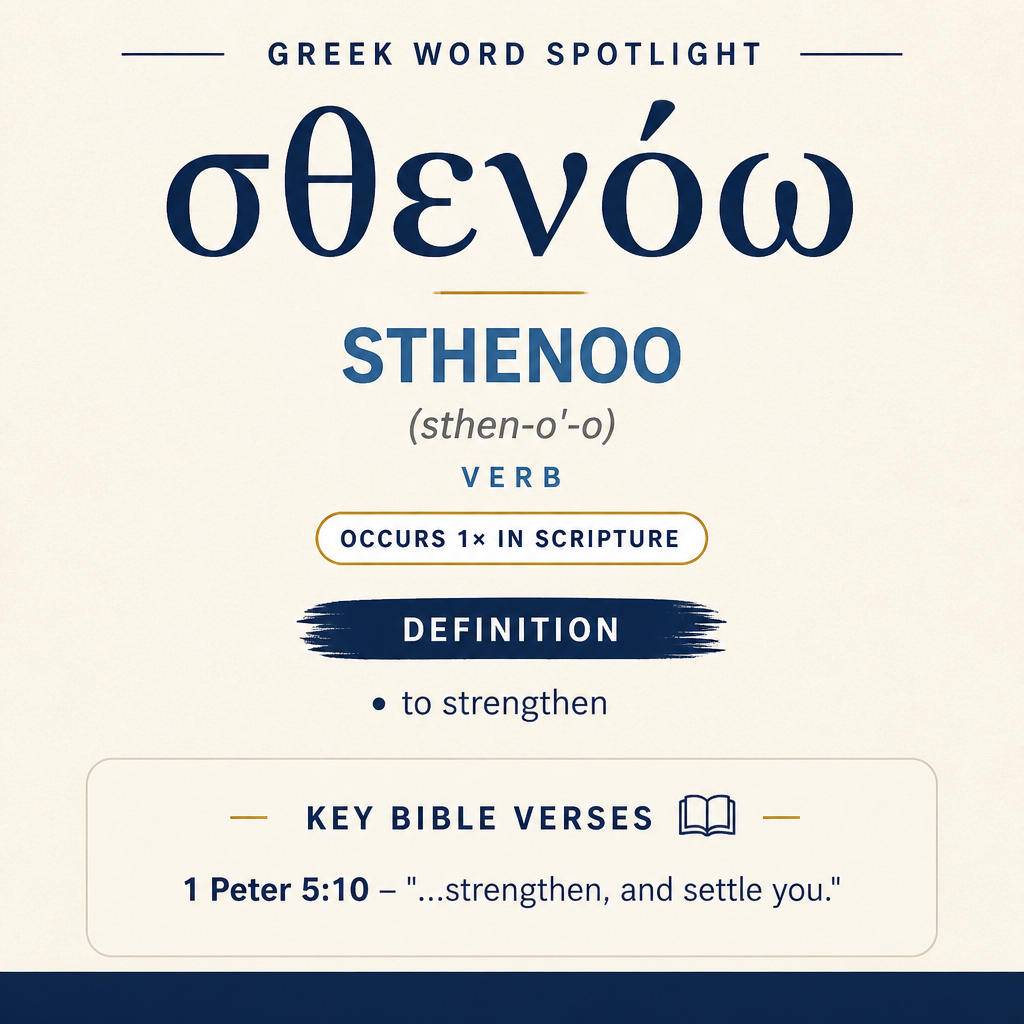
σθενόω (Sthenoo) means “to strengthen” and appears once in Scripture, in 1 Peter 5:10.
Scripture Occurrence
This verb occurs 1 time in Scripture. Its sole occurrence is in 1 Peter 5:10.
Learn More →Verse Context
In 1 Peter 5:10, the verse includes language about suffering “a little while,” where σθενόω appears in the passage.
Learn More →σθενόω expresses the action “to strengthen,” and it is attested in the New Testament in 1 Peter 5:10. In that setting it stands within a series of requested divine actions directed toward believers after a period of suffering.
Occurrences
“But may the God of all grace, who called you to his eternal glory by Christ Jesus, after you have suffered a little while, perfect, establish, strengthen, and settle you.” (1 Peter 5:10)
In 1 Peter 5:10 σθενόω appears as one element in a tightly packed chain of petitions: “perfect, establish, strengthen, and settle you.” The verse frames these actions as what “the God of all grace” does for those whom he “called…to his eternal glory by Christ Jesus,” and it places the timing “after you have suffered a little while.” Within this sequence, σθενόω contributes the specific idea of imparted strength, not as an abstract quality floating free of circumstance, but as a divine response situated on the far side of endured hardship. The grammar of the sentence keeps the focus on God as the active giver: the strengthening is requested from God, not generated by the sufferers.

The surrounding verbs help define the contour of “strengthen” in this context. The four requested outcomes are not separated by explanation; they are stacked, suggesting a comprehensive divine work that addresses multiple dimensions of the readers’ condition following affliction. σθενόω therefore functions as one facet of restoration and reinforcement, coordinated with being “perfect[ed],” “establish[ed],” and “settle[d].” Even without unpacking each term, the collocation makes clear that strengthening is envisaged as part of a stabilizing and completing movement—an action that supports endurance and firmness after destabilizing experiences described simply as “suffered a little while.”
The immediate clause “after you have suffered a little while” is especially important for how σθενόω lands. The verse does not treat suffering as the end point; it is the temporary prelude (“a little while”) to God’s action. In that rhetorical flow, σθενόω carries an implicit contrast between the weakness, strain, or depletion associated with suffering and the renewed capacity implied by being strengthened. The strength in view is thus not presented as mere natural resilience but as grace-given reinforcement that follows, and answers, the experience of suffering. The verse’s opening designation—“the God of all grace”—sets the strengthening within the character of God as a generous giver, so that σθενόω belongs to the domain of gracious divine help rather than human self-improvement.
Finally, the objects of the verbs (“you”) keep the application personal and communal: the strengthening is directed toward the recipients as the ones called “to his eternal glory by Christ Jesus.” σθενόω therefore participates in a forward-looking frame: the God who has called them to glory is also the one who strengthens them in the present after suffering, aligning the strengthening with the larger trajectory of God’s calling.

Sense and Usage
In its lone attestation, σθενόω is used in a prayer-wish that gathers up several complementary actions God is asked to perform. The sense “to strengthen” is not isolated as a stand-alone event but as one strand in a coordinated set of outcomes that together portray divine support and restoration. Because σθενόω is placed among other verbs without explanatory clauses, its force is carried largely by its position and by the sentence’s movement from suffering to divine reinforcement.
The verse’s structure provides several usage features. First, σθενόω is oriented toward the aftermath of suffering (“after you have suffered a little while”), so strengthening is presented as something that meets people at a point when they have been tested. This setting gives the word a practical, pastoral weight: it is the kind of strengthening that answers real strain. Second, σθενόω is framed as something God does: “may the God of all grace… strengthen… you.” The verb’s usage here implies an outside source of strength entering the life of the community, consistent with the description of God as the one who “called you to his eternal glory by Christ Jesus.” The strengthening, then, is not merely encouragement but an act of divine grace tied to God’s calling and purpose.
Third, the coordination with “perfect, establish… and settle” positions strengthening as part of a stabilizing set of actions. Even without turning those neighboring verbs into separate definitions, their combined effect is clear: the verse envisages an outcome in which the recipients are not left fragile or wavering after suffering. σθενόω contributes the element of increased strength within that broader picture of being made fit, made firm, and made settled. The usage thus leans toward strengthening as reinforcement that supports perseverance and steadiness.
Because σθενόω is embedded in a call-to-glory frame (“called you to his eternal glory by Christ Jesus”), its strengthening is not an end in itself. It serves the readers’ continued life under God’s gracious calling. The verse connects past divine initiative (“who called you”) with future-oriented identity (“to his eternal glory”) and present need (“after you have suffered a little while”), so σθενόω operates at the intersection of those themes: grace supplies strength in the wake of suffering for those moving toward the glory to which they have been called.
Imagery and Force
Though 1 Peter 5:10 contains no extended metaphor, the pairing of suffering with a subsequent cluster of divine actions evokes the sense of someone brought from a shaken condition into a state of firmness. In that movement, σθενόω carries the force of renewed capacity granted by “the God of all grace,” so that the readers’ endurance after hardship is portrayed as supported by God’s strengthening work.
Sources: Lexical data from Strong’s Exhaustive Concordance and the Translators Brief Lexicon of Extended Strongs for Greek (STEPBible, CC BY). Occurrence data from the Translators Amalgamated Greek New Testament (STEPBible, CC BY). Scripture quotations from the World English Bible (public domain).