Exploring the Meaning of Silouanos in Greek
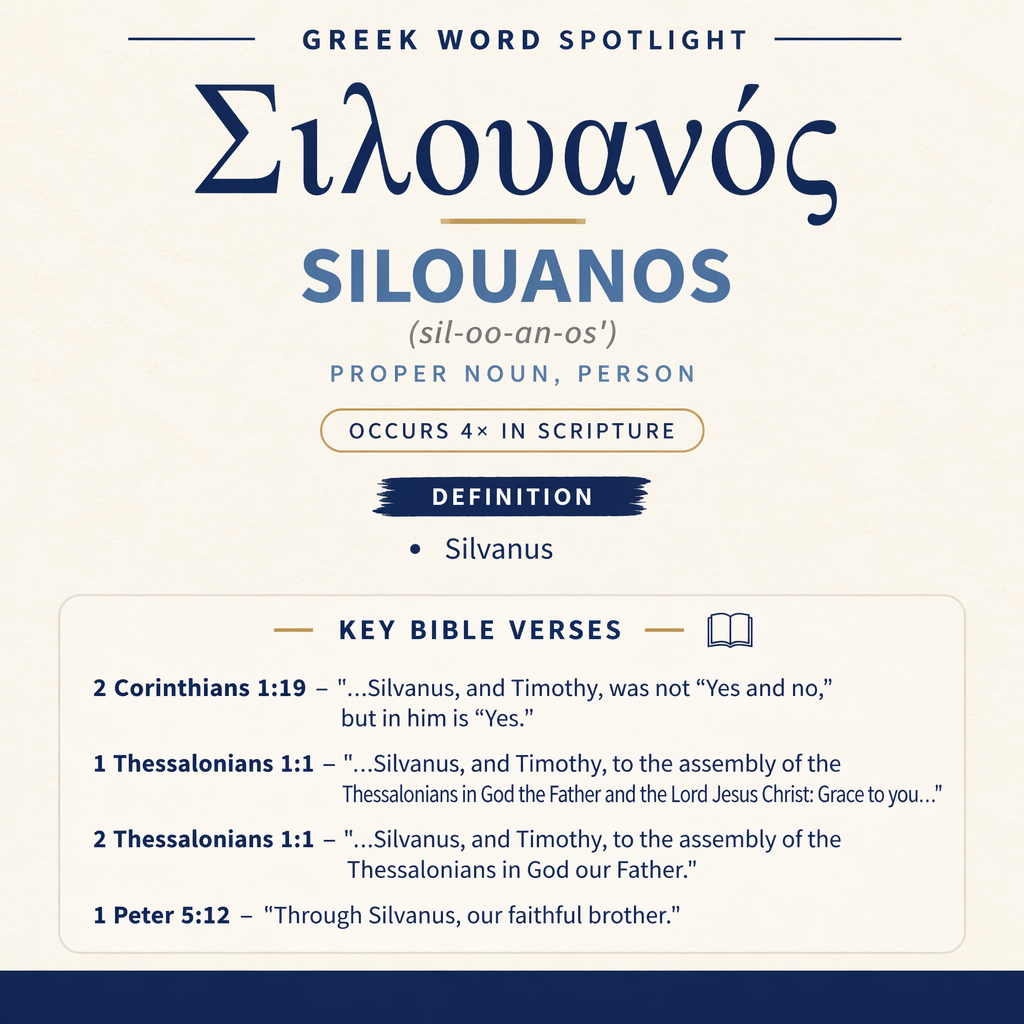
Σιλουανός (Silouanos) means Silvanus and appears in 2 Corinthians 1:19; 1 Thessalonians 1:1; 2 Thessalonians 1:1; and 1 Peter 5:12.
New Testament Mentions
The name occurs four times in Scripture: 2 Corinthians 1:19; 1 Thessalonians 1:1; 2 Thessalonians 1:1; and 1 Peter 5:12.
Learn More →Context in Verses
Silvanus is listed with Paul and Timothy in 2 Corinthians 1:19 and in the openings of 1 and 2 Thessalonians. In 1 Peter 5:12, Peter writes “through Silvanus,” calling him a faithful brother.
Learn More →Σιλουανός refers to Silvanus, named in the openings and framework of several apostolic letters. In these passages he appears alongside other recognized messengers, and his name functions as part of the letters’ stated provenance and delivery.
Occurrences
For the Son of God, Jesus Christ, who was preached among you by us, by me, Silvanus, and Timothy, was not “Yes and no,” but in him is “Yes.” (2 Corinthians 1:19)
Here Σιλουανός is embedded in a recollection of shared preaching: “by us, by me, Silvanus, and Timothy.” The name is not ornamental; it anchors the message (“the Son of God, Jesus Christ”) in identifiable human witnesses who proclaimed it “among you.” By pairing Silvanus with Paul (“by me”) and Timothy, the sentence presents the proclamation as a united testimony, and that unity supports the claim about the character of the preached Christ: “was not ‘Yes and no,’ but in him is ‘Yes.’” Silvanus’ inclusion strengthens the plural “us” and underscores that the message’s consistency is not merely a private assertion but part of a shared public ministry.

Paul, Silvanus, and Timothy, to the assembly of the Thessalonians in God the Father and the Lord Jesus Christ: Grace to you and peace from God our Father and the Lord Jesus Christ. (1 Thessalonians 1:1)
In this salutation, Σιλουανός stands within a threefold sender line: “Paul, Silvanus, and Timothy.” The placement is significant because the greeting defines the relationship between senders and recipients as ecclesial and theological rather than merely personal: the recipients are “the assembly of the Thessalonians in God the Father and the Lord Jesus Christ.” Naming Silvanus in the sender list identifies him as part of the circle responsible for addressing that assembly with a formal benediction—“Grace to you and peace”—spoken in the shared name of “God our Father and the Lord Jesus Christ.” The name thus functions as a marker of corporate authorship and fellowship in the letter’s pastoral approach.
Paul, Silvanus, and Timothy, to the assembly of the Thessalonians in God our Father, and the Lord Jesus Christ: (2 Thessalonians 1:1)
Again Σιλουανός appears in the opening triad, repeating the same basic pattern of identified senders addressing “the assembly of the Thessalonians.” This recurrence shows that Silvanus is consistently presented as part of the same team that speaks into the life of that community. Even without the expanded blessing in this verse, the greeting still frames the church’s identity “in God our Father, and the Lord Jesus Christ,” and Silvanus’ name participates in that framing by positioning him among the recognized communicators who write to the church under that shared confession.
Through Silvanus, our faithful brother, as I consider him, I have written to you briefly, exhorting, and testifying that this is the true grace of God in which you stand. (1 Peter 5:12)
Here Σιλουανός is not listed as a co-sender but introduced as the means by which the message comes: “Through Silvanus.” The writer adds an explicit commendation—“our faithful brother, as I consider him”—which gives Silvanus a distinct characterization in relation to the letter’s purpose. The sentence identifies what the writing is doing (“exhorting, and testifying”) and what it asserts (“this is the true grace of God in which you stand”). Silvanus’ role, expressed by the preposition “Through,” places him in the channel of communication for that exhortation and testimony, aligning his faithfulness with the reliability and pastoral intent of the brief letter.

Sense and Usage
Across these occurrences, Σιλουανός functions as a personal name that situates apostolic proclamation and correspondence within concrete relationships. In 2 Corinthians 1:19 the name belongs to the remembered event of preaching—an activity that took place “among you”—and it is rhetorically tied to the integrity of the message about Christ. The verse does not simply mention a colleague; it presents a united set of preachers whose shared work supports the claim that what they proclaimed is internally consistent (“not ‘Yes and no,’ but in him is ‘Yes’”). Thus Silvanus’ name carries the weight of being one of the public voices associated with that message.
In 1 Thessalonians 1:1 and 2 Thessalonians 1:1, the name operates within letter conventions: the sender line identifies who addresses the community. In both greetings, Silvanus is placed between Paul and Timothy, which in practice makes him part of the recognizable “we” behind the letters’ voice. The recipients are not addressed as a mere social group but as “the assembly” located “in God” and “the Lord Jesus Christ,” and the inclusion of Silvanus in the sender line implies that he shares in the pastoral responsibility and spiritual concern expressed in the greeting. When the blessing is spelled out (“Grace to you and peace”), the presence of Silvanus in the senders makes him a participant in that pronouncement rather than a detached observer.
In 1 Peter 5:12, Σιλουανός is used differently: instead of being part of the “from” at the head of the letter, he is the trusted intermediary “Through” whom the letter is written. This statement situates Silvanus at the point where a written exhortation meets its recipients. The writer’s evaluation—“our faithful brother”—serves a practical function: it commends the bearer or associate through whom the recipients encounter the letter, and it harmonizes with the letter’s aim of exhortation and testimony. The verse links the reliability of the messenger with the clarity of the message (“this is the true grace of God in which you stand”), so the name participates in a network of trust that supports the letter’s persuasive and strengthening intent.
Taken together, these passages show Σιλουανός associated with two closely related spheres of early Christian ministry: proclamation (“preached among you”) and pastoral communication by letter (“to the assembly…,” “I have written to you briefly”). In the Thessalonian greetings, his name contributes to the public, communal nature of the address: the assembly is greeted and located theologically, and Silvanus is presented as one of the recognized voices extending that greeting. In 2 Corinthians, his presence undergirds the credibility of a preached message by placing it within shared ministry. In 1 Peter, his name marks a faithful conduit for a brief written exhortation, connecting personal character (“faithful brother”) to the responsible conveyance of teaching and encouragement.
Imagery
The passages that name Σιλουανός evoke the concrete picture of ministry carried out in company and in motion: preachers speaking “among you,” letters sent “to the assembly,” and a brief written exhortation communicated “Through Silvanus.” Within these scenes, the name is a reminder that the proclamation of Christ and the strengthening of assemblies come through identifiable coworkers whose faithfulness and shared voice serve the message they carry.
Sources: Lexical data from Strong’s Exhaustive Concordance and the Translators Brief Lexicon of Extended Strongs for Greek (STEPBible, CC BY). Occurrence data from the Translators Amalgamated Greek New Testament (STEPBible, CC BY). Scripture quotations from the World English Bible (public domain).