
Exploring the Meaning of Siloam in Greek
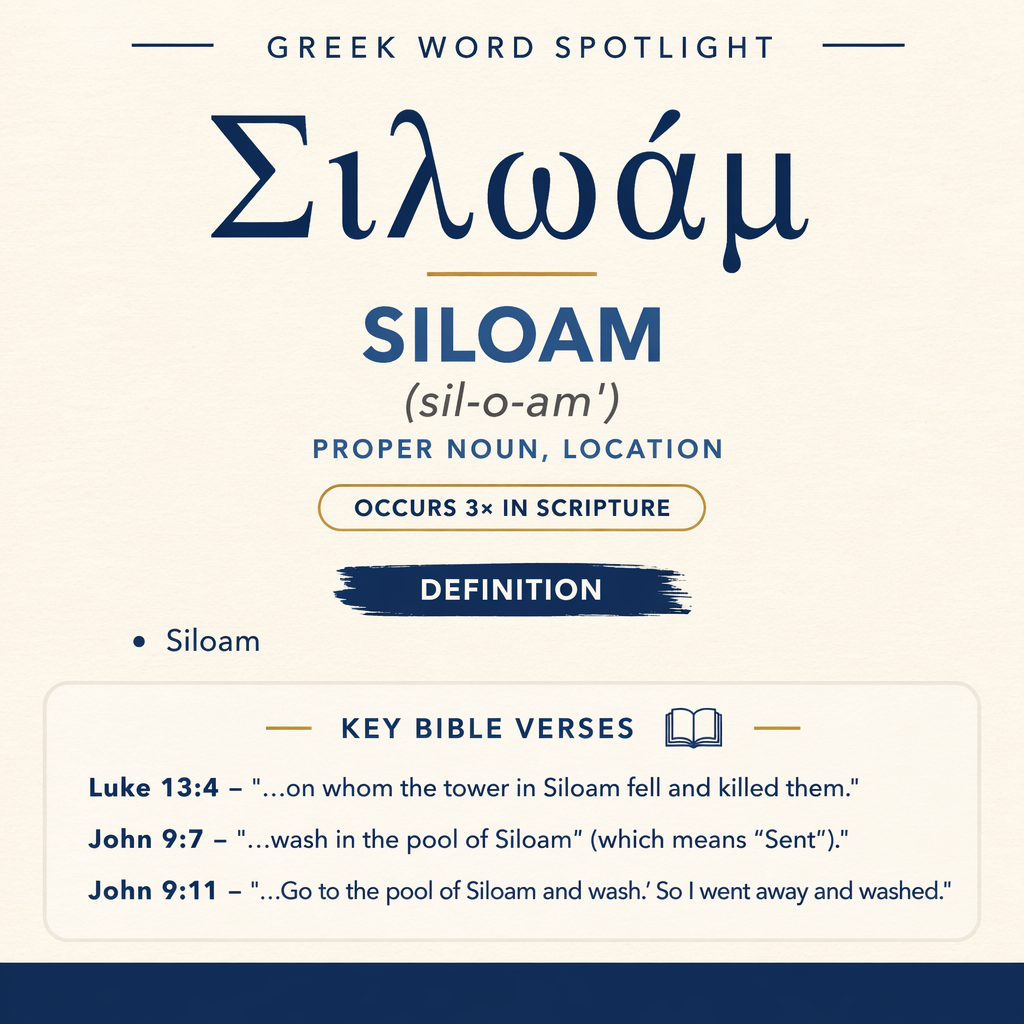
Σιλωάμ means “Siloam” and appears in Luke 13:4 and John 9:7, 9:11.
Meaning
Σιλωάμ is the Greek proper name “Siloam.” John 9:7 notes that “Siloam” means “Sent.”
Learn More →Scripture Occurrences
This word occurs 3 times in Scripture. The references are Luke 13:4; John 9:7; and John 9:11.
Learn More →Context in Passages
Luke 13:4 mentions the tower in Siloam that fell and killed eighteen. John 9:7 and 9:11 refer to washing in the pool of Siloam.
Learn More →Σιλωάμ is the place-name “Siloam,” appearing in a warning about a deadly collapse in Jerusalem and in the account of a healing connected with washing at a pool. In the passages where it occurs, the name anchors events to a specific, recognizable location and lends concrete spatial detail to the narrative.
Occurrences
Luke 13:4 — “Or those eighteen, on whom the tower in Siloam fell and killed them; do you think that they were worse offenders than all the men who dwell in Jerusalem?”
Here Σιλωάμ marks the site of a public tragedy: a tower “in Siloam” collapses, killing eighteen people. The location functions as more than scenery; it frames the example in a way that invites the hearer to recall (or imagine) a known place within the larger setting of Jerusalem (“all the men who dwell in Jerusalem”). By attaching the incident to Siloam, the saying gains the force of a concrete case rather than an abstract warning. The phrasing also distinguishes the victims not by moral category but by circumstance—those “on whom the tower in Siloam fell”—so the place-name becomes the identifying tag for the event and for the people caught in it.
Within the logic of the question, Siloam supplies the “where” that supports the moral probe: the speaker asks whether a catastrophe at a particular place implies that the victims were “worse offenders.” Σιλωάμ therefore helps the sentence hold together as an argument from a specific remembered happening to a broader judgment about how one interprets disaster within the community of Jerusalem.
John 9:7 — “and said to him, “Go, wash in the pool of Siloam” (which means “Sent”). So he went away, washed, and came back seeing.”
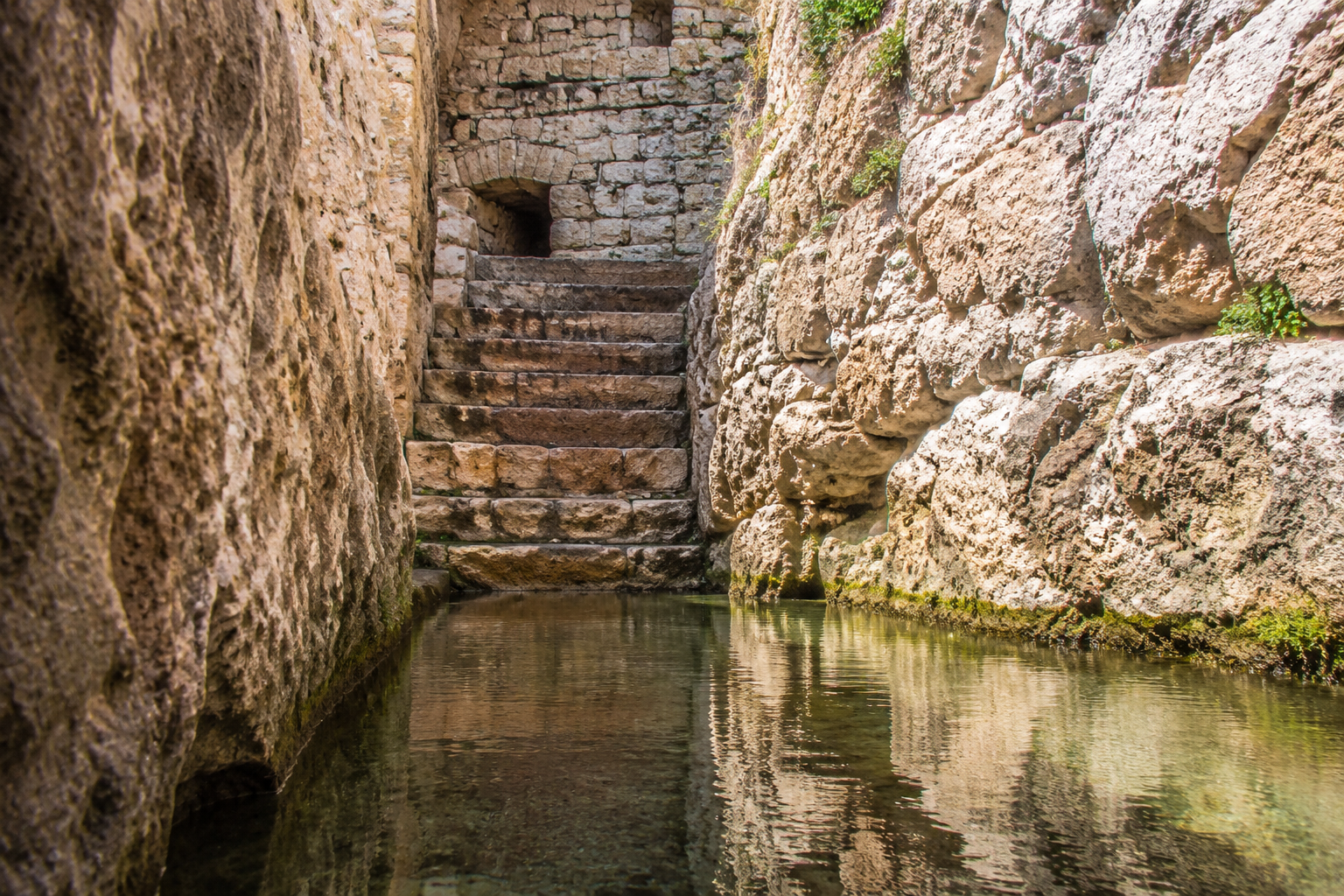
In this scene, Σιλωάμ appears as the destination of a command: “Go, wash in the pool of Siloam.” The narrative treats the place as a definite, named water site—“the pool of Siloam”—that can be reached and used for washing. The name serves the story’s sequence of actions: a directive is given, a place is specified, and obedience is described with brisk, physical verbs (“went away, washed”). The effect is to locate the moment of washing at a particular pool rather than in an undefined body of water, making the healing that follows (“came back seeing”) connected to a concrete location and act.
John’s parenthetical note, “(which means “Sent”),” calls attention to the name itself in a way that is unique among these occurrences. Even so, the sentence keeps the pool central: the meaning-note sits inside the command without interrupting the action. Σιλωάμ is thus both a proper place-name and a name the narrator chooses to explain, encouraging readers to hear the place’s name as part of the account’s texture while still following the straightforward chain of command, washing, and restored sight.
John 9:11 — “He answered, “A man called Jesus made mud, anointed my eyes, and said to me, ‘Go to the pool of Siloam and wash.’ So I went away and washed, and I received sight.””
This occurrence repeats the location within reported speech, now as the healed man recounts what happened. Σιλωάμ is again “the pool of Siloam,” presented as a known place that can be identified in testimony. The man’s account stacks a series of concrete steps—mud, anointing, the instruction to go to Siloam, washing, and then the result: “I received sight.” In this retelling, the place-name helps verify the event’s ordinary, public character: the command included a reachable destination and a simple action at a specific pool, and the speaker presents his compliance (“So I went away and washed”) as a key link in the sequence leading to sight.
Because this is a response (“He answered”), the mention of Σιλωάμ also functions evidentially. The speaker is not offering a vague claim of improvement; he recounts a remembered instruction with a named location. The pool’s name becomes part of the account’s specificity and, by being repeatable in dialogue, part of what can be checked and discussed by others within the narrative world.
Sense and Usage
Across these passages, Σιλωάμ operates consistently as a location-name, “Siloam,” and the contexts show two primary ways a place-name can work in discourse: as a marker of a disaster site and as a marker of a healing-related destination. In Luke 13:4, Siloam is tied to a tower and to the loss of life; the name identifies the incident in a way that makes it a shared point of reference within Jerusalem. The argument depends on that concreteness: the question can be asked precisely because the event is portrayed as a definite occurrence attached to a definite place.
In John 9:7 and 9:11, Siloam is tied to a pool and to the act of washing. The repeated phrase “the pool of Siloam” presents the location as a known water source within the setting, one that can be singled out in instruction and recalled in testimony. The narrative builds around movement to a place and the completion of an act there; thus the place-name supports the storyline’s physical realism. It also underscores the public nature of the action: going to a pool implies leaving one’s present spot and entering a shared space, and the repetition of the pool’s name in both narrator voice and the healed man’s voice keeps that locality in view.
John 9:7 additionally includes an explanatory aside about the name’s meaning (“Sent”), drawing attention to the name itself without changing its basic function as a label for a place. Within the verse, this note sits beside a command and a result, showing that the name is worth interpreting while remaining firmly anchored to a real location where washing occurs. The use of Σιλωάμ in John, therefore, intertwines identifiable geography (“pool”) with narrated significance (a name the author chooses to gloss), all while keeping the sense of the word as a place-name intact.
Imagery
The three uses of Σιλωάμ gather around vivid, ordinary images: a tower that falls and a pool where washing takes place. Luke 13:4 evokes sudden collapse and mortality at a named location within Jerusalem. John 9:7 and 9:11 evoke water, movement, and cleansing as part of a tightly narrated sequence that ends in sight. Taken together, these scenes make Siloam a remembered point on the map where human vulnerability and human restoration are both set in plain view through events attached to a specific place.
Sources: Lexical data from Strong’s Exhaustive Concordance and the Translators Brief Lexicon of Extended Strongs for Greek (STEPBible, CC BY). Occurrence data from the Translators Amalgamated Greek New Testament (STEPBible, CC BY). Scripture quotations from the World English Bible (public domain).





