
Exploring the Meaning of Sige in Greek
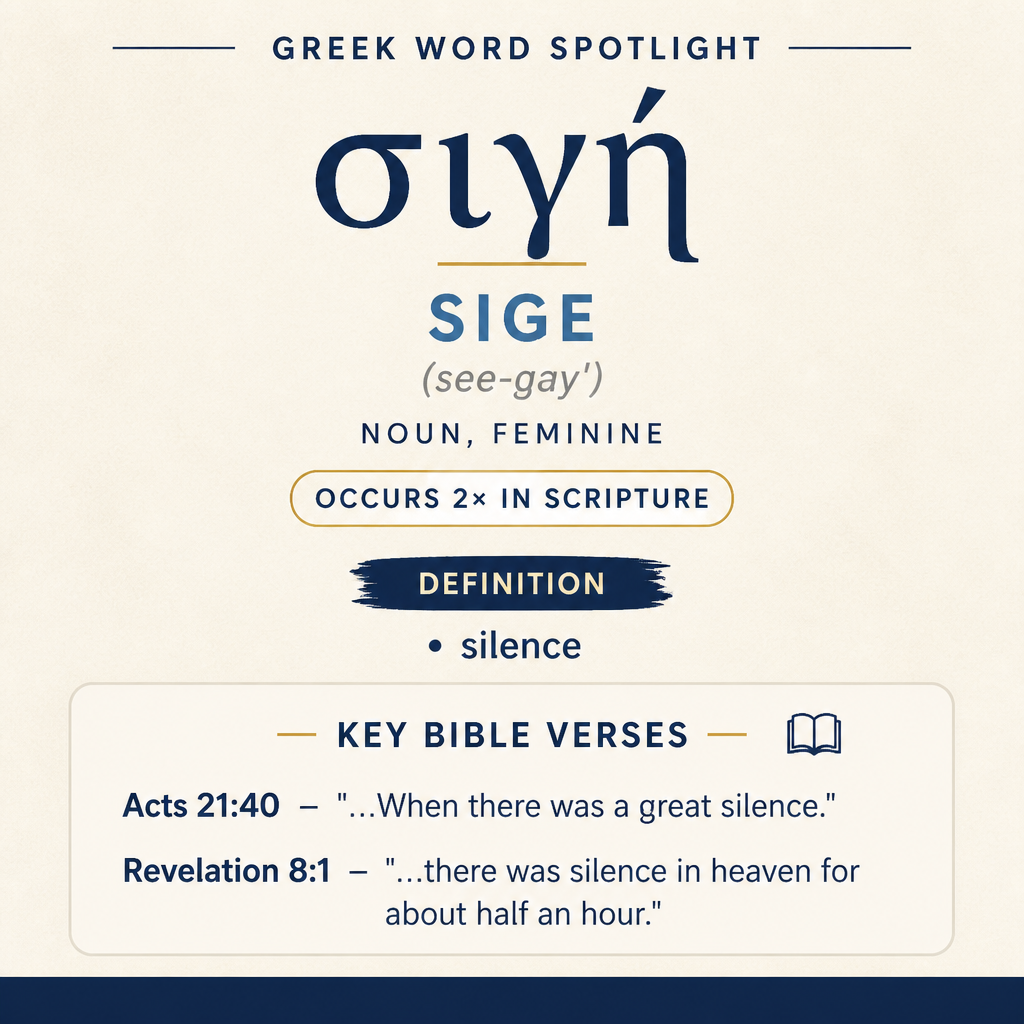
σιγή means “silence” and appears twice in Scripture: Acts 21:40 and Revelation 8:1.
Scripture Occurrences
It occurs 2 times in Scripture. The references are Acts 21:40 and Revelation 8:1.
Learn More →Context Snapshots
In Acts 21:40, Paul beckons to the people, and there is silence. In Revelation 8:1, there is silence in heaven for about half an hour.
Learn More →σιγή expresses “silence,” and in the New Testament it appears in two sharply drawn scenes: a public address on the stairs in Jerusalem and a moment of stillness in heaven. In both, silence functions as a marked pause that frames speech or action by removing competing sound.
Occurrences
“When he had given him permission, Paul, standing on the stairs, beckoned with his hand to the people. When there was a great silence, he spoke to them in the Hebrew language, saying,” (Acts 21:40)
Here σιγή names a crowd’s sudden quiet in response to Paul’s gestures and the official permission granted to him. The verse presents a sequence of controlled movements: permission is given, Paul takes a visible position “on the stairs,” he “beckoned with his hand,” and then “there was a great silence.” The silence is not merely an absence of noise; it is the condition that makes audible speech possible in a tense, public setting. The phrase “a great silence” heightens the sense of an entire gathering being stilled at once, as though collective attention has been gathered into one point. Only after this silence is established does Paul “sp[eak] to them in the Hebrew language,” so σιγή serves as the narrative threshold between unrest and intelligible address. In this scene, silence is depicted as something that can come over a crowd in a measurable way—large enough to be called “great”—and it is linked directly to the act of listening that precedes spoken explanation.
“When he opened the seventh seal, there was silence in heaven for about half an hour.” (Revelation 8:1)
In Revelation, σιγή is located not in a street-level crowd but “in heaven,” and it occurs at a decisive moment: “When he opened the seventh seal.” The verse ties the silence to a specific action and gives it a duration: “for about half an hour.” Unlike the crowd scene, where silence is immediately followed by speech, this heavenly silence is itself the event described. The stated time span underscores that the quiet is sustained and deliberate, not momentary. By placing silence immediately after the opening of the “seventh seal,” the text portrays σιγή as a kind of still interval that stands between one stage of revelation and what follows. The scene’s force comes from the contrast between an act that sounds like it should trigger immediate consequence and the unexpected hush that instead fills heaven. σιγή thus becomes the audible shape of suspense and attention: the opened seal is met first by quiet.

Sense and Usage
As a feminine noun (σιγή), the word designates the state of silence, and in these passages it marks silence as a significant, describable condition rather than a passing detail. Acts 21:40 and Revelation 8:1 show silence operating on two different scales—human assembly and heavenly realm—yet both portray it as a response to an authoritative moment. In Acts, silence answers a combination of public permission and deliberate gesture: Paul is permitted to speak, he signals, and the people become quiet enough to hear. In Revelation, silence answers a climactic action: the opening of a seal, followed by a quiet that lasts “about half an hour.”
Both uses portray silence as something that creates a boundary in the flow of events. In Acts, it is a boundary that leads into speech: “When there was a great silence, he spoke… saying,” so σιγή functions as the audible clearing of space for words. The narrative implies a before-and-after: before, the people are present and need to be signaled; after, they are sufficiently quiet for an address in a particular language. In Revelation, the boundary is not immediately filled with words; instead, silence itself occupies the interval after the seventh seal is opened. The text does not describe what the silence sounds like, but it does measure it—“about half an hour”—so the reader is invited to feel its weight as time passing under restraint.
The adjective “great” in Acts 21:40 modifies the crowd’s silence and points to its extent: not a partial quieting, but a broad hush that can settle over “the people” as a whole. That nuance of scale suits the physical setting “on the stairs,” where distance and crowd size would otherwise challenge audibility. In Revelation 8:1, the scale is specified by realm (“in heaven”) and by duration (“for about half an hour”). The precision of the time marker makes the silence tangible: it is long enough to be noticed, long enough to be counted, and long enough to function as its own meaningful segment within the sequence of events.
Across these two scenes, σιγή also shows how silence can be portrayed either as a prerequisite for speech or as a response that stands on its own. In Acts, silence is instrumental and immediately purposeful: it enables Paul’s speaking to begin in an orderly way. In Revelation, silence is contemplative and arresting: it is the first described consequence of the seal’s opening. The shared thread is that silence is not random; it arrives at the hinge-point where attention is demanded. The crowd becomes still as Paul prepares to speak; heaven becomes still as the seventh seal is opened.
Because both verses position σιγή immediately after an initiating action—Paul’s beckoning and the opening of the seal—the word carries the sense of a quiet that is produced, not merely observed. The silence in Acts “comes” when Paul signals; the silence in Revelation “is” when the seal is opened. In narrative terms, σιγή functions like a pause written into the story’s soundscape: it is the moment when noise stops, and the reader is directed to listen for what matters next.
Imagery
The imagery of σιγή in these passages is concrete and spatial: a man “standing on the stairs” raising his hand until a “great silence” spreads across a crowd (Acts 21:40), and an opened seal followed by a hush that fills heaven for a measured span of time (Revelation 8:1). In both, silence is portrayed as something that can settle over a place—over “the people,” over “heaven”—so that the scene is defined not only by what happens but by what is withheld: sound. The word invites the reader to experience the moment as a stilling of the world, whether for the clarity of a spoken defense or for the gravity of what the seventh seal’s opening signals.
Sources: Lexical data from Strong’s Exhaustive Concordance and the Translators Brief Lexicon of Extended Strongs for Greek (STEPBible, CC BY). Occurrence data from the Translators Amalgamated Greek New Testament (STEPBible, CC BY). Scripture quotations from the World English Bible (public domain).




