Exploring the Meaning of Sigao in Greek
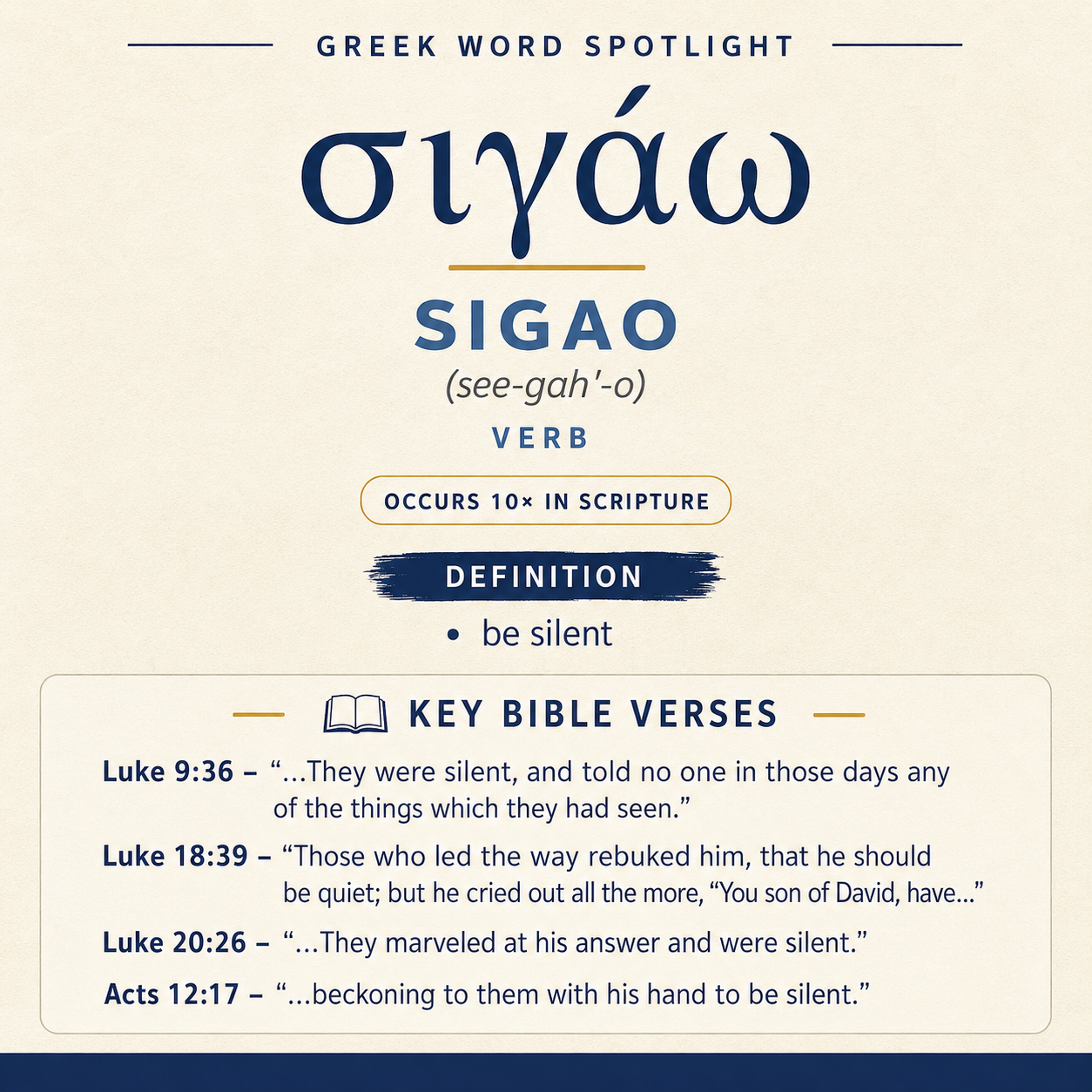
σιγάω means “be silent” and occurs 10 times in Scripture, including Luke 9:36; Luke 18:39; Luke 20:26; Acts 12:17; Acts 15:12–13; Romans 14:24; and 1 Corinthians 14:28.
Scripture Occurrences
It appears 10 times in Scripture. Examples include Luke, Acts, Romans 14:24, and 1 Corinthians 14:28.
Learn More →Usage in Context
It describes people being silent (Luke 9:36; Luke 20:26; Acts 15:12–13). It also describes being told to be quiet (Luke 18:39) and being beckoned to silence (Acts 12:17).
Learn More →σιγάω means “be silent.” It appears in narrative, debate, congregational instruction, and doxological context, where silence can mark awe, restraint, order, or the deliberate withholding of speech.
Occurrences
“When the voice came, Jesus was found alone. They were silent, and told no one in those days any of the things which they had seen.” (Luke 9:36)
Here silence is paired with not telling. The disciples’ silence functions as a concrete response to what they “had seen,” holding back speech in the immediate aftermath of the voice and the scene’s resolution (“Jesus was found alone”). The verb frames their restraint not merely as a pause but as a chosen non-disclosure “in those days.”
“Those who led the way rebuked him, that he should be quiet; but he cried out all the more, “You son of David, have mercy on me!”” (Luke 18:39)
Silence is demanded as social control: “Those who led the way” attempt to suppress the man’s plea by rebuke. The word stands over against persistent petition (“he cried out all the more”), so “be silent” is the opposite of public appeal. In this scene, being silent would mean ceasing the audible request for mercy addressed to Jesus.
“They weren’t able to trap him in his words before the people. They marveled at his answer and were silent.” (Luke 20:26)
After an unsuccessful attempt to catch Jesus in speech, silence marks the collapse of their verbal strategy. Their silence follows two inner responses named in the verse: inability (“weren’t able to trap him”) and astonishment (“marveled”). The verb depicts the abrupt end of their contesting speech in the presence of the people.
“But he, beckoning to them with his hand to be silent, declared to them how the Lord had brought him out of the prison. He said, “Tell these things to James and to the brothers.” Then he departed and went to another place.” (Acts 12:17)
Silence here is a practical requirement to make room for a report. Peter signals with his hand and calls for quiet so he can “declare” what happened. The narrative sets silence as the condition for intelligible testimony: the group’s speech must stop in order for Peter’s account of deliverance to be heard, and then for the instruction to be passed on (“Tell these things…”).
“All the multitude kept silence, and they listened to Barnabas and Paul reporting what signs and wonders God had done among the nations through them.” (Acts 15:12)
In a large assembly, silence becomes the posture of attentive listening. The multitude’s quiet is not empty; it is filled with hearing a report about “signs and wonders” and about what God “had done.” The verb highlights a communal hush that enables the testimony to be received without interruption.
“After they were silent, James answered, “Brothers, listen to me.”” (Acts 15:13)
This silence marks a transition of speakers. The group’s quiet creates a clear handoff from Barnabas and Paul’s reporting to James’s answer. James’s opening, “Brothers, listen to me,” assumes the silence already achieved and directs it toward sustained attention for what he is about to say.
“Now to him who is able to establish you according to my Good News and the preaching of Jesus Christ, according to the revelation of the mystery which has been kept secret through long ages,” (Romans 14:24)
In this doxological sentence, the verb appears in a clause about a “mystery” that “has been kept secret through long ages.” Silence is conceptually tied to the long concealment of something now being spoken of in “revelation.” The word contributes the idea of maintained secrecy: a prolonged withholding that stands in contrast to proclamation and preaching mentioned in the same line.
“But if there is no interpreter, let him keep silent in the assembly, and let him speak to himself, and to God.” (1 Corinthians 14:28)
Silence is commanded for the sake of orderly communication in the gathering. The instruction makes silence conditional (“if there is no interpreter”) and locates it “in the assembly.” The person is not portrayed as having nothing to say—he may “speak to himself, and to God”—but his public speech is restrained so that the gathered community is not addressed without interpretation.
“But if a revelation is made to another sitting by, let the first keep silent.” (1 Corinthians 14:30)
Here silence governs turn-taking when multiple speakers are involved. If one person receives “a revelation,” another who was speaking is told to fall silent. The verb functions as a mechanism for yielding the floor, ensuring that the new revelation can be heard rather than competed against.
“Let the wives be quiet in the assemblies, for it has not been permitted for them to be talking except in submission, as the law also says,” (1 Corinthians 14:34)
Silence is applied as a rule within congregational life (“in the assemblies”). The verse sets “be quiet” against “be talking,” making silence the opposite of speech in that setting. The instruction is framed as permission and propriety—what “has not been permitted”—and places quietness within a stated posture of “submission.”

Sense and Usage
Across these passages, “be silent” functions as an enacted boundary around speech: who speaks, when speech is appropriate, and when speech must stop. In Luke, silence can be a response to overwhelming events (Luke 9:36), an attempted suppression of a plea (Luke 18:39), or the forced end of an adversarial exchange (Luke 20:26). In each case it is socially visible: either others notice the quiet or someone tries to impose it.
Acts uses the verb in communal settings where speech must be coordinated. Peter’s hand signal (Acts 12:17) portrays silence as something that can be requested and granted in real time, enabling a coherent narrative of deliverance and a concrete instruction to pass the news along. At the Jerusalem gathering (Acts 15:12–13), the verb frames two adjacent movements: first, the multitude becomes quiet so they can listen to a report; then, once they are quiet, a new speaker addresses them. Silence is thus not an end in itself but a shared discipline that protects intelligibility and allows testimony and deliberation to proceed.
In Romans 14:24, the word aligns with the idea of secrecy maintained over time (“kept secret through long ages”). The surrounding phrases juxtapose preaching (“my Good News and the preaching of Jesus Christ”) with what was formerly kept in silence. Here, silence is not primarily a gathered community’s behavior but the long-term concealment of content now connected with revelation.
In 1 Corinthians 14, “be silent” is explicitly procedural. It operates under conditions (no interpreter, another receives a revelation) and in a particular location (“in the assembly,” “in the assemblies”). The verb becomes a tool of congregational order: it restricts speech that would not benefit hearers (14:28), it curbs overlap so a new message can be received (14:30), and it sets an expectation for a particular group’s speech within the meeting (14:34). These instructions show silence not as mere absence of sound but as a deliberate act that shapes how the assembly hears, understands, and responds.
Imagery and Effect
The passages give silence a vivid, situational feel: stunned quiet after a voice from heaven (Luke 9:36), a crowd trying to hush a man crying for mercy (Luke 18:39), opponents left with nothing to say (Luke 20:26), a room quieting at a hand gesture so a rescue story can be told (Acts 12:17), and an assembly settling into attentive listening before testimony and an answer (Acts 15:12–13). In the congregational instructions (1 Corinthians 14:28, 14:30, 14:34), silence becomes the practiced restraint that keeps the gathering’s speech from becoming noise, and in Romans 14:24 it evokes the long-held quiet of a mystery now associated with revelation.
Sources: Lexical data from Strong’s Exhaustive Concordance and the Translators Brief Lexicon of Extended Strongs for Greek (STEPBible, CC BY). Occurrence data from the Translators Amalgamated Greek New Testament (STEPBible, CC BY). Scripture quotations from the World English Bible (public domain).