Exploring the Meaning of Semei in Greek
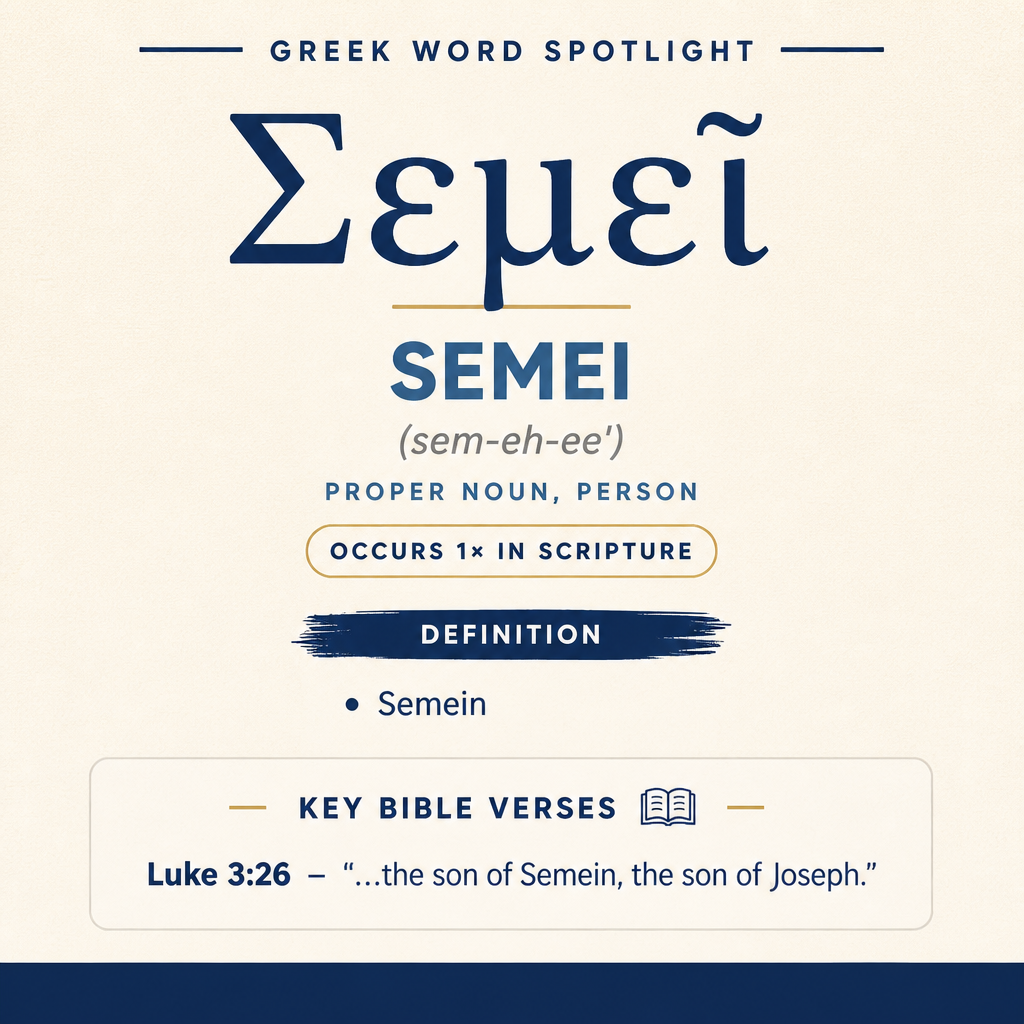
Σεμεΐ (Semei) means “Semein” and appears once in Scripture in Luke 3:26.
Genealogy Context
In Luke 3:26, Semein is listed in a genealogy. The verse places him between Mattathias and Joseph.
Learn More →Σεμεΐ is defined as “Semein” and appears in the genealogy recorded in Luke 3. In that setting it functions as a personal name within a chain of descent.
Occurrences
Luke 3:26
“the son of Maath, the son of Mattathias, the son of Semein, the son of Joseph, the son of Judah,” (Luke 3:26)
Here Σεμεΐ is embedded in a tightly structured list of fathers and sons. The repeated phrasing “the son of …” frames each name as a link in a sequence, and “Semein” occupies one of those links: Mattathias is identified as “the son of Semein,” and Semein is in turn placed as “the son of Joseph.” Within the quoted line, the name does not stand alone as a character with actions or speech; it serves the genealogical purpose of anchoring one generation to another so that relationships in the line are stated with clarity.
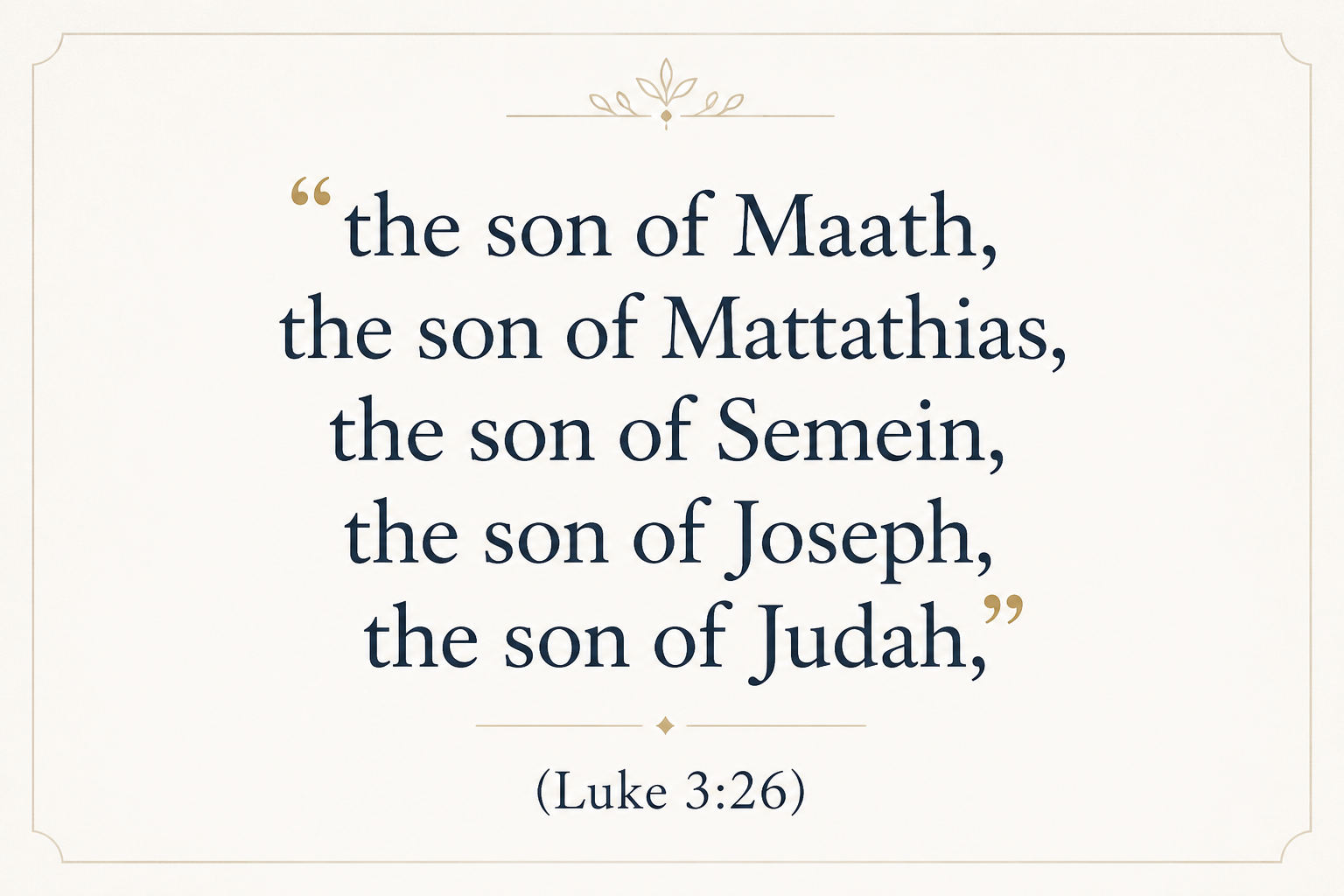
The immediate neighbors in the chain (“Maath,” “Mattathias,” “Joseph,” “Judah”) show how the genealogy moves step by step through individuals rather than summarizing generations in bulk. Σεμεΐ therefore contributes to the precision of the record: the line is not merely a list of names but a series of explicit parent–child identifications. In the rhythm of the verse, the name functions almost like a fixed point between two “the son of” clauses—one looking forward to Mattathias, the other looking backward to Joseph—so that the continuity of descent is verbally reinforced.

Sense and Usage
The definition “Semein” marks Σεμεΐ as a personal designation. In Luke 3:26, this sense is enacted in a formal genealogical register: the name is used to identify a distinct individual within a lineage rather than to describe a role, title, or trait. Genealogical discourse depends on stable identifiers, and the verse’s repetitive syntax treats each name as a necessary element in a chain of relationships. In that framework, “Semein” functions as an identifying label that allows one person (Mattathias) to be located in relation to another (Joseph) through a stated paternal link.
The verse also illustrates how a personal name can carry meaning in a text through placement rather than narration. Even without any attached biographical detail, the name contributes to the text’s forward movement: each mention advances the reader from one generation to the next. The effect is cumulative. By stating “the son of Semein,” the genealogy asserts that the line passes through this individual, and by immediately continuing “the son of Joseph,” it situates him between adjacent generations. The usage is therefore relational and structural: the name’s function is to support the sequence of descent being recited.
Because the name appears in a chain of successive “son of” identifications, its communicative force lies in how it stabilizes the transition between two relatives. The phrase does not leave the relationship implicit; it makes it explicit in a form that can be followed and checked within the list itself. In this kind of register, names are less about personal presence and more about continuity: each one is a connective marker that keeps the genealogy from collapsing into an undifferentiated list. “Semein” contributes exactly that connective clarity in the portion quoted.
This also highlights a basic feature of how names operate in genealogies: they are not interchangeable placeholders but unique points in an ordered chain. The verse gives a compact demonstration of that ordering by naming both the preceding and following connections. “Semein” stands in the middle of two relations, showing that the genealogy is constructed as a series of linked assertions, each one building on the last. In that sense, the use of the name is not merely decorative; it is integral to the sentence’s logic and to the genealogy’s stated aim of tracing descent through identifiable persons.
Imagery in Context
Luke 3:26 presents imagery not through a visual scene but through the cadence of succession: one name after another, bound by the repeated phrase “the son of.” In that ordered recital, “Semein” evokes the idea of a single human life positioned within generations—an individual located between ancestors and descendants through stated kinship, contributing to the sense of an unbroken line articulated name by name.
Sources: Lexical data from Strong’s Exhaustive Concordance and the Translators Brief Lexicon of Extended Strongs for Greek (STEPBible, CC BY). Occurrence data from the Translators Amalgamated Greek New Testament (STEPBible, CC BY). Scripture quotations from the World English Bible (public domain).