Exploring the Meaning of Salmon in Greek
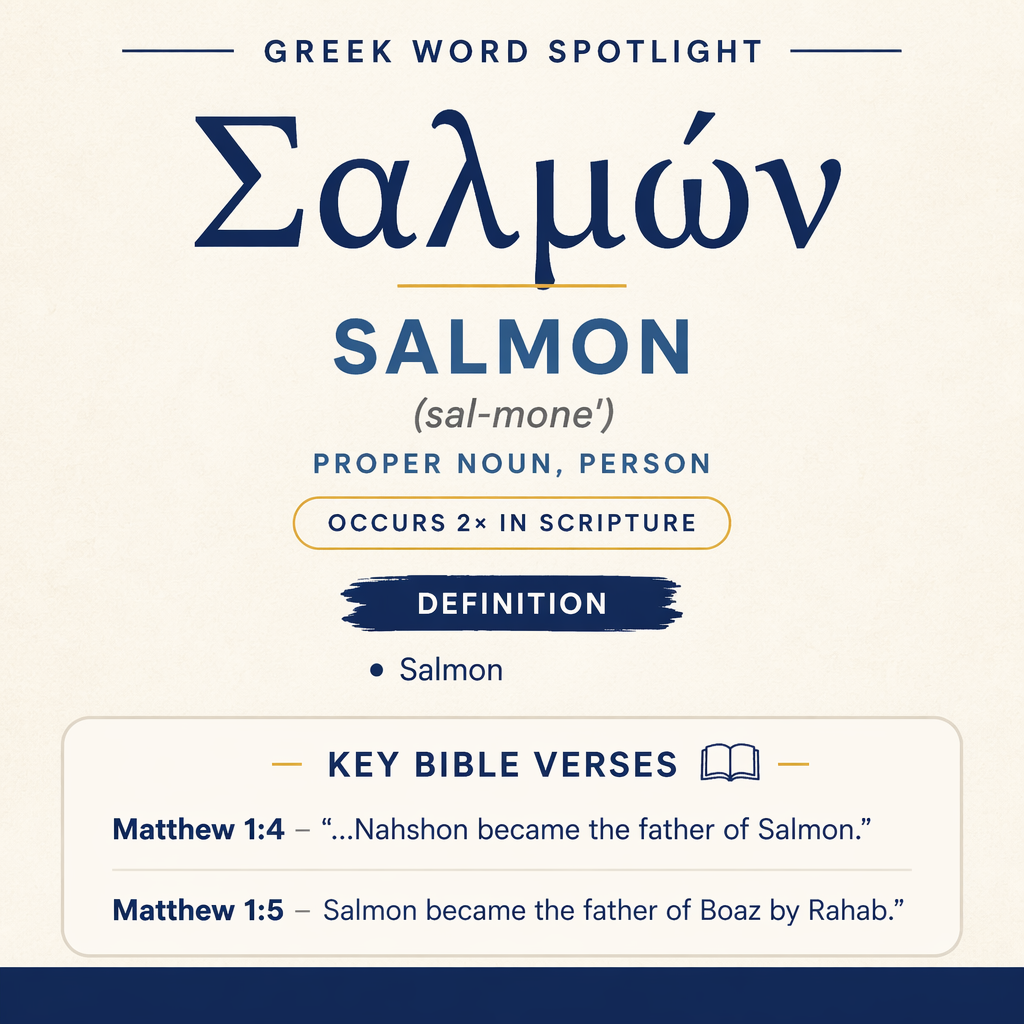
Σαλμών means “Salmon” and appears twice in Scripture, in Matthew 1:4–5.
Matthew Genealogy
In Matthew 1:4, Salmon is listed in the lineage following Nahshon. In Matthew 1:5, Salmon is named as the father of Boaz.
Learn More →Family Links
Matthew 1:5 connects Salmon to Rahab through the birth of Boaz. The genealogy continues from Boaz to Obed, then Jesse.
Learn More →Σαλμών (Salmon) is a personal name appearing in Matthew’s genealogy of Jesus. In these verses it functions as a link in a family line, tying named generations together through stated father–son relationships.
Occurrences
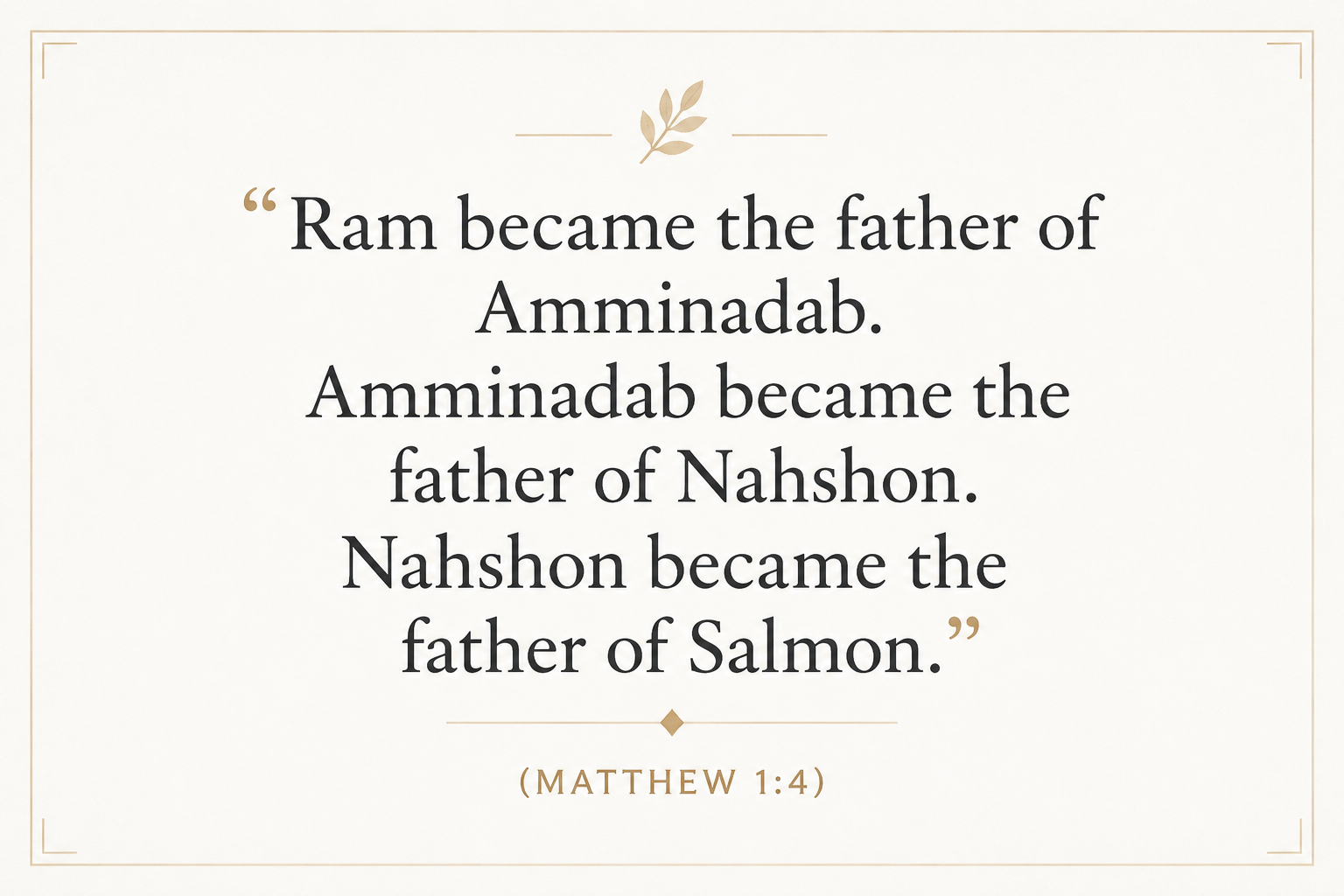
“Ram became the father of Amminadab. Amminadab became the father of Nahshon. Nahshon became the father of Salmon.” (Matthew 1:4)
Here Σαλμών appears as the last name in a short chain of descent. The repeated formula “became the father of” moves the genealogy forward step by step, and “Salmon” marks the point where Nahshon’s line is carried into the next generation named in the list. In the structure of the sentence, Σαλμών is not described by occupation, location, or any other identifier; it is presented purely as the next bearer of the lineage being traced. Its contribution is therefore structural and referential: it is the proper name that anchors a specific generational transition (“Nahshon became the father of Salmon”) within the larger ancestry Matthew is assembling.
“Salmon became the father of Boaz by Rahab. Boaz became the father of Obed by Ruth. Obed became the father of Jesse.” (Matthew 1:5)
In this verse Σαλμών stands at the head of a new segment of the genealogy and is immediately placed in a paternal relationship to “Boaz.” The phrase “by Rahab” adds a maternal link to the otherwise strongly patterned paternal formula, specifying the mother in connection with the birth of Boaz. Within the verse’s parallelism, Salmon is the first of three successive fathers named (“Salmon… Boaz… Obed”), and the text uses this sequence to keep the line moving toward later figures (“Jesse” concludes the verse). As in Matthew 1:4, Σαλμών’s role is to identify a particular individual in the genealogy; but here the naming is expanded by the explicit mention of a woman (“Rahab”), giving Salmon’s fatherhood a specified relational context rather than being presented as a bare link alone.

Sense and Usage
Across both occurrences, Σαλμών functions as a stable personal identifier in a genealogical register. The name does not operate as a title or description; it serves the genealogy’s main task: to connect generations through declared parentage. In Matthew 1:4 Σαλμών is introduced as the son of Nahshon, placing him downstream of “Ram,” “Amminadab,” and “Nahshon” within the same tightly patterned sentence. Matthew 1:5 then immediately uses the same name as the starting point for the next generational steps, showing continuity from the prior verse and preventing any break in the line’s progression.
The syntax of Matthew 1:5 shows how the genealogy sometimes provides additional relational detail without changing its basic framework. “Salmon became the father of Boaz by Rahab” combines the standard paternal formula with a maternal specification. The addition does not redefine what the name refers to; it situates Salmon within a family unit that includes both father and mother in relation to the child. This gives Σαλμών a dual function in that verse: (1) it maintains the genealogical chain, and (2) it is the point at which an explicit maternal association enters the line (at least within the immediate clause). The same verse mirrors this structure again with “Boaz… by Ruth,” which reinforces the sense that Matthew’s genealogy can foreground particular maternal connections while keeping the lineage’s forward motion intact.
Because Σαλμών appears only within the fixed formula of descent, its usage is highly constrained by genre. In these lines the name is not the subject of narrative action, speech, or characterization; instead, it acts as a referent required by the genealogy’s logic. The repetition of “became the father of” makes the genealogy read like a sequence of handoffs, and Σαλμών is one of the named bearers through whom the line is carried. In Matthew 1:4 the name closes a triad (“Amminadab… Nahshon… Salmon”), while in Matthew 1:5 it opens another triad (“Salmon… Boaz… Obed”), showing how the same individual can appear at the hinge between adjacent segments of the list.
Genealogical Imagery
In Matthew 1:4–5, Σαλμών carries the quiet imagery common to genealogies: the steady passing of life from one generation to the next, expressed through a simple verbal pattern. The text presents that movement with minimal adornment, yet the placement of “by Rahab” alongside Salmon’s fatherhood shows that this lineage is not only a sequence of names; it is a succession of family relationships that, at key points, includes mothers as well as fathers within the same line.
Sources: Lexical data from Strong’s Exhaustive Concordance and the Translators Brief Lexicon of Extended Strongs for Greek (STEPBible, CC BY). Occurrence data from the Translators Amalgamated Greek New Testament (STEPBible, CC BY). Scripture quotations from the World English Bible (public domain).