Exploring the Meaning of Saleuo in Greek
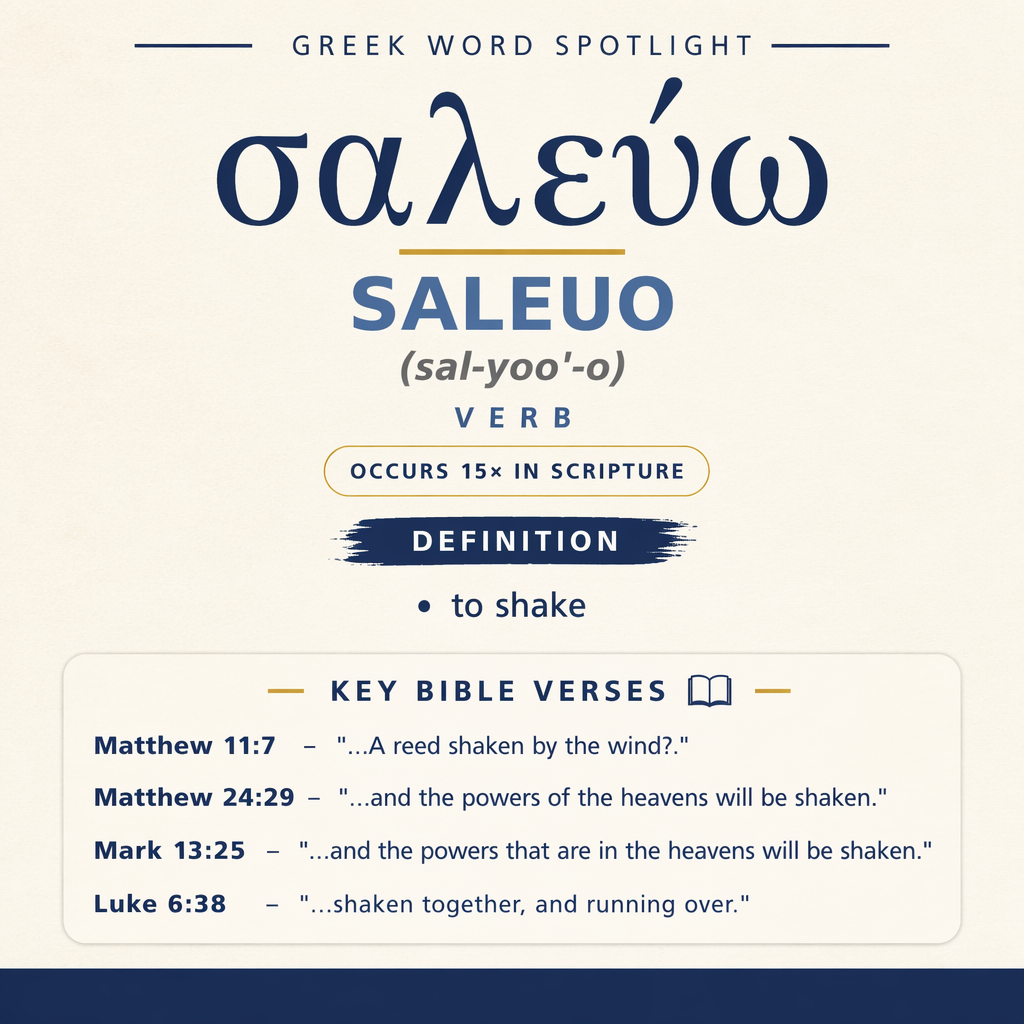
σαλεύω means “to shake” and occurs 15 times in Scripture, including Matthew 11:7; Matthew 24:29; Mark 13:25; Luke; and Acts 2:25.
Gospel Occurrences
It appears in Matthew 11:7 and 24:29, and in Mark 13:25. It also occurs in Luke 6:38; 6:48; 7:24; and 21:26.
Learn More →Acts Occurrence
σαλεύω occurs in Acts 2:25, in a citation introduced with “For David says concerning him.”
Learn More →σαλεύω means “to shake” and is used for physical motion as well as disturbance that reaches into the mind or the structures of the world. In the passages where it appears, it ranges from a wind-tossed reed, to a place rocked by prayer, to cosmic powers shaken in scenes of fear and upheaval.
Occurrences
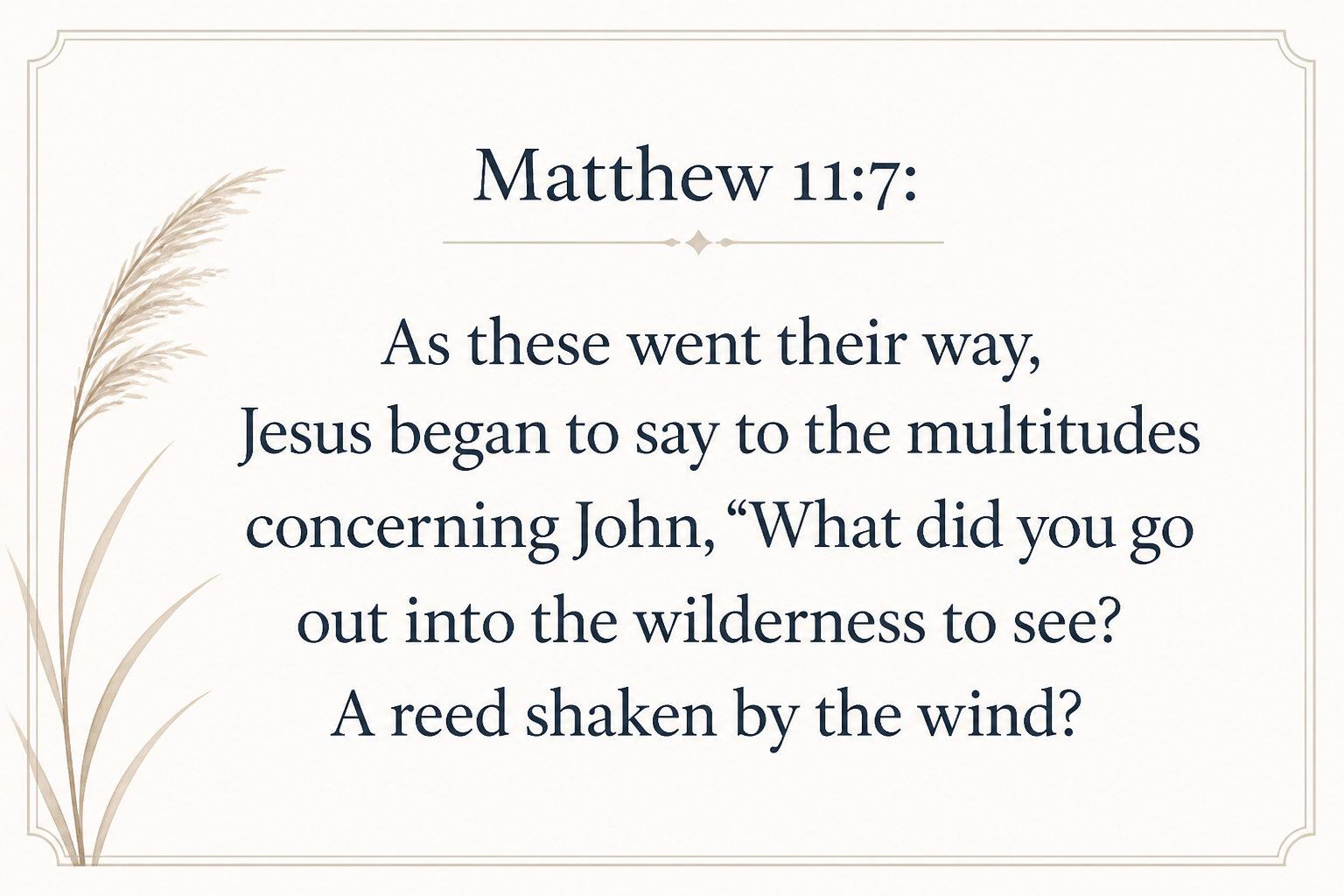
Matthew 11:7: As these went their way, Jesus began to say to the multitudes concerning John, “What did you go out into the wilderness to see? A reed shaken by the wind?
Here “shaken” is the visible, ordinary motion of a reed responding to wind. The image sets a baseline for what “to shake” looks like: light, responsive movement driven by an outside force. In the question’s framing, the shaking of the reed functions as a concrete picture offered to “the multitudes” as they assess what kind of sight they expected in the wilderness.
Matthew 24:29: But immediately after the suffering of those days, the sun will be darkened, the moon will not give its light, the stars will fall from the sky, and the powers of the heavens will be shaken;
“Will be shaken” moves the verb from small-scale motion to cosmic-scale upheaval. The shaking belongs to “the powers of the heavens,” coordinated with darkening sun and moon and falling stars. The verb contributes the sense of destabilization: what is normally experienced as fixed and ordered is pictured as undergoing forceful movement.
Mark 13:25: the stars will be falling from the sky, and the powers that are in the heavens will be shaken.
This parallels the Matthean wording, again pairing falling stars with shaken heavenly powers. The shaking is not described as an isolated event but as part of a cluster of disruptions. The verb sharpens the scene’s intensity by attributing movement to “powers” rather than only to visible objects like stars.
Luke 6:38: “Give, and it will be given to you: good measure, pressed down, shaken together, and running over, will be given to you. For with the same measure you measure it will be measured back to you.”
“Shaken together” depicts deliberate handling to settle contents in a container so the measure becomes full and compact. The shaking here is purposeful and constructive, not destructive: it is part of preparing “good measure” alongside “pressed down” and “running over.” The verb contributes tactile realism, emphasizing that the measured gift is not careless but made abundant through physical action.
Luke 6:48: He is like a man building a house, who dug and went deep, and laid a foundation on the rock. When a flood arose, the stream broke against that house, and could not shake it, because it was founded on the rock.
“Could not shake it” frames shaking as the test a storm brings to a structure. The stream “broke against that house,” but the intended effect—making it move, loosen, or shift—fails because of the foundation “on the rock.” The verb thus marks the difference between pressure applied and actual displacement: the house experiences assault, yet remains unshaken.
Luke 7:24: When John’s messengers had departed, he began to tell the multitudes about John, “What did you go out into the wilderness to see? A reed shaken by the wind?
The same reed image returns, reinforcing the idea of shaking as a wind-driven swaying. Repetition in this setting (after the messengers depart) keeps the focus on what kind of object properly illustrates the situation. The verb supplies a recognizable motion that needs no explanation: a reed yields readily to wind.
Luke 21:26: men fainting for fear, and for expectation of the things which are coming on the world: for the powers of the heavens will be shaken.
Here the shaking of “the powers of the heavens” is tied directly to human reaction: “men fainting for fear.” The verb helps explain the fear’s magnitude—what is coming affects not only earthly affairs but the heavenly powers themselves. The shaking functions as a sign that the coming events involve a profound disturbance of what people perceive as stable.
Acts 2:25: For David says concerning him, ‘I saw the Lord always before my face, for he is on my right hand, that I should not be moved.
“That I should not be moved” expresses the opposite of being shaken: steadiness in posture and situation because “he is on my right hand.” Within the quotation, the language portrays a secure stance arising from proximity to the Lord. Even though the English reads “moved,” it contributes to the semantic field of shaking by expressing immovability where shaking would imply unsettlement.
Acts 4:31: When they had prayed, the place was shaken where they were gathered together. They were all filled with the Holy Spirit, and they spoke the word of God with boldness.
“The place was shaken” describes a physical effect associated with the community’s prayer. The verb turns the setting itself into something that responds: the gathered location undergoes motion. The shaking is narrated alongside being “filled with the Holy Spirit” and speaking “with boldness,” so the movement of the place intensifies the moment’s seriousness and divine activity without shifting attention away from their speech and courage.
Acts 16:26: Suddenly there was a great earthquake, so that the foundations of the prison were shaken; and immediately all the doors were opened, and everyone’s bonds were loosened.
Here σαλεύω is the mechanical result of “a great earthquake”: even “the foundations of the prison” are shaken. The verb conveys the reach of the quake down into the building’s base, not merely surface trembling. The narrative links this shaking with immediate consequences—opened doors and loosened bonds—so the motion is depicted as strong enough to alter the prison’s secured state.
Acts 17:13: But when the Jews of Thessalonica had knowledge that the word of God was proclaimed by Paul at Beroea also, they came there likewise, agitating the multitudes.
“Agitating the multitudes” applies the idea of shaking to a crowd’s social and emotional condition. The verb depicts a stirring up—an induced unrest—produced by opponents who “came there likewise.” In this scene, shaking is not a natural force like wind or earthquake, but a targeted attempt to disturb public response to “the word of God.”
2 Thessalonians 2:2: not to be quickly shaken in your mind, and not be troubled, either by spirit, or by word, or by letter as if from us, saying that the day of Christ has already come.
“Shaken in your mind” brings the verb squarely into inner experience: destabilized thinking that leads to being “troubled.” The warning is against a rapid onset (“quickly”) of this mental shaking, especially when prompted by claims delivered “by spirit, or by word, or by letter as if from us.” The verb contributes the picture of thoughts being jolted out of steadiness by persuasive or alarming messages.

Sense and Usage
Across these passages, “to shake” consistently portrays motion produced by an external force, but the force varies in kind and scale. In the wilderness sayings (Matthew 11:7; Luke 7:24), wind acts on a reed, and the shaking is ordinary, visible, and easily imagined. In the measuring image (Luke 6:38), the shaking is intentional handling, integrated with “pressed down” and leading to “running over,” so the motion serves fullness rather than loss.
In the storm-and-house comparison (Luke 6:48), shaking becomes the criterion of stability: the flood applies pressure, but the house does not yield. In Acts, the verb moves between natural events and communal settings. The “place” shaken after prayer (Acts 4:31) presents shaking as a striking environmental response accompanying a spiritual moment, whereas the prison’s foundations shaken by earthquake (Acts 16:26) shows shaking as brute physical disruption that produces immediate, tangible changes in security and confinement.
The word’s reach extends beyond objects into persons and societies. “Agitating the multitudes” (Acts 17:13) and being “shaken in your mind” (2 Thessalonians 2:2) use shaking for disturbance that spreads through people—crowds stirred by opposition, and believers unsettled by alarming assertions. Finally, in the apocalyptic sayings (Matthew 24:29; Mark 13:25; Luke 21:26), the shaking of “the powers of the heavens” portrays ultimate destabilization at the level of the cosmos, matched by human fear. Within this range, the verb can mark anything from mild swaying to foundational upheaval, but it repeatedly carries the idea of a state being driven from settled firmness into motion.
Imagery
The passages cluster around two contrasting pictures: what shakes and what does not. A reed moves easily in wind, foundations can be shaken by earthquake, and even heavenly powers are depicted as shaken; by contrast, a house “founded on the rock” cannot be shaken, and the speaker in Acts 2:25 expresses a steadiness captured in “that I should not be moved.” The verb therefore serves as a vivid measure of vulnerability or stability—whether in nature, buildings, communities, or the mind.
Sources: Lexical data from Strong’s Exhaustive Concordance and the Translators Brief Lexicon of Extended Strongs for Greek (STEPBible, CC BY). Occurrence data from the Translators Amalgamated Greek New Testament (STEPBible, CC BY). Scripture quotations from the World English Bible (public domain).