
Exploring the Meaning of Rhomaios in Greek
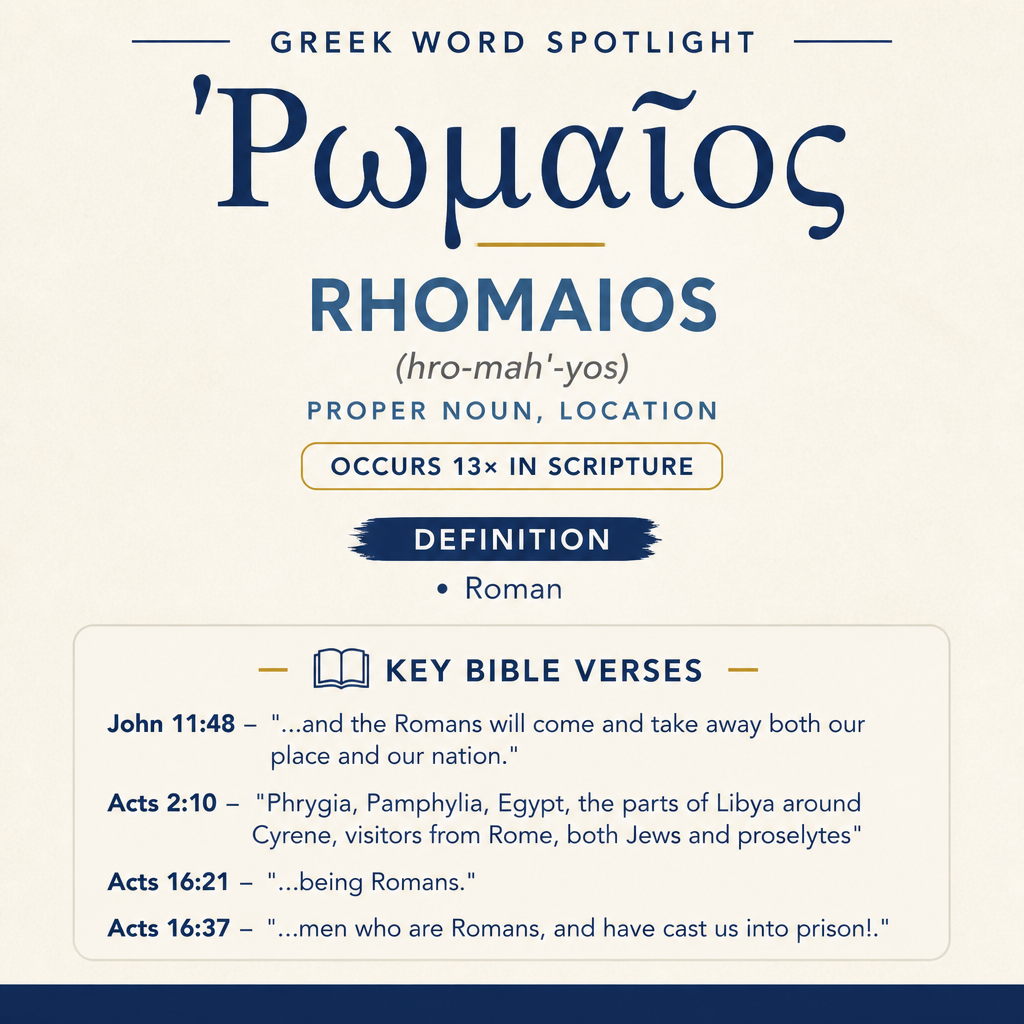
Ῥωμαῖος (Rhomaios) means “Roman” and appears 13 times in Scripture, including John 11:48 and multiple passages in Acts.
Where It Appears
It occurs in John 11:48 and in Acts (2:10; 16:21, 16:37–38; 22:25–27).
Learn More →Usage In Acts
In Acts 16 and Acts 22, it is used in statements identifying someone as a Roman.
Learn More →Ῥωμαῖος marks someone or some group as “Roman.” Across its appearances it can point to imperial forces feared by local leaders, to visitors connected with Rome, to legally protected persons, and to the administrative system that handles arrests, trials, and custody.
Occurrences
“If we leave him alone like this, everyone will believe in him, and the Romans will come and take away both our place and our nation.” (John 11:48)
Here “the Romans” are presented as an external power whose intervention would be decisive and destructive. The speakers imagine a chain reaction—public belief leading to Roman action—ending with loss (“take away”) of both a local “place” and a collective “nation.” Ῥωμαῖος therefore functions as a political label evoking coercive capacity: the group called “Romans” can remove what others possess and value.

“Phrygia, Pamphylia, Egypt, the parts of Libya around Cyrene, visitors from Rome, both Jews and proselytes,” (Acts 2:10)
In this list, “visitors from Rome” situates Rome among many geographic points of origin. Ῥωμαῖος contributes to the sense of breadth by anchoring the gathering to the capital’s orbit: people connected with Rome are present alongside those from other regions. The word identifies a recognizable destination-point (“Rome”) and thereby strengthens the impression that the audience is not local or uniform but drawn from wide-ranging places.
“and advocate customs which it is not lawful for us to accept or to observe, being Romans.” (Acts 16:21)
“Being Romans” is the stated basis for an appeal to what is “lawful” and what is “not lawful” to accept or observe. Ῥωμαῖος is used rhetorically: the speakers frame their identity as the controlling norm for communal practice, claiming that “customs” are prohibited for “us” because of what they are. The word thus carries the weight of an identity that can be invoked as a boundary-marker for permitted behavior.
“But Paul said to them, “They have beaten us publicly without a trial, men who are Romans, and have cast us into prison! Do they now release us secretly? No, most certainly, but let them come themselves and bring us out!”” (Acts 16:37)
Paul’s protest hinges on two points held together: injustice (“beaten us publicly without a trial”) and status (“men who are Romans”). Ῥωμαῖος names the status that makes the mistreatment especially actionable in this setting; it is precisely because they are “Romans” that secret release is unacceptable. The word gives force to Paul’s demand for public accountability: the officials must “come themselves” and “bring us out,” reversing the public shame of the beating with a public acknowledgment.
“The sergeants reported these words to the magistrates, and they were afraid when they heard that they were Romans,” (Acts 16:38)
The magistrates’ fear is directly triggered by the report that the men are “Romans.” Ῥωμαῖος is the piece of information that changes the officials’ posture from confident punishment to apprehension. In this brief scene, the word operates almost like a legal alarm bell: once the identity is known, the power dynamic shifts and fear replaces control.
“When they had tied him up with thongs, Paul asked the centurion who stood by, “Is it lawful for you to scourge a man who is a Roman, and not found guilty?”” (Acts 22:25)
Paul frames the issue as a legal question tied to identity: “a man who is a Roman” should not be scourged when “not found guilty.” Ῥωμαῖος functions here as a category that carries procedural expectations. The word strengthens Paul’s question by contrasting what the soldiers are about to do (“tied him up with thongs”) with what should govern their conduct (“Is it lawful…?”).
“When the centurion heard it, he went to the commanding officer and told him, “Watch what you are about to do, for this man is a Roman!”” (Acts 22:26)
In the centurion’s warning, Ῥωμαῖος is the decisive fact that demands immediate caution. “Watch what you are about to do” indicates imminent action that must be reconsidered; “for this man is a Roman” gives the reason. The word thus acts as a stop-sign in the narrative: identity compels a change in how authority proceeds.
“The commanding officer came and asked him, “Tell me, are you a Roman?” He said, “Yes.”” (Acts 22:27)
Here Ῥωμαῖος is tested through direct inquiry and confirmed by a simple answer. The exchange shows the term functioning as a formal status that can be asserted and recognized in an official setting. The commanding officer’s question treats “Roman” identity as something determinate—something that can be verified by testimony and that will govern the next steps.
“Immediately those who were about to examine him departed from him, and the commanding officer also was afraid when he realized that he was a Roman, because he had bound him.” (Acts 22:29)
Once Paul’s identity is “realized,” it produces immediate consequences: examiners withdraw “immediately,” and the commanding officer becomes “afraid,” specifically “because he had bound him.” Ῥωμαῖος therefore explains the sudden reversal from coercive examination to restraint. The word also links fear to prior action: the binding itself becomes a liability once the prisoner is known to be Roman.
““This man was seized by the Jews, and was about to be killed by them, when I came with the soldiers and rescued him, having learned that he was a Roman.” (Acts 23:27)
The speaker presents the rescue as tied to learning the man’s identity. Ῥωμαῖος provides a rationale for intervention: once the threatened person is known as “a Roman,” military action (“I came with the soldiers”) and rescue are narrated as appropriate. The term functions as a status that warrants protection amid conflict and attempted violence.
“I answered them that it is not the custom of the Romans to give up any man to destruction before the accused has met the accusers face to face and has had opportunity to make his defense concerning the matter laid against him.” (Acts 25:16)
Here Ῥωμαῖος appears in a general statement about “the custom of the Romans.” The word points not to an individual identity but to an institutional pattern: Romans do not hand someone over “to destruction” without a process that includes confrontation (“met the accusers face to face”) and a chance to respond (“opportunity to make his defense”). Ῥωμαῖος thus contributes to the depiction of Roman governance as operating with recognizable procedures, at least as claimed in this speech.
“After three days Paul called together those who were the leaders of the Jews. When they had come together, he said to them, “I, brothers, though I had done nothing against the people or the customs of our fathers, still was delivered prisoner from Jerusalem into the hands of the Romans,”” (Acts 28:17)
Paul describes his transfer of custody: he was “delivered prisoner… into the hands of the Romans.” Ῥωμαῖος identifies the authority now holding him and implies a change in jurisdiction—from local conflict in Jerusalem to Roman control. The phrase “into the hands of” gives the word a tangible feel: it is not merely a label but an account of who possesses legal custody over his person.

Sense and Usage
Across these passages, Ῥωμαῖος consistently serves as a marker of Roman identity, but the narrative uses that identity in several distinct ways. In John 11:48, “the Romans” are a feared collective whose arrival would mean dispossession; the term is a shorthand for imperial power capable of taking away political and communal goods. In Acts 2:10, the connection with Rome is geographical and social: “visitors from Rome” places the scene within the reach of Rome’s world, without any overt legal conflict.
In Acts 16, Ῥωμαῖος becomes an identity invoked inside a city’s public life. Accusers appeal to what is “lawful… being Romans,” making Roman identity a claimed norm for public customs. Paul then uses the same identity in a different direction: “men who are Romans” turns his mistreatment into an offense that requires open redress. The immediate fear of magistrates when they learn this identity shows that “Roman” status carries consequences that officials take seriously.
Acts 22–23 develops the term within a tightly focused sequence of arrest, restraint, and official review. The word “Roman” is introduced as a legal barrier against unjust punishment (“scourge… and not found guilty”), then is relayed up the chain of command, then is confirmed by questioning, and finally produces withdrawal and fear when the binding is recognized as problematic. The same status also explains a rescue narrative: learning he is “a Roman” motivates protective action by soldiers. In Acts 25:16 and 28:17, Ῥωμαῖος shifts from a personal descriptor to a collective and administrative frame—“the custom of the Romans” and “the hands of the Romans”—highlighting Roman procedures and custody as operative realities surrounding an accused person.
Imagery
The word’s imagery in these scenes is concrete and institutional: Romans “come,” “take away,” enforce what is “lawful,” inspire fear in magistrates, bind with “thongs,” “rescue” with soldiers, and hold a prisoner “into the hands” of their authority. Ῥωμαῖος repeatedly evokes the presence of a governing power that can punish or protect, and that can define both public boundaries and legal process.
Sources: Lexical data from Strong’s Exhaustive Concordance and the Translators Brief Lexicon of Extended Strongs for Greek (STEPBible, CC BY). Occurrence data from the Translators Amalgamated Greek New Testament (STEPBible, CC BY). Scripture quotations from the World English Bible (public domain).




