
Exploring the Meaning of Rhomaikos in Greek
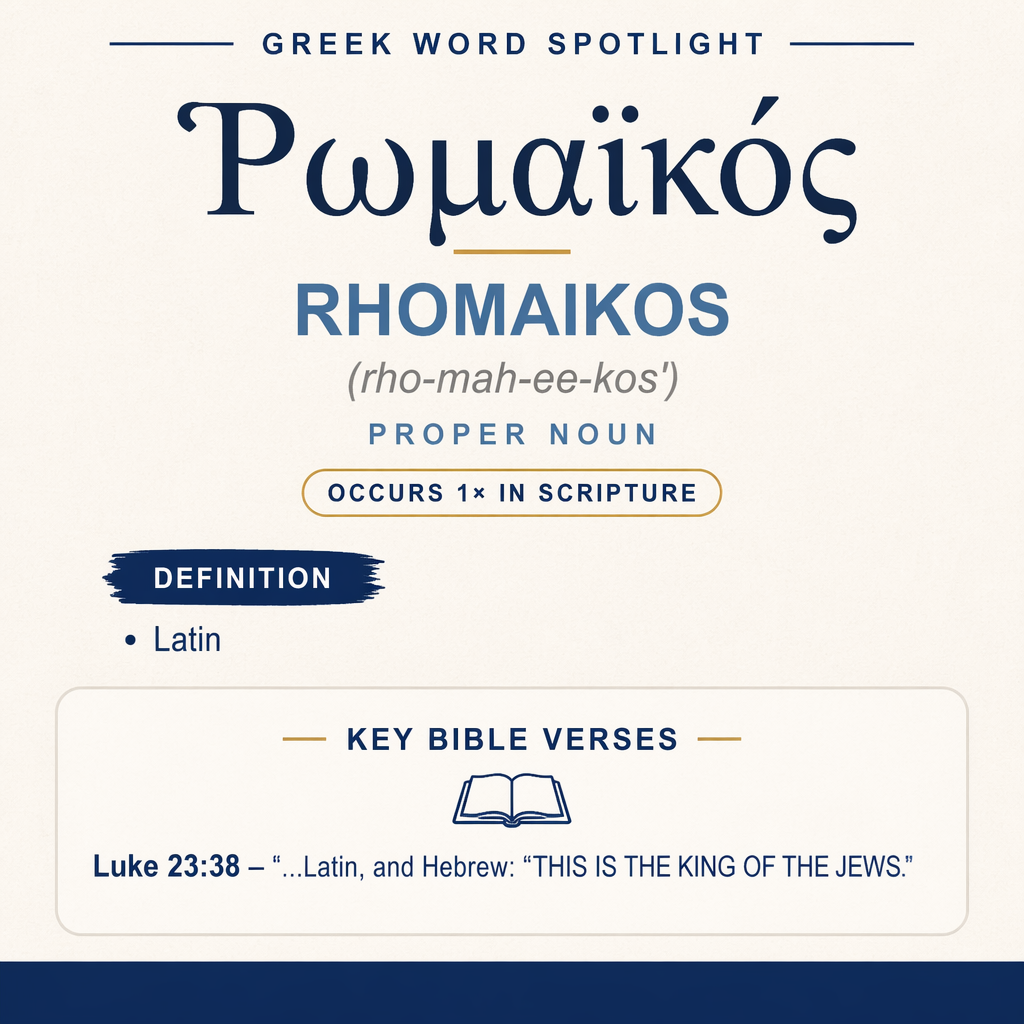
Ῥωμαϊκός means “Latin” and appears once in Scripture in Luke 23:38.
Scripture Context
It occurs in Luke 23:38, where an inscription over Jesus was written in Greek, Latin, and Hebrew.
Learn More →Ῥωμαϊκός means “Latin” and appears in the passion narrative describing the languages used for the inscription placed above Jesus. In its lone New Testament setting, the word points to one of the written scripts in which the charge was publicly displayed.
Root and Related Words
Ῥωμαϊκός (Rhomaikos) derives from Ῥωμαῖος (Rhomaios), “Roman” (Strong’s G4514). The relationship is reflected in Luke’s description of the multilingual inscription: the term belongs to the language associated with Roman public life in the setting of the crucifixion.

Occurrences
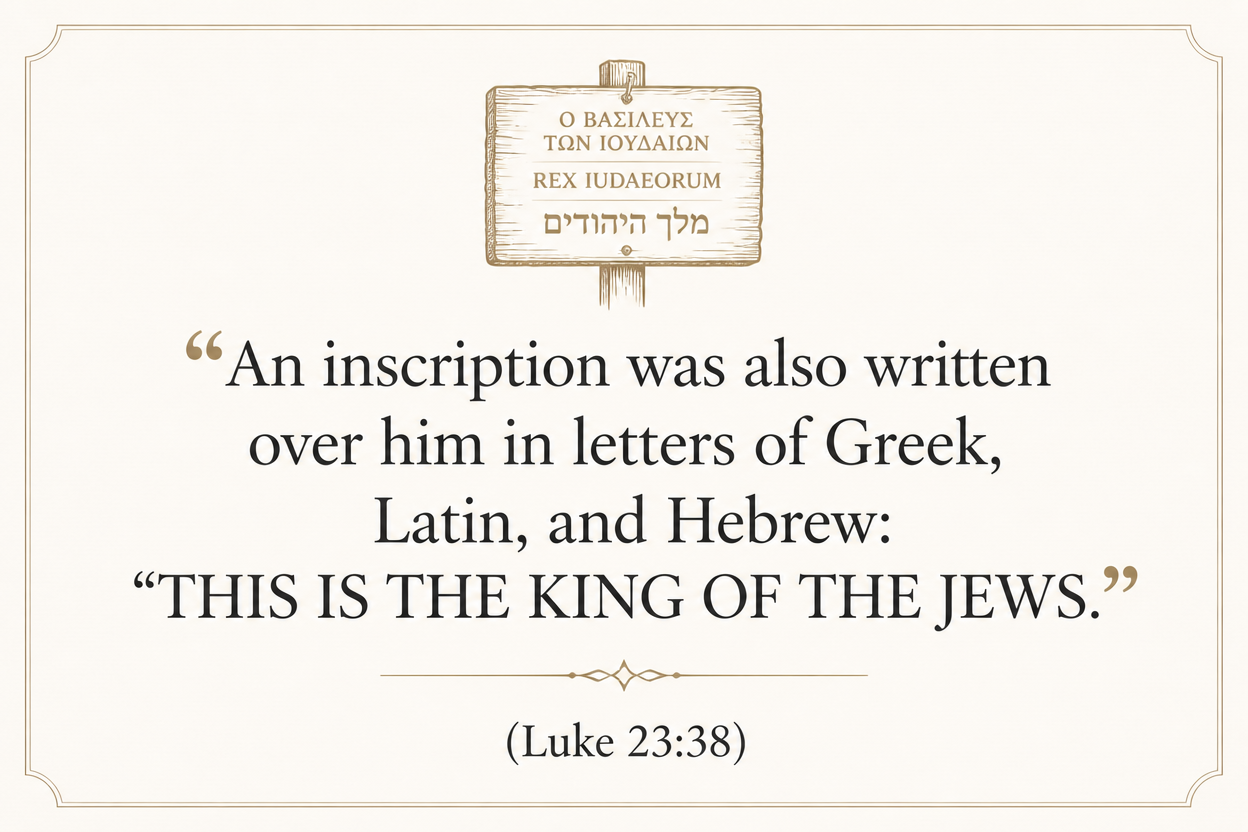
“An inscription was also written over him in letters of Greek, Latin, and Hebrew: “THIS IS THE KING OF THE JEWS.”” (Luke 23:38)
Here Ῥωμαϊκός identifies one of the “letters” used for the inscription placed “over him.” Luke frames the notice as a formally written placard, not a spoken accusation, and he stresses its legibility across multiple language communities by listing “Greek, Latin, and Hebrew.” Within that triad, Ῥωμαϊκός marks the Latin component of the written message, presenting the charge as publicly accessible and officially posted. The placement “over him” binds the word to the scene’s visible elements: the cross, the inscribed notice, and the three scripts by which the same statement is disseminated.
The verse’s structure also gives Ῥωμαϊκός a coordinating role. Latin is named alongside Greek and Hebrew without further explanation, functioning as one item in a set that collectively communicates reach. The content of the inscription—“THIS IS THE KING OF THE JEWS.”—is presented as the message conveyed through these “letters,” so the mention of Latin is integral to the narrative’s emphasis that the message was written and displayed rather than privately relayed. In short, Ῥωμαϊκός in Luke 23:38 contributes to the portrayal of the crucifixion as a public event with a public statement, set down in recognized written forms.
Sense and Usage
As “Latin,” Ῥωμαϊκός functions as a language label within a concrete, administrative act: composing an inscription. Luke attaches the term to “letters,” underlining the written medium. The word therefore does not describe ethnicity, geography, or personal identity in this verse, but a script or language used for public signage. Its force lies in specifying which linguistic register is in view when the inscription’s languages are enumerated.
Because the inscription is narrated as being written in three languages, Ῥωμαϊκός participates in a depiction of broad public communication. The listing implies a crossroads of audiences: those who read Greek, those who read Latin, and those who read Hebrew. In that communicative setting, Ῥωμαϊκός marks the Latin form of the message as one strand in the inscription’s overall visibility. The term’s contribution is thus distributive: it helps divide the posted statement into its multiple written realizations while keeping the content unified (“THIS IS THE KING OF THE JEWS.”).
The single attestation also keeps the word’s usage tightly anchored to the passion narrative’s material details. The language label is not presented as an abstract category but as part of the physical notice “written over him.” In Luke’s sentence, Ῥωμαϊκός belongs to the world of writing instruments, official postings, and the public display of a charge at an execution site.
Imagery
Luke connects Ῥωμαϊκός with the stark image of a written placard suspended above a crucified man. The word evokes the look of formal lettering—one of several scripts—set out in a public place so that the same brief sentence can be read in different languages.
Sources: Lexical data from Strong’s Exhaustive Concordance and the Translators Brief Lexicon of Extended Strongs for Greek (STEPBible, CC BY). Occurrence data from the Translators Amalgamated Greek New Testament (STEPBible, CC BY). Scripture quotations from the World English Bible (public domain).




