
Exploring the Meaning of Rhode in Greek
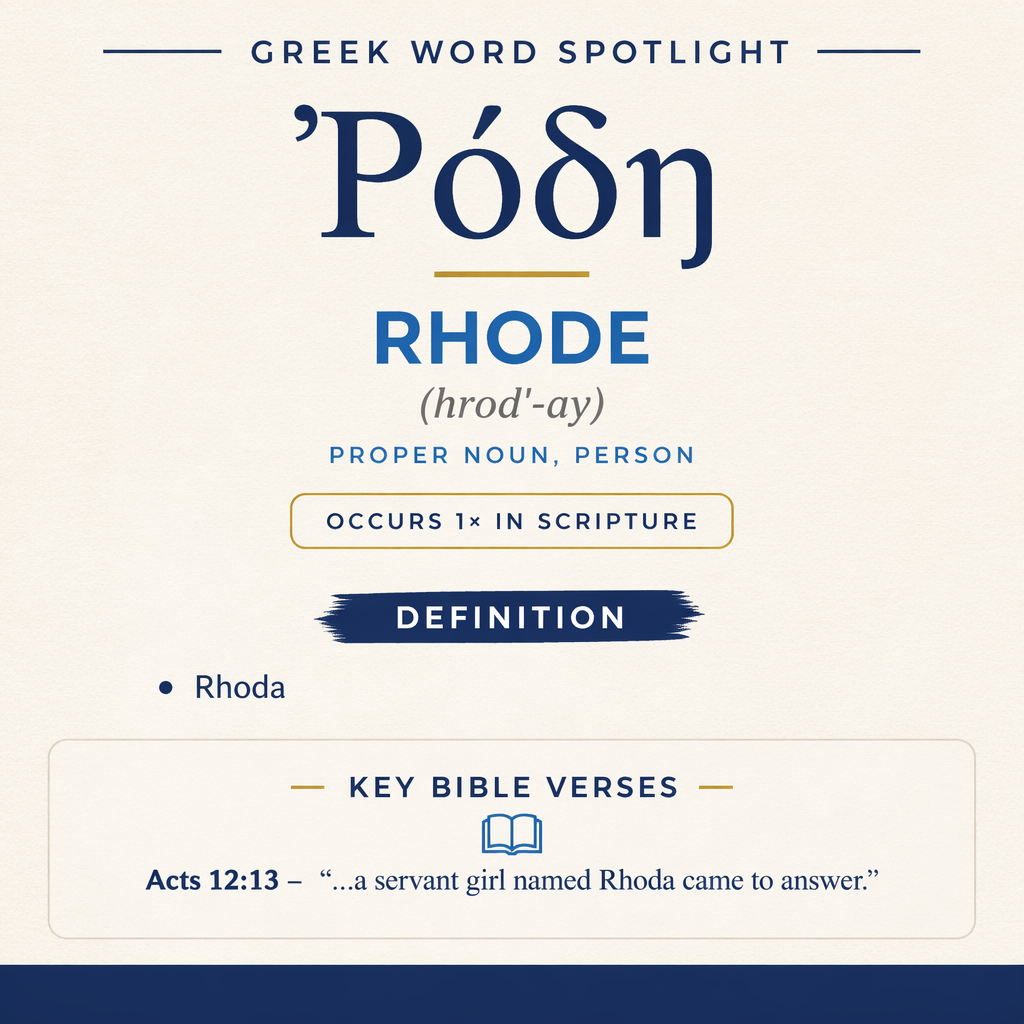
Ῥόδη (Rhode) means “Rhoda” and appears once in Scripture in Acts 12:13.
Narrative Context
In Acts 12:13, when Peter knocked at the gate door, a servant girl named Rhoda came to answer.
Learn More →Ῥόδη means “Rhoda” and appears in Acts 12:13 as the personal name of a servant girl who responds to a knock at the outer entrance. In that single scene, the narrative pauses to identify her and to place her in the action at the gate.
Occurrences
“When Peter knocked at the door of the gate, a servant girl named Rhoda came to answer.” (Acts 12:13)
Here Ῥόδη functions as a specific personal identifier inserted into a brief but vivid domestic moment. The verse sets up a small sequence of physical actions and locations—Peter outside, “knocked,” a “door,” and “the gate”—and then introduces the one who responds: “a servant girl named Rhoda.” The name does more than label an otherwise anonymous figure; it individualizes the servant girl as a participant in the episode, anchoring the scene in the ordinary rhythms of a household where someone is responsible to “come to answer” at an outer entry.
The structure of the sentence makes the naming clause (“named Rhoda”) the hinge between the external action (Peter knocking) and the internal response (someone answering). As a result, Ῥόδη stands at the boundary of inside and outside, the point of contact between a visitor at the gate and those within. The naming also signals that the narrative expects the reader to track her, even though the immediate action described is simple. In a story built on movement, access, and response, the personal name marks this servant girl as more than a background detail; she is the one whose approach to the gate matters to what follows from the knock.

Sense and Usage
As a proper name meaning “Rhoda,” Ῥόδη does not describe a trait or role; it designates an individual person. Yet its placement alongside “servant girl” shows how the narrative joins social position with personal identity: she is both a member of the household staff and a particular named individual. The word therefore works in tandem with the descriptive phrase “a servant girl,” narrowing the reference from a general category (a servant girl could be anyone in such a household) to a specific person whose actions can be remembered and distinguished from others present.
In Acts 12:13, the naming also contributes to pacing. The verse could have moved quickly from “Peter knocked” to “someone answered,” but instead it pauses to supply a personal name at the moment of response. That pause slows the reader at the threshold—“the door of the gate”—and gives the scene a concrete, almost report-like quality: an identifiable person comes, not an unnamed figure. The name Ῥόδη thus helps the episode feel situated in a real household with recognizable individuals rather than in an abstract setting where actions occur without personal agents.
The immediate context also shows how a proper name can function as a narrative spotlight. The sentence introduces Peter’s action first, but it is Rhoda who is newly introduced; Peter is already known, whereas “a servant girl named Rhoda” is presented as new information. The proper name is the key marker of that newness. Within this single verse, Ῥόδη serves as the narrative’s way of inviting attention to the responder at the gate, preparing the reader to notice how the household’s internal response to the knock will unfold through particular people rather than through a vague collective.
Finally, the placement of Ῥόδη at the point of contact between the outside visitor and the inside household suggests the practical role of servants in managing access to the home. The verse does not expand on the household or the wider setting; it simply shows a servant girl responding to the knock. The name makes that role personal: the one who comes to answer is Rhoda. In this way Ῥόδη functions as a compact narrative tool—one word that turns “a servant girl” into a recognizable participant at a crucial doorway moment.
Imagery
The imagery surrounding Ῥόδη in Acts 12:13 is concrete and spatial: a gate, a door, a knock, and a servant girl approaching to respond. The name is heard at the threshold—where a closed entrance separates those within from the one standing outside—so Rhoda is pictured in motion toward an entryway, framed by the ordinary architecture and routines of a household. In that brief snapshot, Ῥόδη evokes the immediacy of a night-time interruption or urgent visit: a knock at the gate and a named person coming to answer.
Sources: Lexical data from Strong’s Exhaustive Concordance and the Translators Brief Lexicon of Extended Strongs for Greek (STEPBible, CC BY). Occurrence data from the Translators Amalgamated Greek New Testament (STEPBible, CC BY). Scripture quotations from the World English Bible (public domain).




