
Exploring the Meaning of Rhouth in Greek
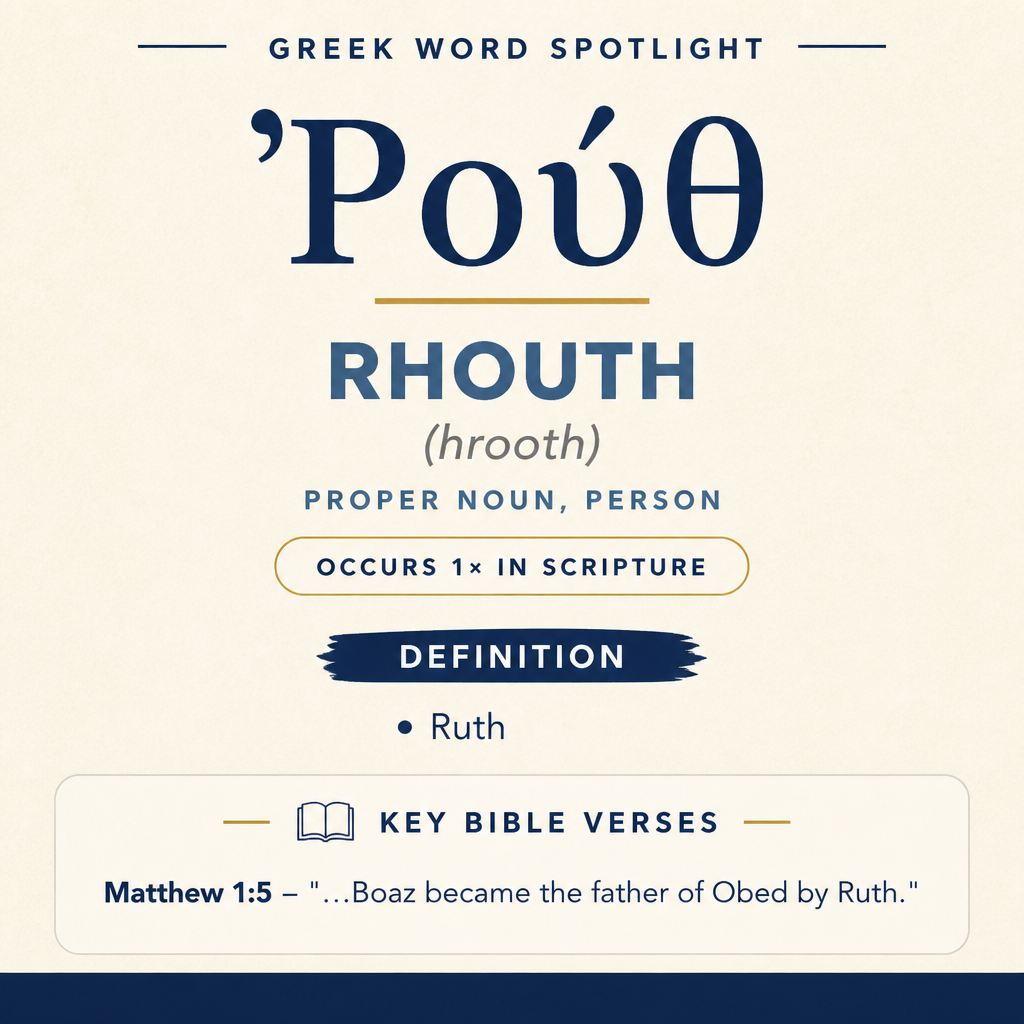
Ῥούθ means Ruth and appears once in Scripture at Matthew 1:5.
Scripture Occurrence
This word occurs 1 time in Scripture. Its single occurrence is in Matthew 1:5.
Learn More →Matthew Genealogy
In Matthew 1:5, Boaz became the father of Obed by Ruth. Obed became the father of Jesse.
Learn More →Ῥούθ means “Ruth” and appears in the New Testament only within a genealogy. In its single attestation, the name marks a maternal link in the line that runs through Boaz, Obed, and Jesse.
Occurrences
“Salmon became the father of Boaz by Rahab. Boaz became the father of Obed by Ruth. Obed became the father of Jesse.” (Matthew 1:5)
Here Ῥούθ functions as a personal name within a chain of parentage statements. The verse presents three successive father–child links (“Salmon … Boaz … Obed … Jesse”), and in two of those links it adds a mother introduced with the preposition “by”: “by Rahab” and “by Ruth.” In the clause where Ῥούθ occurs, the name identifies the woman associated with Boaz in the begetting of “Obed.” The structure is terse and repetitive, and that very terseness is part of what the name contributes: it anchors a specific, remembered mother inside a list otherwise driven by male ancestry.
The placement of Ῥούθ between “Boaz” and “Obed” gives the name a precise genealogical function. The wording does not narrate Ruth’s actions or character; it assigns her a fixed relational role in the lineage. By stating, “Boaz became the father of Obed by Ruth,” the text keeps the paternal formula intact (“became the father of”) while also preserving the maternal identity that accompanies that birth. In the immediate context of this verse, Ruth stands alongside Rahab as another named woman included in the same genealogical rhythm.

Sense and Usage
As a proper name, Ῥούθ designates a particular individual rather than describing a class, quality, or activity. In Matthew 1:5 it operates as an identifier that makes the genealogical statement more specific: Obed is not only traced to Boaz as father but also connected to Ruth as mother. The name therefore functions as a point of recognition—an element that distinguishes this birth from a merely generic entry in a list of descendants.
The verse’s pattern shows how the name is used syntactically. The repeated formula “X became the father of Y” supplies the backbone, and the addition “by [woman’s name]” supplies maternal attribution. Ῥούθ appears in precisely this “by + name” slot. Within that slot, the name is not merely incidental detail; it is integrated into the formal structure of the genealogy, presented in parallel with “Rahab.” That parallelism places Ruth within a small set of women explicitly named in this segment and indicates that her identity is being intentionally preserved as part of the ancestry being traced.
Because the verse moves immediately from Ruth to “Obed” and then to “Jesse,” the name also serves as a hinge between generations. It marks the transition from Boaz’s generation to Obed’s, and in doing so it ties the subsequent line (“Obed … Jesse”) to a remembered maternal figure. Even without additional description, the name carries genealogical weight: it is the means by which the reader can locate the origin of Obed’s birth within the family line.
Imagery
The imagery associated with Ῥούθ in Matthew 1:5 is the imagery of a lineage being spoken aloud: a sequence of names, each joined by the steady cadence of “became the father of.” Within that cadence, “by Ruth” evokes a household moment implied rather than narrated—the birth of Obed within a named mother–father pairing. The verse’s compact list turns the name into a quiet memorial inside the genealogy, a single word that preserves a maternal presence amid successive generations.
Sources: Lexical data from Strong’s Exhaustive Concordance and the Translators Brief Lexicon of Extended Strongs for Greek (STEPBible, CC BY). Occurrence data from the Translators Amalgamated Greek New Testament (STEPBible, CC BY). Scripture quotations from the World English Bible (public domain).




