Exploring the Meaning of Rhetor in Greek
ῥήτωρ means “spokesman” and appears once in Scripture in Acts 24:1.
Acts Context
In Acts 24:1, Ananias came with certain elders and an orator, Tertullus. They informed the.
Learn More →ῥήτωρ means “spokesman,” and it appears in the New Testament in the narrative of Paul’s hearing before a Roman governor. In that setting it designates a particular kind of speech-role within a formal accusation.

Root and Related Words
ῥήτωρ is related to the verb rheō (ἐρέω), “to say” (Strong’s G4483). The relationship places the noun in the sphere of speech as an act: saying, speaking, and the public function that depends on it.

Occurrences
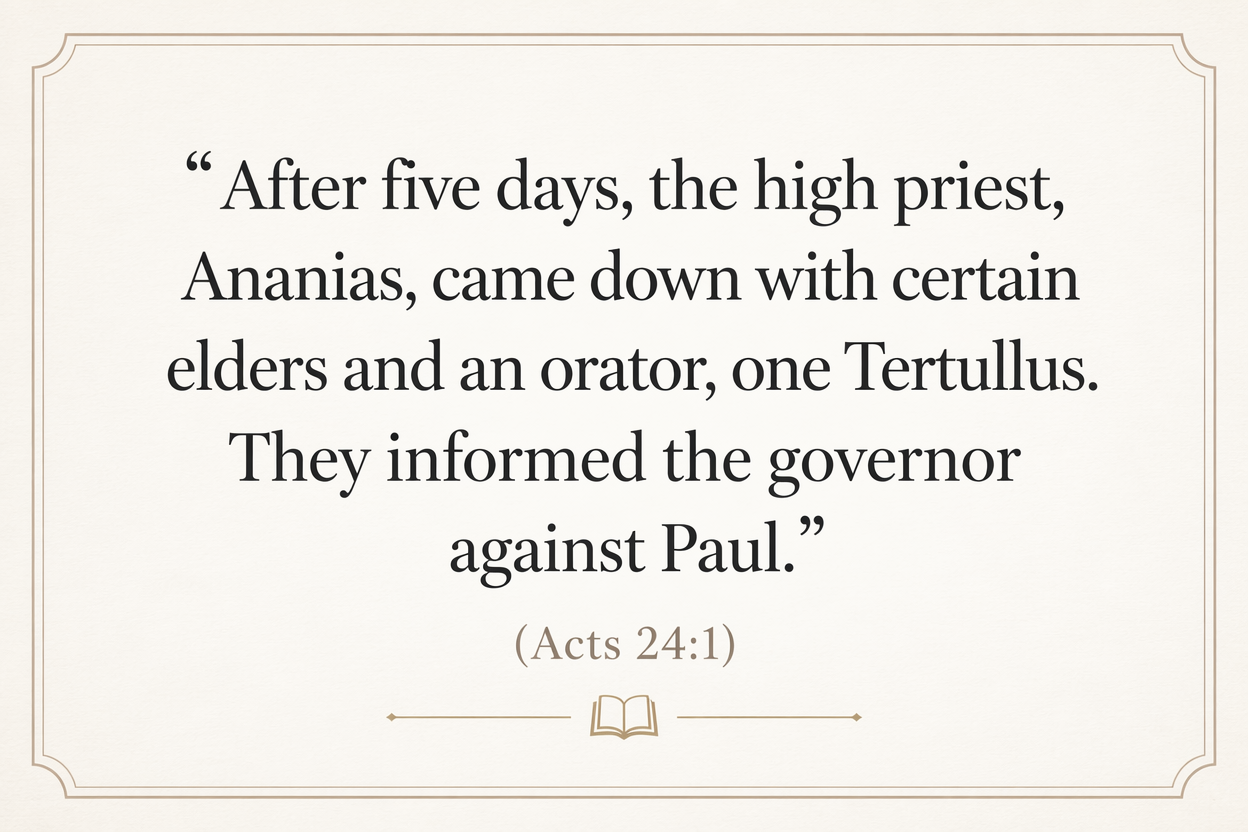
“After five days, the high priest, Ananias, came down with certain elders and an orator, one Tertullus. They informed the governor against Paul.” (Acts 24:1)
In Acts 24:1, ῥήτωρ identifies one member of a delegation that arrives to present a case “against Paul.” The verse gives a compact list: “the high priest, Ananias,” “certain elders,” and “an orator, one Tertullus.” Calling Tertullus a ῥήτωρ marks him out by function rather than by office or rank. Ananias is named by priestly position, the elders by collective standing, and Tertullus by what he does in the moment: he is there to speak on behalf of the accusing party.
The word also helps the reader see how the group intends to proceed before the governor. The leaders “informed the governor against Paul,” and the inclusion of a ῥήτωρ frames that informing as something done through a designated spokesman rather than as an unstructured set of complaints. The noun thus indicates an arranged presentation: one person is set forward as the voice of the group in the official setting suggested by “the governor.” Even within the brief wording of the verse, ῥήτωρ signals that the delegation has prepared not merely facts to report but a public-facing speech role to carry their accusation.
By naming “one Tertullus” immediately after “an orator,” Acts 24:1 attaches ῥήτωρ to a specific individual, not simply to the general idea of speaking. The spokesman is not anonymous; he is introduced as part of the entourage and as a distinct participant in the proceedings. The term therefore contributes to characterization at the level of courtroom-like action: there is an accuser’s side with recognized representatives and a chosen voice for their charge.
Sense and Usage
The definition “spokesman” fits the way ῥήτωρ functions in Acts 24:1: it denotes a person appointed or engaged to speak for others in a formal matter. The immediate context is not casual conversation but an approach to authority—“the governor”—for the purpose of bringing an accusation. In such a context, a spokesman is more than someone who speaks; he is the voice of a party, representing its claims as a unified message.
Several features of the verse sharpen how “spokesman” is to be heard here. First, the spokesman stands alongside recognized community authorities (“the high priest” and “elders”), which suggests that his speaking role complements their institutional roles: they come as leaders, but they also bring someone whose defined contribution is to speak. Second, the spokesman is included as part of a deliberate delegation arriving “after five days,” language that conveys timing and coordination. Third, the action is directed outward—“They informed the governor”—so the spokesman’s role is oriented to an audience with power to act on the report.
The word also clarifies the dynamics of group speech. The verse does not say Tertullus alone informed the governor, but “They informed the governor against Paul.” Yet the naming of “an orator” within the “they” highlights that, within collective action, a group can act through a single voice. ῥήτωρ therefore carries the idea of represented speech: one person speaks, but the speech is socially and procedurally the speech of the group that has brought him.
Because the passage identifies a spokesman by name, ῥήτωρ in this instance functions as a role-title attached to a person in a proceeding. It distinguishes Tertullus from the other members of the delegation without implying a different message; he is part of the same unified effort “against Paul.” The word’s contribution is to bring the rhetoric of representation into view: not merely a complaint, but a complaint presented through someone acting as the group’s voice.
Imagery
Acts 24:1 places ῥήτωρ in a scene of arrival and accusation: leaders come down, stand before a governor, and set forward a spokesman. The word evokes the picture of a formal hearing where speech is delegated—where a case is carried into the public arena not only by status and authority, but by an appointed voice who will do the informing.
Sources: Lexical data from Strong’s Exhaustive Concordance and the Translators Brief Lexicon of Extended Strongs for Greek (STEPBible, CC BY). Occurrence data from the Translators Amalgamated Greek New Testament (STEPBible, CC BY). Scripture quotations from the World English Bible (public domain).