
Exploring the Meaning of Rhegma in Greek
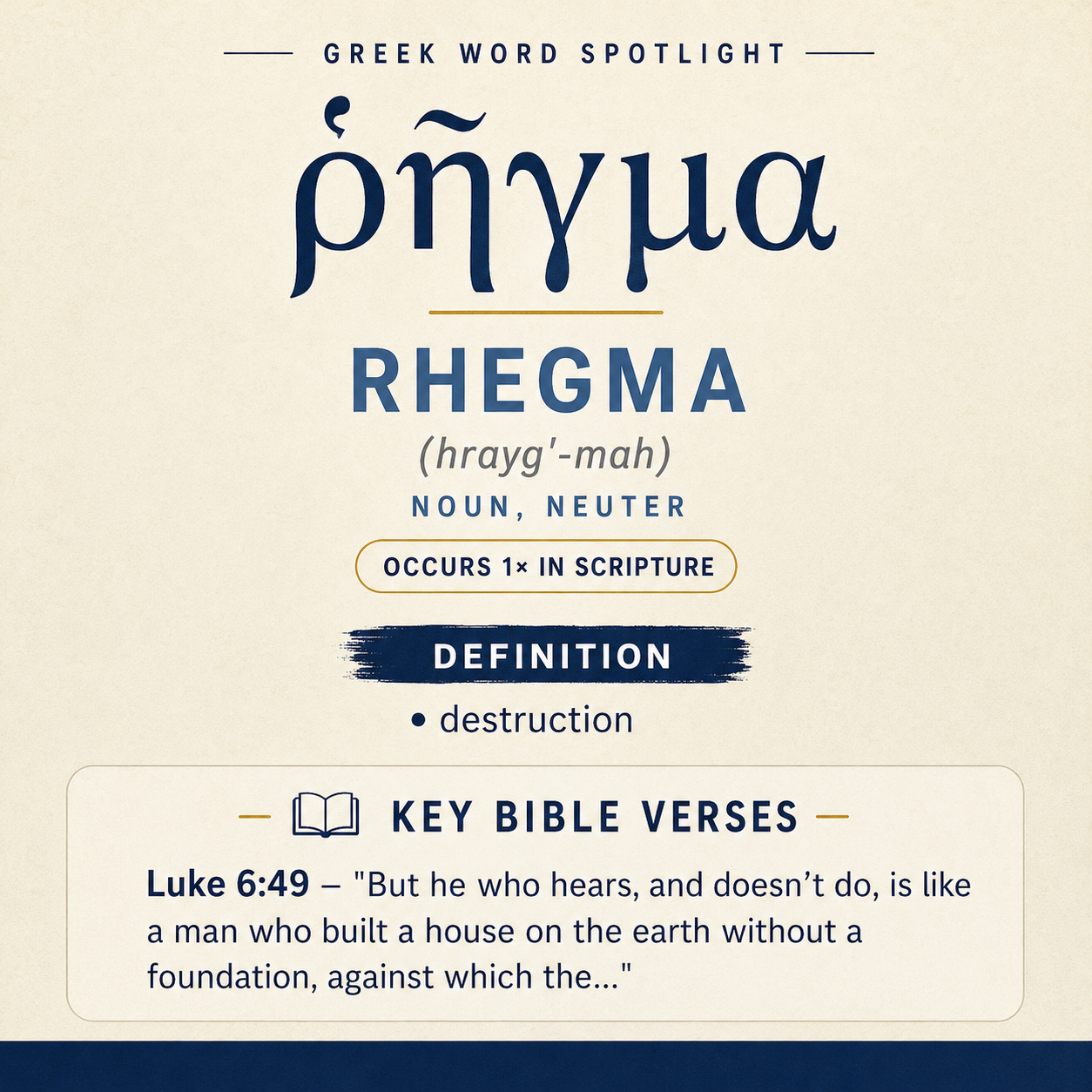
ῥῆγμα means “destruction” and appears once in Scripture, in Luke 6:49.
Scripture Occurrence
This word occurs 1 time in Scripture. Its single reference is Luke 6:49.
Learn More →Verse Context
In Luke 6:49 it describes the destructive outcome for a house built without a foundation.
Learn More →ῥῆγμα means “destruction” and is used once in the New Testament, in Jesus’ closing line of a parable about hearing and doing. In its lone occurrence it names the end-result of collapse, the wreckage that remains when what is built cannot withstand the force set against it.
Root and Related Words
ῥῆγμα is related to rhegnymi (ῥήγνυμι), “to throw violently” (Strong’s G4486). The relationship links the noun to the idea of forceful impact and breaking pressure—language that fits the scene in which a stream strikes a foundationless house.

Occurrences
“But he who hears, and doesn’t do, is like a man who built a house on the earth without a foundation, against which the stream broke, and immediately it fell, and the ruin of that house was great.” (Luke 6:49)
Here ῥῆγμα identifies what is left when the building fails: the “ruin” that follows an immediate fall. The line moves in a tight sequence—hearing without doing; building without a foundation; a stream breaking against the structure; the sudden collapse; then the pronounced outcome, “the ruin of that house was great.” In this narrative logic, ῥῆγμα is not the moment of impact (“the stream broke”) or even the act of falling (“it fell”), but the resulting destruction that can be assessed after the collapse. The adjective “great” intensifies the word’s weight: the destruction is extensive, not a minor crack or partial damage, but a ruin large enough to be recognized as catastrophic within the story.
Because the setting is domestic and concrete—a house placed “on the earth” with “no foundation”—the term lands as an image of total failure at the very point where stability was expected. The mention of a “stream” that “broke” against the house places the destruction within an external test: something comes against the structure, and what follows shows what the building truly was. ῥῆγμα therefore functions as the concluding verdict on the entire comparison: a life that receives words but does not act on them ends in destruction, just as a house built without a foundation ends with a great ruin.
Sense and Usage
With the definition “destruction,” ῥῆγμα in Luke 6:49 serves as a results-word: it names the final state produced by collapse under pressure. The parable’s imagery distinguishes between (1) the decision to build as one chooses, (2) the encounter with a force that exposes the weakness, and (3) the aftermath. ῥῆγμα occupies the third slot, drawing attention to the consequence that remains after the event. That placement matters for how the term works: it is a sober label for what the collapse yields, not merely a vivid description of the collapsing action.
In the sentence, the destruction is measurable—“great”—which suggests destruction as something that can be large in degree. Within the story, the magnitude of the ruin underscores the seriousness of the earlier choices: “hears, and doesn’t do” parallels “built…without a foundation.” The parable is framed in practical building terms (house, earth, foundation, stream), and ῥῆγμα gathers up all those details into a single concluding outcome. The word therefore carries a sense of decisiveness: once the stream has broken against the unsupported structure and it has fallen, the situation is no longer one of risk or warning but of realized destruction.
The choice to name the end as ῥῆγμα also keeps the focus on what failure produces rather than on the force itself. The stream is the immediate pressure, but it is not the final subject of the sentence. The final clause is about the house and its ruin. That grammatical focus makes the destruction belong to the inadequate construction; the house is the object evaluated, and ῥῆγμα is the evaluation’s term. In this way, “destruction” becomes the narrative’s closing image: the visible, undeniable outcome when hearing is separated from doing, and when building is separated from a foundation.
Imagery
Luke 6:49 pairs ῥῆγμα with the picture of water striking a vulnerable structure: “the stream broke, and immediately it fell.” The word evokes the aftermath of such a scene—the scattered remains of what had the outward form of a house but lacked what it needed beneath. By ending with “the ruin of that house was great,” the parable leaves the reader not with the sound of rushing water, but with the sight of destruction as the final, lasting testimony to an ungrounded build.
Sources: Lexical data from Strong’s Exhaustive Concordance and the Translators Brief Lexicon of Extended Strongs for Greek (STEPBible, CC BY). Occurrence data from the Translators Amalgamated Greek New Testament (STEPBible, CC BY). Scripture quotations from the World English Bible (public domain).




