
Exploring the Meaning of Apistos in Greek
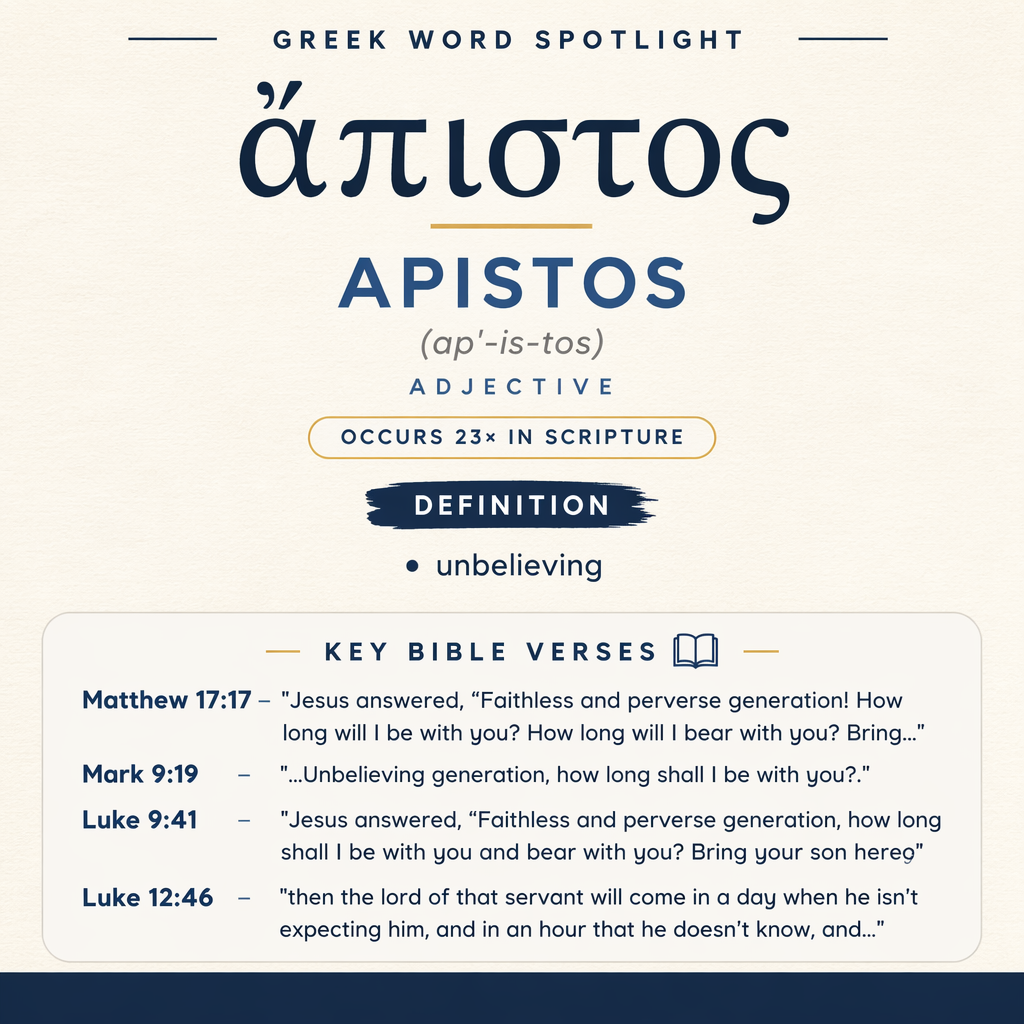
ἄπιστος means “unbelieving” and appears 23 times in Scripture, including Matthew 17:17, Mark 9:19, Luke 9:41, and John 20:27.
Gospel Examples
Jesus addresses an “unbelieving generation” in Matthew 17:17, Mark 9:19, and Luke 9:41. In John 20:27, Jesus tells Thomas, “Don’t” (in context of unbelief).
Learn More →Other Occurrences
The word appears in Acts 26:8 in a question about God raising the dead. In 1 Corinthians 6:6 and 7:12 it refers to “unbelievers,” including an “unbelieving wife.”
Learn More →ἄπιστος expresses the condition of being “unbelieving.” In the passages below it appears both as a sharp description of a whole “generation,” as a direct admonition to an individual, and as a label for people inside household, civic, and table settings where belief becomes socially and morally consequential.
Occurrences
Matthew 17:17: Jesus answered, “Faithless and perverse generation! How long will I be with you? How long will I bear with you? Bring him here to me.”
Here the word is embedded in a public rebuke. The complaint (“How long will I be with you? How long will I bear with you?”) frames unbelief as a persistent, wearying posture in the community Jesus is addressing. The command “Bring him here to me” places that unbelief in the immediate context of a need brought for help: the unbelieving climate is not abstract, but part of the setting in which a suffering person is being brought forward.

Mark 9:19: He answered him, “Unbelieving generation, how long shall I be with you? How long shall I bear with you? Bring him to me.”
Mark’s wording makes the label “Unbelieving” prominent at the start of the address. The repetition of “how long” again presents unbelief as something endured over time. In this scene it functions as a diagnosis of the group’s disposition at the very moment a child is being presented (“Bring him to me”), so unbelief is portrayed as standing in the way of responsive trust when urgent need is present.
Luke 9:41: Jesus answered, “Faithless and perverse generation, how long shall I be with you and bear with you? Bring your son here.”
Luke intensifies the interpersonal angle by specifying “your son.” The term marks the surrounding audience as unbelieving while the narrative focus narrows to a parent and child. The effect is to contrast the community-wide posture (“Faithless and perverse generation”) with Jesus’ immediate readiness to act (“Bring your son here”): the unbelief belongs to the atmosphere of the moment, not to Jesus’ capacity or willingness.
Luke 12:46: then the lord of that servant will come in a day when he isn’t expecting him, and in an hour that he doesn’t know, and will cut him in two, and place his portion with the unfaithful.
In this warning, ἄπιστος identifies a category of people with whom a servant may be “placed” as a punitive outcome. The narrative stresses surprise and accountability (“a day when he isn’t expecting him… an hour that he doesn’t know”), and the servant’s destiny is described spatially and socially—his “portion” is assigned “with the unfaithful.” Unbelief is therefore portrayed not only as an internal stance but as a defining association and share: it marks the company one is allotted when unpreparedness is exposed.
John 20:27: Then he said to Thomas, “Reach here your finger, and see my hands. Reach here your hand, and put it into my side. Don’t be unbelieving, but believing.”
This is the most direct, personal use: an imperative aimed at one disciple. The command is paired with invited inspection (“see my hands… put it into my side”), so “Don’t be unbelieving” is spoken into a moment where tangible evidence is offered. The contrast “but believing” sets unbelief and belief as two opposed stances toward the same presented reality. Here ἄπιστος names a refusal or hesitation in the face of what is shown, and the instruction presses Thomas toward a different posture.
Acts 26:8: Why is it judged incredible with you, if God does raise the dead?
In Paul’s question, unbelief is framed as a judgment: something is “judged incredible.” The focus is not on mere lack of information but on an evaluative response to a claim about God’s action (“if God does raise the dead”). ἄπιστος thus contributes the idea of incredulity within an audience’s reasoning, challenging the plausibility verdict they have rendered.
1 Corinthians 6:6: But brother goes to law with brother, and that before unbelievers!
Here ἄπιστος labels outsiders as the audience before whom believers are exposing internal conflict. The outrage in the exclamation (“and that before unbelievers!”) depends on the social boundary the term marks: these are people characterized as unbelieving, and therefore an inappropriate venue for adjudicating family-like disputes (“brother… with brother”). The word functions to heighten the shame and misplaced appeal implied in taking the matter to court.
1 Corinthians 7:12: But to the rest I—not the Lord—say, if any brother has an unbelieving wife, and she is content to live with him, let him not leave her.
In household instruction, ἄπιστος identifies the spouse who does not share belief, while still being “content to live” with the believing partner. The term sets up a mixed-belief marriage without making the unbelieving spouse the cause for separation; instead, the directive is stability (“let him not leave her”) conditioned on the spouse’s willingness to remain. Unbelief here is relationally significant, but not treated as automatically dissolving the marriage.
1 Corinthians 7:13: The woman who has an unbelieving husband, and he is content to live with her, let her not leave her husband.
This parallel instruction applies the same category to a husband. The repetition shows that ἄπιστος functions symmetrically across gender: the key pastoral factor in the counsel is not who is unbelieving, but whether the unbelieving spouse is “content to live” with the believer. The word marks difference in belief within a shared home, while the command again favors continued union.
1 Corinthians 7:14: For the unbelieving husband is sanctified in the wife, and the unbelieving wife is sanctified in the husband. Otherwise your children would be unclean, but now they are holy.
Here ἄπιστος is repeated for emphasis, naming both husband and wife as possible unbelieving partners. The statement “is sanctified in” assigns a consequential relational status to the unbelieving spouse by virtue of the believing spouse, and the logic extends to children (“Otherwise your children would be unclean, but now they are holy”). In this sentence, the term marks the spouse who lacks belief, yet the household is described in terms of a holiness/cleanness outcome that touches family identity.
1 Corinthians 7:15: Yet if the unbeliever departs, let there be separation. The brother or the sister is not under bondage in such cases, but God has called us in peace.
In contrast to the earlier “content to live,” this verse addresses the case where the unbelieving partner chooses departure. ἄπιστος now appears as “the unbeliever” whose action triggers a different counsel: “let there be separation.” The term helps define responsibility: the believer is “not under bondage in such cases,” and the aim is “peace.” Unbelief here is connected with a decisive relational move—leaving—that alters the obligations of the believing spouse.
1 Corinthians 10:27: But if one of those who don’t believe invites you to a meal, and you are inclined to go, eat whatever is set before you, asking no questions for the sake of conscience.
In a social setting, ἄπιστος characterizes the host: “one of those who don’t believe.” The instruction assumes ordinary interaction is possible (“invites you… you are inclined to go”), and it gives practical guidance about table behavior (“eat whatever is set before you, asking no questions”). The word marks the host as outside the believing community, while the counsel regulates how a believer’s conscience should operate in that mixed setting.

Sense and Usage
Across these passages, “unbelieving” functions in two main ways: as a collective characterization and as a relational identifier.
As a collective characterization, ἄπιστος describes an atmosphere or posture that colors an entire group’s response to God’s activity. In the Synoptic rebukes (Matthew 17:17; Mark 9:19; Luke 9:41), unbelief is addressed as a generational trait that provokes frustration and delay—language of endurance (“How long… bear with you?”) suggests a settled resistance rather than a momentary question. In Acts 26:8, the same posture appears as a cognitive verdict—treating God’s raising of the dead as “incredible”—so unbelief is pictured as a judgment that filters what one will accept as possible. In John 20:27, the term becomes a direct summons away from that posture, pressing a single person to move from unbelief to belief in the presence of offered, concrete demonstration.
As a relational identifier, ἄπιστος names people in proximity to believers—spouses, legal observers, meal hosts—where belief status shapes what is fitting or wise. In 1 Corinthians 6:6, the term draws a boundary around the public sphere: unbelievers are an inappropriate audience for believers’ intra-family disputes. In 1 Corinthians 7:12–15, it marks the spouse who does not share faith; yet the practical guidance turns on the unbelieving spouse’s stance toward continued cohabitation (“content to live” versus “departs”), showing that unbelief alone does not settle the question of staying or separating. In 1 Corinthians 10:27, the unbelieving person is a normal social contact who may host a meal, and the believer’s conduct is directed by conscience rather than suspicion. In each case, ἄπιστος signals a difference in belief that must be reckoned with—sometimes as a warning about public perception, sometimes as a framework for peaceful household decisions, sometimes as a cue for measured participation in ordinary social life.
Imagery and Force
The word carries a strong evaluative edge in Jesus’ speech: an “unbelieving generation” is addressed as burdensome and in need of correction (Matthew 17:17; Mark 9:19; Luke 9:41). The same term can also be quietly descriptive in Paul’s counsel, where “unbelieving” marks the other party in marriage or hospitality without making them untouchable (1 Corinthians 7:12–15; 10:27). Luke 12:46 gives the term a stark, judicial coloring: to be classed “with the unfaithful” is to receive an allotted “portion” among a defined group under judgment. Taken together, these scenes show ἄπιστος operating both as an indictment of a resisting stance and as a practical label for those outside the circle of belief who still share courts, homes, and tables with believers.
Sources: Lexical data from Strong’s Exhaustive Concordance and the Translators Brief Lexicon of Extended Strongs for Greek (STEPBible, CC BY). Occurrence data from the Translators Amalgamated Greek New Testament (STEPBible, CC BY). Scripture quotations from the World English Bible (public domain).




