Exploring the Meaning of Prosergazomai in Greek
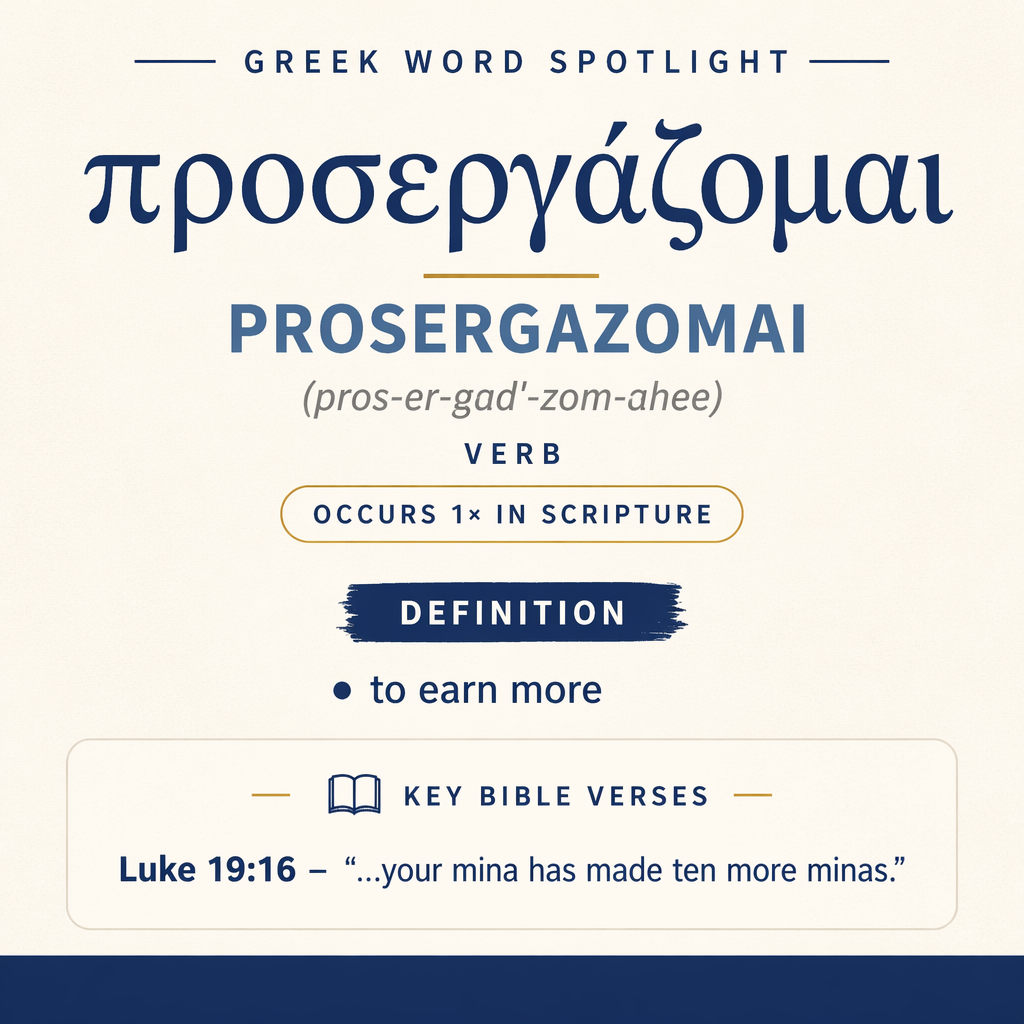
προσεργάζομαι means “to earn more” and appears once in Scripture in Luke 19:16.
Verse Context
In Luke 19:16, the first servant reports, “your mina has made ten more minas.”
Learn More →Prosergazomai means “to earn more” and appears in the report of gains in Jesus’ parable of the minas. In its lone New Testament occurrence, it describes an increase produced from what was entrusted.
Root and Related Words
Prosergazomai is formed from ergazomai (ἐργάζομαι), “to work” (Strong’s G2038), together with pros (πρός), “to/with” (Strong’s G4314). The combination presents the idea of work directed toward an added result.

Occurrences
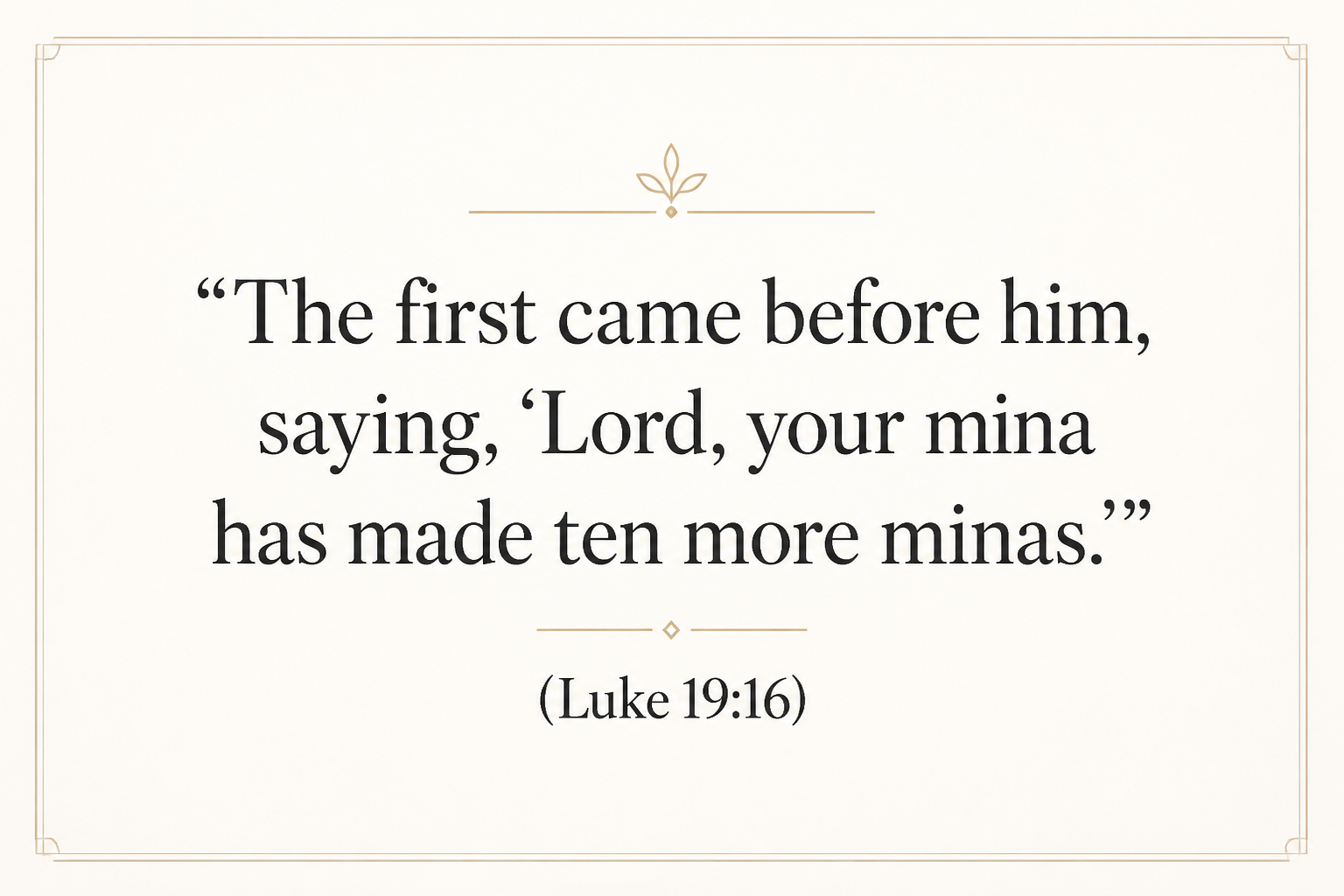
“The first came before him, saying, ‘Lord, your mina has made ten more minas.’” (Luke 19:16)
In this line the servant addresses his master directly (“Lord”) and points to the entrusted sum as the agent of increase: “your mina has made ten more minas.” Prosergazomai frames the servant’s report as an outcome that can be counted and displayed—an added amount that now exists because something has been done with what was given. The statement focuses on gain that is specifically additional (“ten more minas”), not merely activity or effort; the result is measurable multiplication of the original trust.
The wording also keeps ownership in view. The servant does not call it “my mina,” but “your mina,” and yet it “has made” more. Prosergazomai thus serves the servant’s accounting: what belongs to the master has produced further value that can be returned to him. The verb’s force, in context, is not about possessing profit as a private reward but about presenting an increase connected to the master’s property and the servant’s handling of it.
Sense and Usage
Because prosergazomai occurs only here, its sense is read from the immediate narrative function of a financial report. The scene is a reckoning: a servant “came before him” and presents a summary of what happened to an entrusted mina. Prosergazomai, “to earn more,” fits that setting by expressing gain that is the product of engagement with what was received. It is not a vague improvement but an addition that can be enumerated (“ten more minas”), which implies an increase beyond the starting amount.
The phrase “has made” places the increase on the far side of a process. The servant’s sentence compresses the work into its outcome, highlighting the completed result rather than describing the steps. In that way, prosergazomai carries an accounting tone: the servant offers a bottom-line figure that answers the implied question, “What came of what you entrusted?” The verb supports the parable’s emphasis on responsibility with delegated resources by specifying that the faithful handling of a mina is expected to yield an added return.
At the same time, the servant’s formulation “your mina” keeps the gain tethered to the master’s interest. Prosergazomai does not introduce a new owner; it describes an increase that accrues to what is already the master’s. The servant’s success is therefore expressed as the master’s asset having generated more assets, which is fitting for a master-servant relationship in which the servant’s role is stewardship and reporting.
Imagery
Luke 19:16 presents the image of a servant standing before his lord with a clear, numeric increase: one mina yielding “ten more minas.” Prosergazomai contributes the picture of added units appearing on the balance sheet of what was entrusted—tangible, countable gain that can be laid before the master in a single sentence.
Sources: Lexical data from Strong’s Exhaustive Concordance and the Translators Brief Lexicon of Extended Strongs for Greek (STEPBible, CC BY). Occurrence data from the Translators Amalgamated Greek New Testament (STEPBible, CC BY). Scripture quotations from the World English Bible (public domain).