
Exploring the Meaning of Proserchomai in Greek
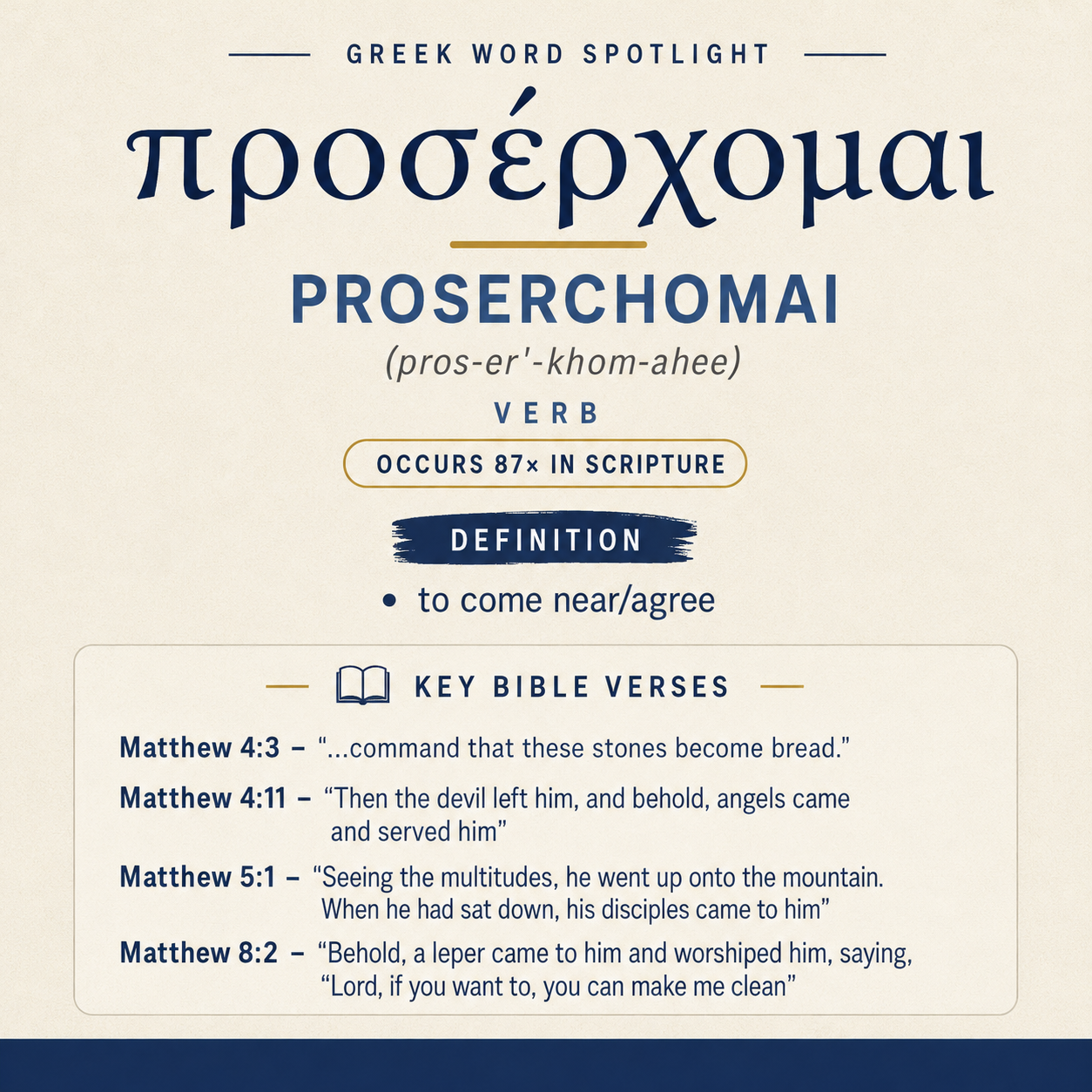
προσέρχομαι means “to come near/agree” and appears 87 times in Scripture, including Matthew 4:3–9:14.
Core Meaning
προσέρχομαι means “to come near/agree.” In Matthew’s Gospel, it describes people coming to Jesus.
Learn More →Matthew Examples
In Matthew 4:3 the tempter came and spoke to Jesus; in Matthew 4:11 angels came and served him. In Matthew 8:2 a leper came and worshiped him, asking to be made clean.
Learn More →Asking and Pleading
In Matthew 8:25 the disciples came to Jesus, woke him, and pleaded for rescue. In Matthew 9:14 John’s disciples came with a question about fasting.
Learn More →Proserchomai expresses the action of coming near, often marking a purposeful approach in scenes of testing, appeal, instruction, and urgent request. In the selected Gospel contexts, it regularly frames who initiates contact and what kind of response or conversation that approach seeks to bring about.
Occurrences
Matthew 4:3 — “The tempter came and said to him, “If you are the Son of God, command that these stones become bread.””
Here the verb depicts an approach that is immediately verbal and challenging: the tempter closes distance in order to press a conditional claim (“If you are the Son of God”) and to propose an action. The coming near sets the confrontation in motion and positions the speaker as one attempting to draw agreement to a demand.
Matthew 4:11 — “Then the devil left him, and behold, angels came and served him.”
The approach of the angels is paired with their service. The coming near is not simply arrival; it is closeness that enables care. In this scene, the verb frames supportive presence after the departure of the devil, highlighting a shift in who approaches Jesus and for what purpose.
Matthew 5:1 — “Seeing the multitudes, he went up onto the mountain. When he had sat down, his disciples came to him.”
The disciples’ coming near follows Jesus’ deliberate positioning (“went up onto the mountain” and “had sat down”). Their approach gathers them to him as a teacher in a setting prepared for instruction. The verb emphasizes the movement toward Jesus as the focal point once he is seated.
Matthew 8:2 — “Behold, a leper came to him and worshiped him, saying, “Lord, if you want to, you can make me clean.””
The leper’s approach is bold and reverent: he comes near and worships, then speaks a request conditioned not on ability but on willingness (“if you want to”). The verb anchors the scene’s personal appeal—approach, homage, and petition belong together as one movement toward Jesus.
Matthew 8:5 — “When he came into Capernaum, a centurion came to him, asking him,”
This occurrence sets two movements side by side: Jesus’ entry into a place and then the centurion’s approach to Jesus. The centurion comes near with a request (“asking him”), so the verb signals an intentional step forward by someone seeking help through direct contact.
Matthew 8:19 — “A scribe came, and said to him, “Teacher, I will follow you wherever you go.””
The scribe’s coming near is presented as a voluntary initiative that expresses commitment. The approach culminates in speech—addressing Jesus as “Teacher” and offering to follow “wherever you go.” The verb therefore marks an approach aiming at alignment and consent to a future course.
Matthew 8:25 — “They came to him, and woke him up, saying, “Save us, Lord! We are dying!””
Here the coming near is urgent and intrusive: the speakers approach closely enough to wake Jesus. The verb conveys more than proximity; it frames a desperate appeal for rescue, voiced with compressed urgency (“Save us, Lord!”) and fear (“We are dying!”).
Matthew 9:14 — “Then John’s disciples came to him, saying, “Why do we and the Pharisees fast often, but your disciples don’t fast?””
John’s disciples approach to raise a pointed question about religious practice. The movement toward Jesus opens a discussion that compares groups (“we and the Pharisees” versus “your disciples”). The verb marks the initiation of inquiry that implicitly seeks explanation and, potentially, agreement about proper conduct.
Matthew 9:20 — “Behold, a woman who had a discharge of blood for twelve years came behind him, and touched the fringe of his garment;”
The woman’s coming near is discreet (“came behind him”) and enacted through touch rather than speech. The verb highlights her intentional movement into closeness sufficient to reach “the fringe of his garment.” In this scene, coming near is the decisive precondition for the physical act that expresses her appeal.
Matthew 9:28 — “When he had come into the house, the blind men came to him. Jesus said to them, “Do you believe that I am able to do this?” They told him, “Yes, Lord.””
The blind men’s approach takes place once Jesus is inside a house, indicating a direct seeking-out of him in a more private setting. Their coming near elicits Jesus’ question about belief in his ability, and their reply (“Yes, Lord”) shows that the approach aims at a response that includes affirmation. The verb thus frames a relational encounter: they approach, he probes their trust, and they agree.
Matthew 13:10 — “The disciples came, and said to him, “Why do you speak to them in parables?””
This is another approach by disciples, but now for clarification. Their coming near initiates a question about Jesus’ method of speaking (“in parables”). The verb sets the posture of learners seeking understanding through direct access to the teacher.
Matthew 13:27 — “The servants of the householder came and said to him, ‘Sir, didn’t you sow good seed in your field? Where did these darnel weeds come from?’”
The servants’ coming near occurs within a household or estate context and leads to a report framed as questions. Their approach is motivated by perceived inconsistency—good seed versus the presence of “darnel weeds.” The verb highlights the act of bringing a problem to the one responsible, seeking explanation and resolution through direct address.

Sense and Usage
Across these passages, Proserchomai consistently marks an approach that is purposeful: people (and angels) come near in order to speak, ask, worship, touch, wake, or serve. The scenes show that coming near is often the hinge between a situation and the interaction that addresses it. In Matthew 4:3 the approach initiates pressure toward compliance; in Matthew 4:11 it enables assistance. In Matthew 5:1 and 13:10 the disciples’ repeated approaching portrays access to instruction and explanation, suggesting that coming near can be the ordinary gesture of learners toward their teacher.
The verb also carries social and emotional weight depending on the one who approaches and what they do upon arrival. A leper comes near and worships while voicing a conditional request (Matthew 8:2), and a centurion comes near “asking” (Matthew 8:5); both are framed as respectful approaches seeking help. A scribe comes near to declare willingness to follow (Matthew 8:19), which casts the approach as a bid for acceptance and shared direction. By contrast, the group who wakes Jesus (Matthew 8:25) approaches under the pressure of immediate peril; the closeness required to rouse him underscores the intensity of their plea.
Several occurrences show that coming near can be either open and verbal or quiet and embodied. The woman in Matthew 9:20 approaches “behind him” and acts by touching his garment, demonstrating that coming near may be the decisive step even when words are absent. The blind men in Matthew 9:28 approach and then answer Jesus’ question with agreement (“Yes, Lord”), showing a pattern in which approach can lead into explicit assent. In Matthew 9:14 and 13:27, those who come near do so to ask questions that probe reasons—about fasting practices or about the appearance of weeds—so the approach functions as the gateway to explanation and, potentially, to shared understanding.
Imagery
In these scenes, coming near is pictured in concrete actions: closing distance to speak (Matthew 4:3), drawing close enough to serve (Matthew 4:11), gathering around a seated teacher (Matthew 5:1), kneeling in worshipful appeal (Matthew 8:2), moving forward to ask (Matthew 8:5), stepping up to pledge loyalty (Matthew 8:19), pushing close to wake someone asleep (Matthew 8:25), approaching to question a practice (Matthew 9:14), slipping in from behind to touch a garment (Matthew 9:20), coming into a house to seek help and affirm belief (Matthew 9:28), and bringing a perplexing problem to an owner (Matthew 13:27). The verb’s repeated use in varied settings ties together a recurring Gospel image: decisive approach that opens the moment of request, clarification, care, or confrontation.
Sources: Lexical data from Strong’s Exhaustive Concordance and the Translators Brief Lexicon of Extended Strongs for Greek (STEPBible, CC BY). Occurrence data from the Translators Amalgamated Greek New Testament (STEPBible, CC BY). Scripture quotations from the World English Bible (public domain).





