
Exploring the Meaning of Prosagoreuo in Greek
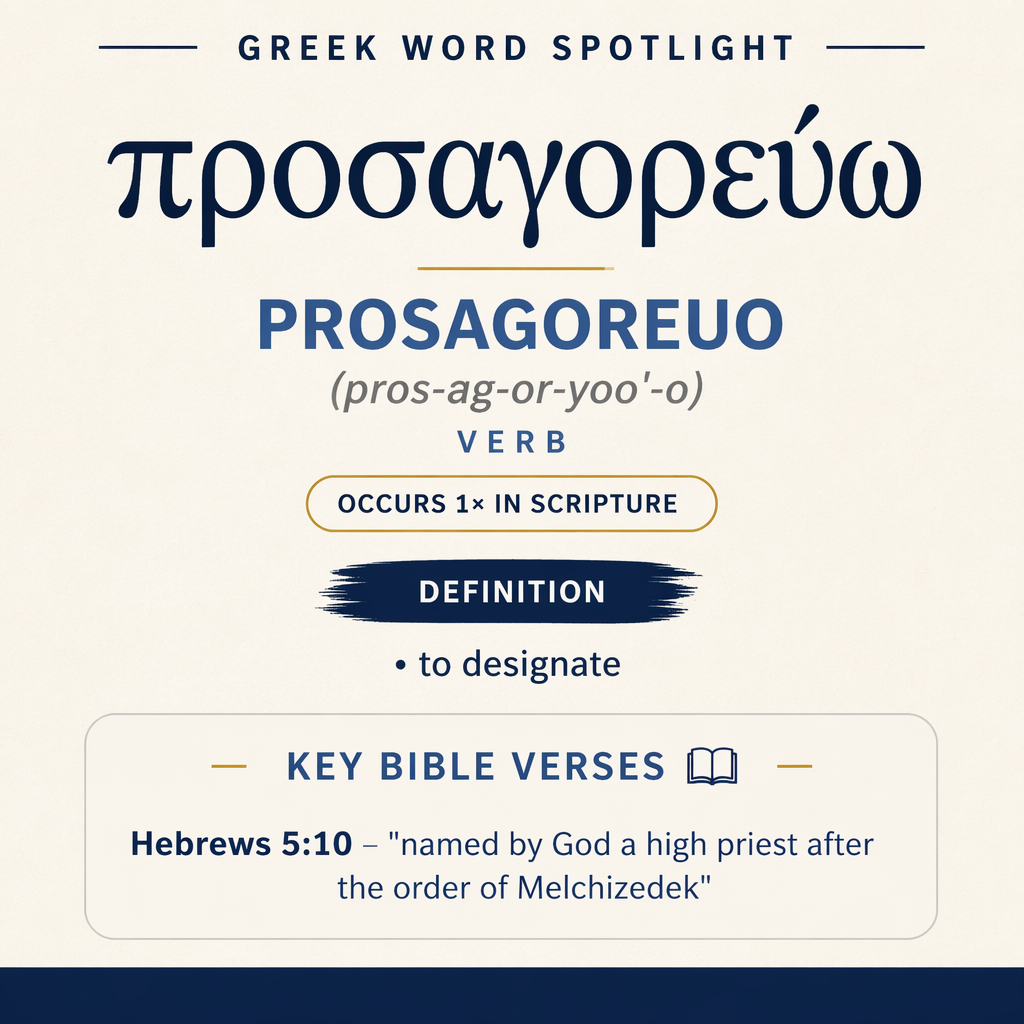
προσαγορεύω means “to designate” and appears once in Scripture, in Hebrews 5:10.
Scripture Occurrence
This word occurs 1 time in Scripture. Its single occurrence is in Hebrews 5:10.
Learn More →Verse Context
In Hebrews 5:10, it is used of being named by God a high priest after the order of Melchizedek.
Learn More →προσαγορεύω means “to designate.” It appears once, in Hebrews 5:10, where it frames how God identifies Christ’s priestly status.
Root and Related Words
Prosagoreuo is connected with πρός (pros), “to/with” (Strong’s G4314), and ἀγορά (agora), “marketplace” (Strong’s G58). Together these related elements evoke the idea of addressing or marking someone in relation to others—language suited to public recognition and formal naming.

Occurrences
“named by God a high priest after the order of Melchizedek.” (Hebrews 5:10)
In Hebrews 5:10, the verb carries the weight of a formal act: God “named” (designated) someone “a high priest.” The line does not describe a private opinion or an informal label; it presents a decisive identification that comes “by God.” The designation is specific in content—“a high priest”—and specific in pattern—“after the order of Melchizedek.” In this sentence, prosagoreuo functions to connect the subject (God) to a concrete appointment expressed in a title and a defined order. The action is not merely that Christ performs priestly work; it is that God assigns and states what he is in relation to priesthood.
The phrasing also makes the designation directional: it moves from God to the one designated, and it results in a recognized status within an established category (“high priest”) and within a particular lineage or arrangement (“after the order of Melchizedek”). Prosagoreuo thus marks the moment where priesthood is not only described but officially attached to the person in view. The emphasis in the clause falls on the authority of the one who designates (“by God”) and on the content of what is designated (“a high priest …”).
Sense and Usage
The single attestation in Hebrews 5:10 shows how “to designate” works when the designation is a conferral of role. The sense is not simply pointing out a trait but assigning a recognized identity that governs how the person is to be regarded. In the verse, the designation is expressed as a predicate (“a high priest”), so the verb serves as a bridge between the person and an office.
Because the designation is “by God,” the verb carries an implied firmness: the status depends on the designator’s authority rather than on human acknowledgment. The verse also binds the designation to a defined model (“after the order of Melchizedek”), so prosagoreuo here does not name in a vague way; it designates with reference to a particular kind of priesthood. In this setting, “designate” is an act that situates someone within a structured framework, identifying not only what the person is called but the order according to which that calling is understood.
The connections of the word with πρός (“to/with”) and ἀγορά (“marketplace”) help illuminate why such a verb fits this context. Designation often operates in the sphere of public recognition—language spoken toward someone and about someone in a way that establishes how they are known among others. Hebrews 5:10 uses that kind of speech-act in a theological register: God’s naming is the decisive speech that sets the terms of Christ’s priestly identity.
Imagery
The imagery in Hebrews 5:10 is that of authoritative naming: God speaks, and a role is assigned—“a high priest.” Prosagoreuo evokes the scene of a title being placed upon a person with clarity and finality, with the added contour that the title is defined “after the order of Melchizedek,” as though the designation points to a particular pattern that shapes the office named.
Sources: Lexical data from Strong’s Exhaustive Concordance and the Translators Brief Lexicon of Extended Strongs for Greek (STEPBible, CC BY). Occurrence data from the Translators Amalgamated Greek New Testament (STEPBible, CC BY). Scripture quotations from the World English Bible (public domain).




