
Exploring the Meaning of Sabbaton in Greek
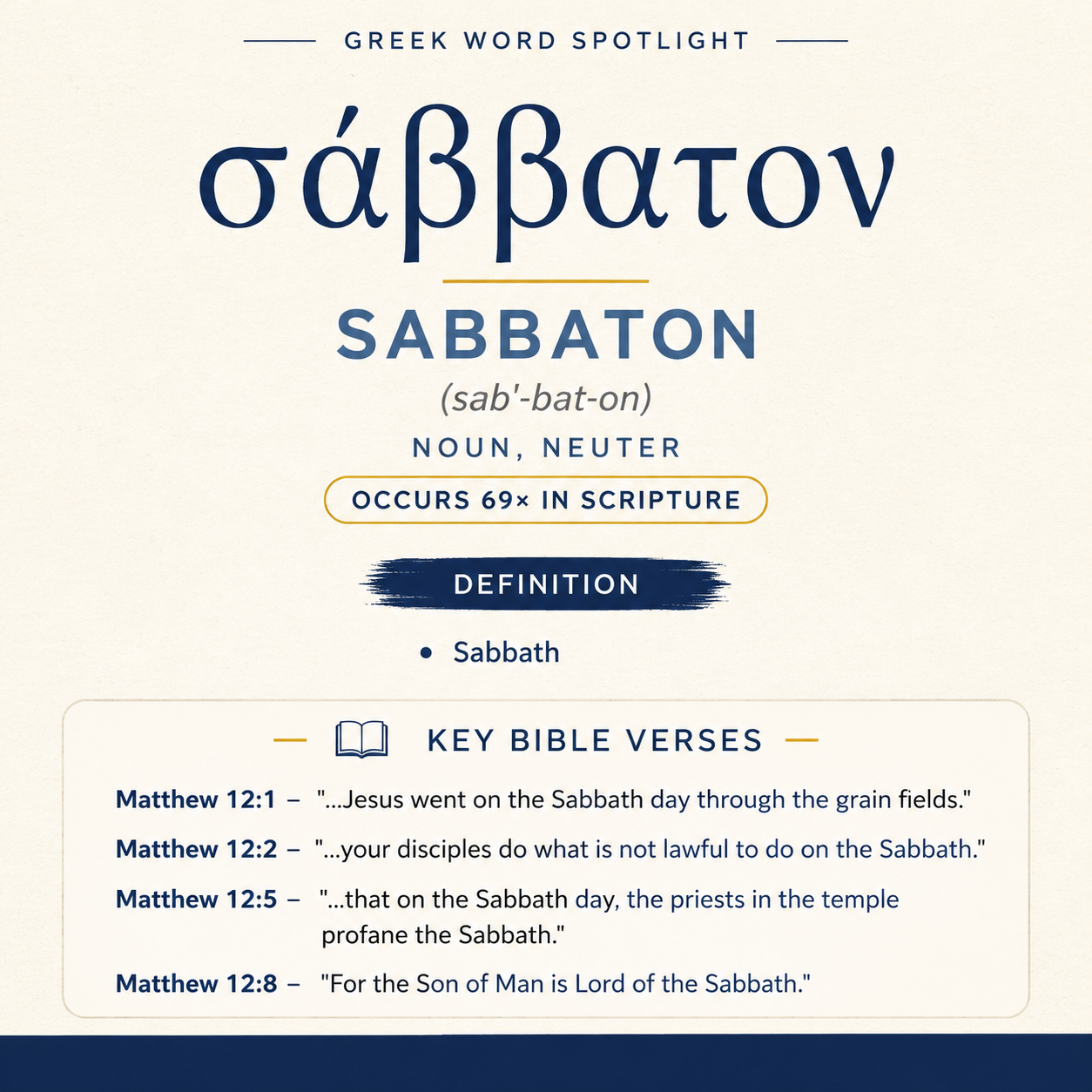
σάββατον (Sabbaton) means “Sabbath” and appears 69 times in Scripture, including in Matthew 12:1–12 and Matthew 24:20.
Matthew 12 Usage
In Matthew 12:1–12, σάββατον frames disputes about what is lawful on the Sabbath day. These include plucking grain and healing on the Sabbath.
Learn More →Other Reference
Matthew 24:20 includes σάββατον in the prayer that flight would not be on a Sabbath. This shows the term used in an eschatological warning context.
Learn More →σάββατον means “Sabbath.” In these passages it marks a specific day that shapes travel plans, worship setting, and disputes about what actions are lawful or fitting.
Occurrences
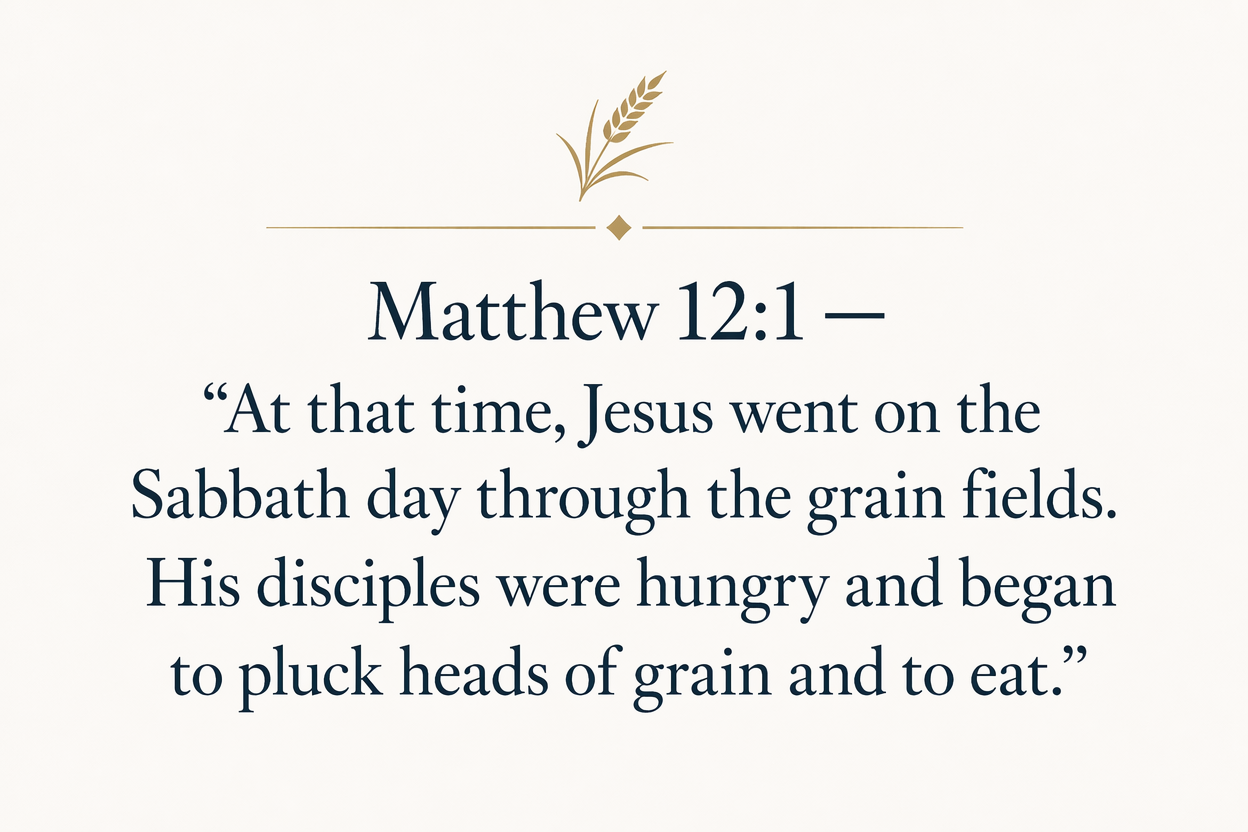
Matthew 12:1 — “At that time, Jesus went on the Sabbath day through the grain fields. His disciples were hungry and began to pluck heads of grain and to eat.”
Here σάββατον sets the time frame for ordinary movement (“went… through the grain fields”) and an act driven by need (“were hungry… pluck… and to eat”). The day’s identity is not incidental: the narrative expects the reader to understand that the disciples’ simple act of gathering food will be evaluated differently because it happens “on the Sabbath day.”
Matthew 12:2 — “But the Pharisees, when they saw it, said to him, “Behold, your disciples do what is not lawful to do on the Sabbath.””
σάββατον becomes the basis of an accusation. The Pharisees’ complaint hinges on lawfulness, and the Sabbath functions as the stated boundary: the same deed is framed as “not lawful” specifically “on the Sabbath.” The word thus carries a social and legal force in the scene, defining what observers expect to be permitted.
Matthew 12:5 — “Or have you not read in the law, that on the Sabbath day, the priests in the temple profane the Sabbath, and are guiltless?”
In this saying, σάββατον is paired with temple service and priestly activity. The line uses a striking juxtaposition: “profane the Sabbath” yet “are guiltless.” The Sabbath is treated as a day with sanctity that could be violated, but the example also shows that within the law itself there are recognized activities that look like infringement yet do not incur guilt.
Matthew 12:8 — “For the Son of Man is Lord of the Sabbath.”
σάββατον is the object of a claim of authority. The statement does not merely discuss what may or may not be done; it asserts that the Son of Man stands in a governing relation to the Sabbath. In context with the surrounding disputes, the word gathers up the whole question of how this day is to be understood and who has the right to speak decisively about it.
Matthew 12:10 — “And behold there was a man with a withered hand. They asked him, “Is it lawful to heal on the Sabbath day?” that they might accuse him.”
σάββατον frames a test question. The presence of a man in need (“withered hand”) is set beside the opponents’ concern for legal categories (“Is it lawful…?”), and the stated motive (“that they might accuse him”) shows that Sabbath observance is being used as a means of scrutiny. The day becomes a courtroom-like setting in which an act of mercy is weighed under the rubric of lawfulness.
Matthew 12:11 — “He said to them, “What man is there among you, who has one sheep, and if this one falls into a pit on the Sabbath day, won’t he grab on to it, and lift it out?”
Here σάββατον is placed within a practical scenario: an animal in danger and an instinctive rescue. The question assumes that even on the Sabbath a person will act to save a valuable sheep. The Sabbath remains a real boundary (“on the Sabbath day”), yet the illustration highlights that the day is lived in concrete circumstances where immediate action can be expected.
Matthew 12:12 — “Of how much more value then is a man than a sheep! Therefore it is lawful to do good on the Sabbath day.”
σάββατον is the time marker for a moral conclusion. The logic moves from animal rescue to human value, and then to a general principle: “lawful to do good on the Sabbath day.” The word thus anchors a positive statement about permissible action—good deeds are not portrayed as exceptions snuck past the Sabbath, but as actions that can be affirmed as lawful within it.
Matthew 24:20 — “Pray that your flight will not be in the winter, nor on a Sabbath,”
σάββατον appears as a practical constraint on movement in a time of urgency (“your flight”). Alongside “in the winter,” the Sabbath is treated as a circumstance that would complicate escape. The word contributes the idea of a day whose normal patterns and restrictions matter even when the concern is rapid travel and survival.
Matthew 28:1 — “Now after the Sabbath, as it began to dawn on the first day of the week, Mary Magdalene and the other Mary came to see the tomb.”
σάββατον functions as a boundary between time periods: “after the Sabbath” and then “the first day of the week.” The word helps locate the visit to the tomb in relation to the completed Sabbath. It serves narrative sequencing, marking the transition from the Sabbath’s conclusion to the beginning of a new day as dawn arrives.
Mark 1:21 — “They went into Capernaum, and immediately on the Sabbath day he entered into the synagogue and taught.”
σάββατον here links Sabbath to synagogue gathering and teaching. The day is when Jesus “entered into the synagogue and taught,” suggesting a customary time for communal assembly. The word gives the scene its setting: a synagogue on the Sabbath, with instruction taking place as part of the day’s activities.
Mark 2:23 — “He was going on the Sabbath day through the grain fields, and his disciples began, as they went, to pluck the ears of grain.”
σάββατον again frames travel through grain fields and the disciples’ plucking of grain, but Mark narrates it with a sense of movement (“as they went”). The day name prepares for conflict by placing an everyday action within a context where it will be judged. The Sabbath is thus presented as a day that accompanies ordinary walking yet carries heightened scrutiny for what is done along the way.
Mark 2:24 — “The Pharisees said to him, “Behold, why do they do that which is not lawful on the Sabbath day?””
σάββατον anchors the Pharisees’ challenge in a question (“why…?”) rather than a flat accusation. The core issue remains lawfulness, and the Sabbath is the decisive condition: the objection is not simply about the act but about the act “on the Sabbath day.” The word therefore stands at the center of a dispute about the meaning of lawful practice within the day’s boundaries.

Sense and Usage
Across these occurrences, σάββατον consistently names a day that matters in public, observable ways: where people go, what they do, and how those actions are evaluated by others. It is the day on which teaching occurs in the synagogue (Mark 1:21), and it is also a day that becomes a flashpoint for debate when ordinary needs—hunger in the fields (Matthew 12:1; Mark 2:23) or the impulse to rescue an animal (Matthew 12:11)—intersect with communal expectations about what is lawful (Matthew 12:2; Mark 2:24).
The word also bears legal and moral weight. Several lines explicitly pose the question of lawfulness “on the Sabbath day” (Matthew 12:2, 12:10), and one draws a general conclusion about the day: “Therefore it is lawful to do good on the Sabbath day” (Matthew 12:12). Another statement, “the priests in the temple profane the Sabbath, and are guiltless” (Matthew 12:5), places the Sabbath within a framework where actions can be described as profaning yet still be guiltless, showing that the day’s sanctity and the assessment of guilt are discussed together rather than assumed to align automatically in every case.
σάββατον further functions as a boundary marker in time and planning. In Matthew 28:1 it divides “after the Sabbath” from “the first day of the week,” helping the reader track when the women approach the tomb. In Matthew 24:20 it appears as a condition that could hinder “flight,” placed alongside winter as a complicating circumstance. In these uses, the Sabbath is not only an object of debate but a real-world constraint that shapes how events are timed and how movement is imagined.
Finally, one occurrence places σάββατον under an explicit claim of authority: “For the Son of Man is Lord of the Sabbath” (Matthew 12:8). Within the cluster of disputes and questions, this line frames the Sabbath not merely as a regulation to be argued about but as a day over which lordship is asserted, supplying a controlling perspective on the conflicts narrated around it.
Imagery
In these passages, σάββατον is pictured through recurring scenes: walking through grain fields with hungry disciples (Matthew 12:1; Mark 2:23), a synagogue where teaching occurs (Mark 1:21), and a moment where healing is debated in the presence of visible need (Matthew 12:10). The word also evokes thresholds—“after the Sabbath” at dawn (Matthew 28:1)—and practical obstacles to urgent travel (Matthew 24:20). These images keep the Sabbath concrete: a day encountered in fields, in gathered worship, in acts of help, and at the turning of the week.
Sources: Lexical data from Strong’s Exhaustive Concordance and the Translators Brief Lexicon of Extended Strongs for Greek (STEPBible, CC BY). Occurrence data from the Translators Amalgamated Greek New Testament (STEPBible, CC BY). Scripture quotations from the World English Bible (public domain).




