Exploring the Meaning of Posos in Greek
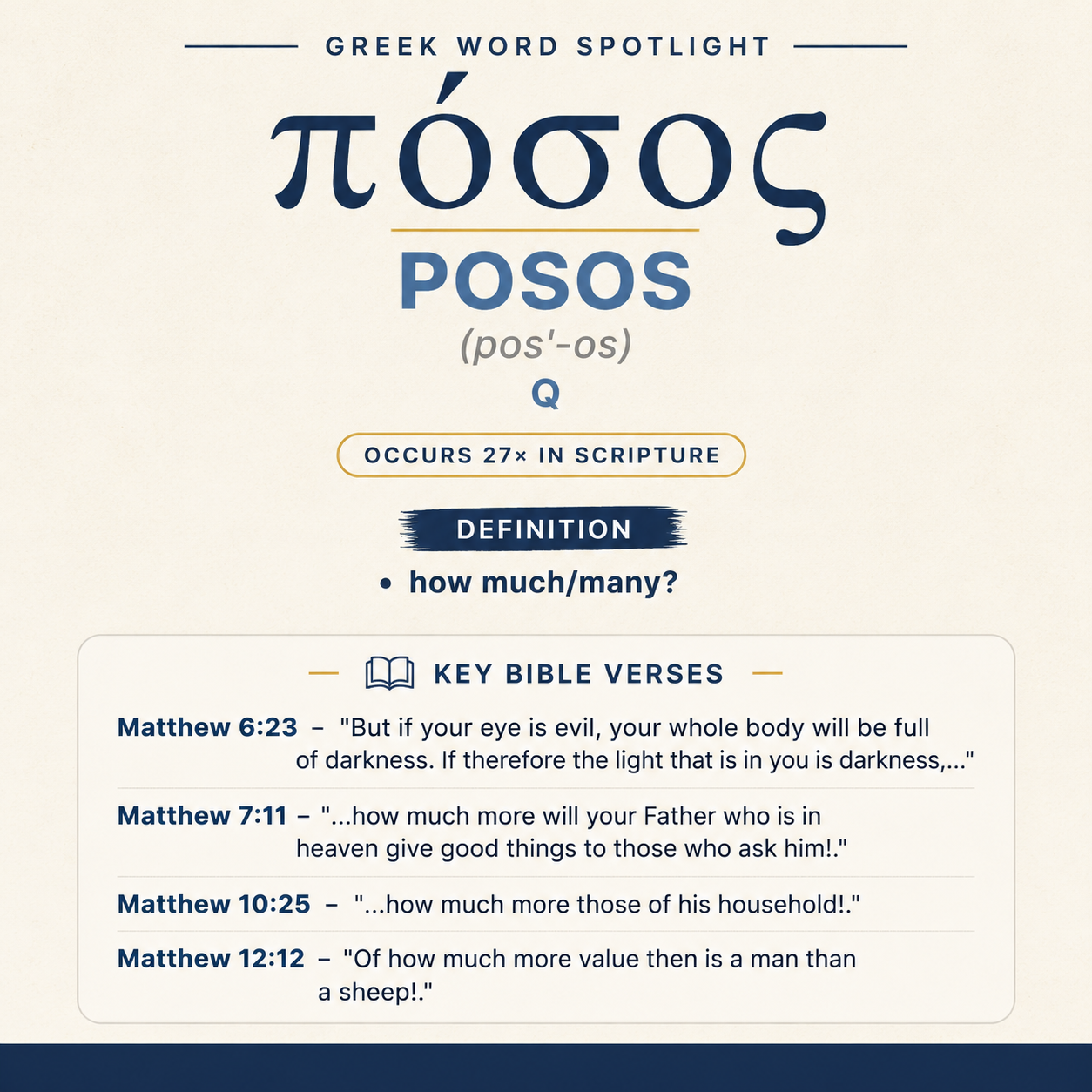
πόσος means “how much/many?” and occurs 27 times in Scripture, including multiple uses in Matthew.
Core Meaning
πόσος asks a question of quantity: “how much/many?” In Matthew it introduces comparisons and counts.
Learn More →Matthew Questions
In Matthew 15:34 Jesus asks, “How many loaves do you have?” It also appears in Matthew 16:9–10 about how many baskets were taken up.
Learn More →Comparative Force
Matthew uses πόσος in “how much more” reasoning (Matthew 7:11; 12:12). It also appears in Matthew 27:13 about how many things testified against Jesus.
Learn More →πόσος asks a question of quantity or extent—“how much/many?”—and it appears in a range of Gospel scenes: probing questions, pointed comparisons, and emphatic exclamations. In these passages it measures darkness and value, counts loaves and baskets, and underscores the weight of testimony.
Occurrences
Matthew 6:23 — “But if your eye is evil, your whole body will be full of darkness. If therefore the light that is in you is darkness, how great is the darkness!”
Here πόσος heightens an exclamation about degree: it does not merely state that darkness exists, but presses the reader to reckon with the magnitude of it—“how great.” The line makes quantity serve moral and spiritual perception: the measure of darkness matches the condition described (“your eye is evil”).
Matthew 7:11 — “If you then, being evil, know how to give good gifts to your children, how much more will your Father who is in heaven give good things to those who ask him!”
πόσος drives an argument from lesser to greater by comparing amounts: if flawed human parents give, the Father’s giving is presented as surpassing that. The question-form (“how much more”) functions rhetorically to intensify confidence in the Father’s generosity within the asking scene.
Matthew 10:25 — “It is enough for the disciple that he be like his teacher, and the servant like his lord. If they have called the master of the house Beelzebul, how much more those of his household!”
In this warning, πόσος again marks an escalation. The comparison measures the expected increase of hostile labeling: if the “master of the house” receives a slur, the “household” should anticipate an even greater share. Quantity language frames social opposition as something that can intensify from one group to another.
Matthew 12:12 — “Of how much more value then is a man than a sheep! Therefore it is lawful to do good on the Sabbath day.”
πόσος here evaluates relative worth by a “how much more” comparison. The question is not seeking a number; it asserts that the difference in value is substantial enough to ground the practical conclusion that follows (“Therefore it is lawful to do good…”). Quantitative language supports ethical reasoning.
Matthew 15:34 — “Jesus said to them, “How many loaves do you have?” They said, “Seven, and a few small fish.””
In this feeding scene, πόσος becomes a straightforward inventory question. The focus is not on comparison but on an immediate count (“How many loaves”), answered concretely (“Seven”). The word moves the narrative from general need to measurable resources on hand.
Matthew 16:9 — “Don’t you yet perceive, neither remember the five loaves for the five thousand, and how many baskets you took up?”
πόσος points to a remembered quantity meant to teach perception. The question recalls the surplus (“how many baskets”) as evidence that should shape understanding. Here quantity functions as a prompt toward insight: the remembered count is a lesson embedded in a past event.
Matthew 16:10 — “Nor the seven loaves for the four thousand, and how many baskets you took up?”
This parallel recollection repeats the quantitative appeal, pressing the disciples to connect two similar outcomes. πόσος highlights the measurable remainder (“how many baskets”) as a salient detail: the count is meant to be memorable and instructive.
Matthew 27:13 — “Then Pilate said to him, “Don’t you hear how many things they testify against you?””
In the trial scene, πόσος measures the sheer number of accusations. Pilate’s question appeals to volume (“how many things”) to underline the pressure of testimony brought against Jesus. Quantity here conveys the weight of opposition not by describing content but by emphasizing multiplicity.
Mark 6:38 — “He said to them, “How many loaves do you have? Go see.” When they knew, they said, “Five, and two fish.””
πόσος again initiates counting, paired with an instruction (“Go see”) that turns the question into an action. The result is an explicit tally (“Five, and two fish”), showing πόσος at work in practical assessment before provision is displayed.
Mark 8:5 — “He asked them, “How many loaves do you have?” They said, “Seven.””
Here πόσος is a concise stock-taking question with an equally concise answer. In the flow of the account, the question sets the baseline of available food; the narrative’s next developments presuppose this measured starting point.
Mark 8:19 — “When I broke the five loaves among the five thousand, how many baskets full of broken pieces did you take up?” They told him, “Twelve.”
πόσος focuses on a specific quantified outcome—“how many baskets full.” The detail is sharpened by the descriptive phrase “full of broken pieces,” making the quantity vivid. The answer (“Twelve”) provides the concrete number that anchors the recollection.
Mark 8:20 — ““When the seven loaves fed the four thousand, how many baskets full of broken pieces did you take up?” They told him, “Seven.””
This second question mirrors the first and again makes the leftover count the centerpiece. πόσος frames the event’s significance through measurable surplus, and the response (“Seven”) supplies the remembered total meant to reinforce learning through repeated quantified examples.

Sense and Usage
Across these passages, πόσος operates as a question-word that measures extent—sometimes in counts that can be answered numerically, sometimes in comparisons that are not resolved by a number, and sometimes in exclamations that magnify an idea. In the feeding narratives (Matthew 15:34; Mark 6:38; Mark 8:5), πόσος requests an immediate count of loaves, drawing attention to what is present before any outcome is narrated. In the recollection questions (Matthew 16:9–10; Mark 8:19–20), it asks about baskets taken up, treating the counted remainder as a teaching tool: the remembered quantity is expected to inform perception and understanding.
In the comparative uses (“how much more”), πόσος serves reasoning by proportion and escalation. It strengthens an argument about giving (Matthew 7:11) and a warning about hostility (Matthew 10:25) by portraying a greater degree that follows from a lesser case. It also frames a value judgment (Matthew 12:12), where “how much more value” turns quantity language toward ethical conclusion (“Therefore it is lawful to do good…”). The word’s quantitative force, then, is not limited to arithmetic; it can express the scale of a moral claim or the expected intensification of an experience.
πόσος can also mark intensity in an exclamation about degree, as in “how great is the darkness!” (Matthew 6:23). Here the “measure” is not counted but felt as magnitude. Finally, in Matthew 27:13, “how many things they testify against you” uses multiplicity to communicate pressure: the number of charges itself becomes the point, even without listing them. In each case, πόσος draws the reader to quantify, compare, or sense the scale of what is being discussed.
Imagery
These occurrences often attach πόσος to concrete objects that can be counted—“loaves” and “baskets full of broken pieces”—so that quantity becomes visible and memorable (Matthew 15:34; Mark 8:19–20). At the same time, the word can measure what cannot be held in the hand: the “darkness” filling a “whole body” (Matthew 6:23), the “value” of a “man” compared with “a sheep” (Matthew 12:12), and the piling up of “many things” in testimony (Matthew 27:13). The recurring effect is to press the question of scale: how much is present, how much remains, and how great the difference is between one case and another.
Sources: Lexical data from Strong’s Exhaustive Concordance and the Translators Brief Lexicon of Extended Strongs for Greek (STEPBible, CC BY). Occurrence data from the Translators Amalgamated Greek New Testament (STEPBible, CC BY). Scripture quotations from the World English Bible (public domain).