
Exploring the Meaning of Polemos in Greek
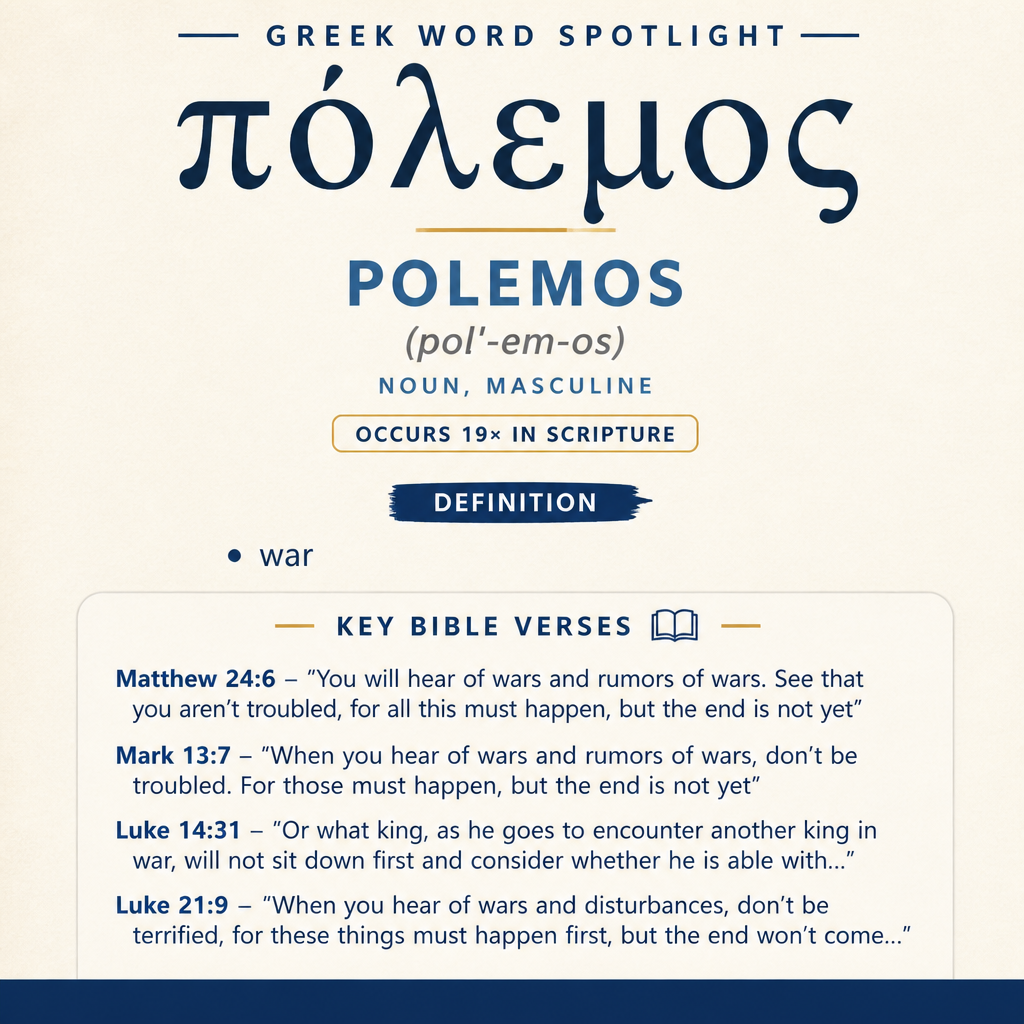
πόλεμος (Polemos) means “war” and occurs 19 times in Scripture, including Matthew 24:6, Mark 13:7, and Revelation 9:7.
Core Meaning
πόλεμος is the Greek word defined as “war.” It is used for warfare in both literal and figurative contexts.
Learn More →Scripture Occurrences
It appears in passages about “wars and rumors of wars” (Matthew 24:6; Mark 13:7) and “wars and disturbances” (Luke 21:9). It is also used in a king’s planning for war (Luke 14:31).
Learn More →Example Contexts
It describes preparation for war imagery (1 Corinthians 14:8; Revelation 9:7). James 4:1 applies it to conflicts among people.
Learn More →πόλεμος names “war,” appearing in sayings about coming upheavals, in practical illustrations about rulers and readiness, in moral critique of communal conflict, and in Revelation’s visions of violent opposition. Across these passages, the word gathers both public events among nations and the direct act of making war against named targets.
Occurrences
Matthew 24:6: “You will hear of wars and rumors of wars. See that you aren’t troubled, for all this must happen, but the end is not yet.”
Here πόλεμος is plural (“wars”) and paired with “rumors of wars,” presenting war both as event and as reported threat. The instruction “See that you aren’t troubled” frames war as an alarming phenomenon that hearsay can intensify, yet it is placed within a sequence (“must happen… but the end is not yet”), so the word marks turmoil without serving as a definitive sign that “the end” has arrived.
Mark 13:7: ““When you hear of wars and rumors of wars, don’t be troubled. For those must happen, but the end is not yet.”
The same pairing (“wars and rumors of wars”) is used to describe what will be “hear[d].” πόλεμος functions as a headline item in public reports, while the repeated command “don’t be troubled” treats war as something expected to occur (“must happen”) but not to be taken as immediate closure to history (“the end is not yet”).
Luke 14:31: “Or what king, as he goes to encounter another king in war, will not sit down first and consider whether he is able with ten thousand to meet him who comes against him with twenty thousand?”
πόλεμος stands within a concrete scenario: a king “goes to encounter another king in war.” The word anchors the illustration in a real contest of forces, highlighted by numerical comparison (“ten thousand… twenty thousand”). War here is not an atmosphere of unrest but a deliberate engagement that prompts sober calculation before contact with an enemy who “comes against him.”
Luke 21:9: “When you hear of wars and disturbances, don’t be terrified, for these things must happen first, but the end won’t come immediately.”
πόλεμος again appears as something “hear[d]” and is linked with “disturbances,” widening the field of threats that unsettle societies. The exhortation shifts from being “troubled” to being “terrified,” implying the emotional weight attached to news of war. Still, the timing language (“must happen first… the end won’t come immediately”) places wars among preliminary upheavals rather than the final moment.
1 Corinthians 14:8: “For if the trumpet gave an uncertain sound, who would prepare himself for war?”
πόλεμος is used to illustrate the necessity of clarity. “Prepare himself for war” assumes war requires coordinated readiness, and that preparation depends on an intelligible signal (“the trumpet”). War functions here as the setting where ambiguity is dangerous: an “uncertain sound” leaves people unready for the decisive demands that war places on a community.
Hebrews 11:34: “quenched the power of fire, escaped the edge of the sword, from weakness were made strong, grew mighty in war, and caused foreign armies to flee.”
πόλεμος appears in a catalog of deliverances and reversals. “Grew mighty in war” treats war as an arena where strength is displayed and outcomes change, culminating in “caused foreign armies to flee.” The word is positioned alongside “the edge of the sword,” keeping war close to immediate peril, yet the emphasis falls on empowerment (“from weakness were made strong”) in the face of martial danger.
James 4:1: “Where do wars and fightings among you come from? Don’t they come from your pleasures that war in your members?”
πόλεμος is applied to conflict “among you,” shifting from international or royal combat to turmoil within a community. The parallel “wars and fightings” intensifies the picture of strife as both large-scale hostility and repeated clashes. The second question traces this outward conflict to inward forces—“your pleasures that war in your members”—so war-language is used to describe antagonism at the level of desire and impulse, without changing the basic idea of war as active hostility.
Revelation 9:7: “The shapes of the locusts were like horses prepared for war. On their heads were something like golden crowns, and their faces were like people’s faces.”
πόλεμος helps define the terrifying readiness of the vision’s creatures: “horses prepared for war.” War here is not fought on-stage in this line, but it supplies the benchmark for their posture and equipment—preparedness, menace, and disciplined purpose. The comparison amplifies fear by presenting the locust-like shapes as already fitted for a violent campaign.
Revelation 9:9: “They had breastplates, like breastplates of iron. The sound of their wings was like the sound of chariots, or of many horses rushing to war.”
πόλεμος again functions as the target of preparation and motion: “horses rushing to war.” The imagery is auditory (“The sound of their wings”) and metallic (“breastplates… of iron”), with war serving as the end toward which the rushing advances. War is thus evoked as overwhelming movement—many forces converging with speed and noise.
Revelation 11:7: “When they have finished their testimony, the beast that comes up out of the abyss will make war with them, and overcome them, and kill them.”
πόλεμος appears in the phrase “make war with them,” describing a directed act of hostility against specific witnesses. War is not generic; it is a chosen response once “they have finished their testimony.” The sequence “make war… overcome… kill” presents war as a means by which the beast achieves domination and death over its opponents.
Revelation 12:7: “There was war in the sky. Michael and his angels made war on the dragon. The dragon and his angels made war.”
πόλεμος is stated outright as a reality in a particular realm: “war in the sky.” The verse repeats the action from both sides—Michael and his angels “made war,” and the dragon and his angels “made war”—so the word highlights reciprocal engagement between opposing forces. War is portrayed as a full conflict with combatants aligned under leaders.
Revelation 12:17: “The dragon grew angry with the woman, and went away to make war with the rest of her offspring, who keep God’s commandments and hold Jesus’ testimony.”
πόλεμος is used for the dragon’s ongoing strategy: “went away to make war with the rest of her offspring.” War is fueled by “angry” resolve and is aimed at an identifiable group marked by conduct and allegiance: they “keep God’s commandments and hold Jesus’ testimony.” The word therefore conveys sustained persecution framed as a warfare campaign against a defined community.

Sense and Usage
In these passages, πόλεμος consistently denotes war as a concrete reality that produces fear, demands readiness, and brings direct opposition. In the sayings about hearing “wars and rumors of wars” (Matthew 24:6; Mark 13:7; Luke 21:9), war is encountered first through report—something heard before it is faced—yet the emotional reaction is addressed: being “troubled” or “terrified” is treated as a response to be resisted. War belongs to a category of events that “must happen,” but its occurrence is separated from the immediacy of “the end,” so πόλεμος functions as a marker of upheaval without serving as the final marker.
In Luke 14:31 and 1 Corinthians 14:8, war becomes a practical frame for decision-making and communication. A king considering war sits down first, counts forces, and measures ability; the act of war is thus connected to planning and the hard arithmetic of vulnerability. Likewise, the trumpet illustration assumes that war requires unified response and that unclear signals cripple that response. πόλεμος in these contexts highlights coordination: war exposes whether leaders can assess reality and whether a community can receive and act on clear instruction.
Hebrews 11:34 places war among threats like fire and sword, yet its emphasis is on transformation—weakness becoming strength—and on turning the tide so that “foreign armies” flee. Here war is the contested space where courage and power are displayed and outcomes reverse. James 4:1 extends war language into the social and inner life: “wars… among you” are traced to “pleasures that war in your members.” War remains war—active hostility and conflict—but it is depicted as having a source within, showing how the same term can name both outward clashes and the hostile drives that incubate them.
Revelation uses πόλεμος to paint readiness for violence (“prepared for war”), the thunder of advance (“rushing to war”), and the deliberate choice to “make war” against witnesses and against a community defined by obedience and testimony. It also locates war “in the sky,” expanding the setting while keeping the action unmistakably martial: organized forces, leaders, and mutual engagement. Across these scenes, πόλεμος carries the weight of conflict that is both strategic and destructive, whether signaled by sound, embodied in armor, or enacted as targeted hostility.
Imagery
The word’s imagery ranges from public headlines—“wars and rumors of wars”—to the immediate textures of combat readiness: a trumpet call, counted troops, iron breastplates, chariots, and horses surging toward battle. Revelation intensifies this imagery by combining preparation and motion with direct statements of war’s location (“in the sky”) and its objects (“make war with them”), so πόλεμος can evoke both the spectacle of massed forces and the personal cost implied by being “overcome… and kill[ed].”
Sources: Lexical data from Strong’s Exhaustive Concordance and the Translators Brief Lexicon of Extended Strongs for Greek (STEPBible, CC BY). Occurrence data from the Translators Amalgamated Greek New Testament (STEPBible, CC BY). Scripture quotations from the World English Bible (public domain).





