
Exploring the Meaning of Polemeo in Greek
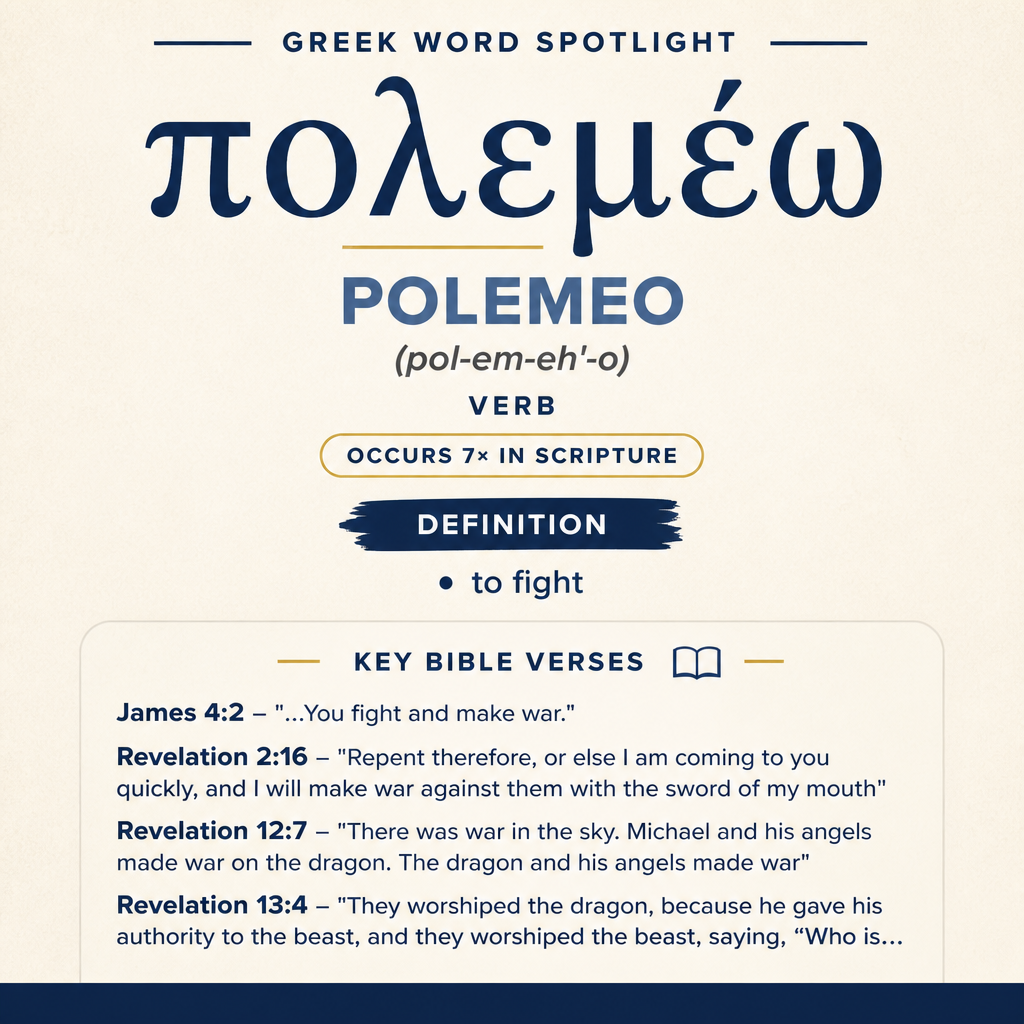
πολεμέω means “to fight” and occurs 7 times in Scripture, including James 4:2 and multiple passages in Revelation.
Where It Appears
This verb occurs 7 times in Scripture. It appears in James 4:2 and in Revelation (2:16; 12:7; 13:4; 17:14; 19:11).
Learn More →Usage Examples
James 4:2 speaks of people who “fight and make war.” Revelation uses it for warring against others, including war in the sky (Revelation 12:7).
Learn More →πολεμέω speaks of fighting, and its New Testament uses range from human quarrels to open, cosmic, and eschatological warfare. It appears in James to describe interpersonal conflict, and in Revelation to portray war waged by and against heavenly and earthly powers.
Occurrences
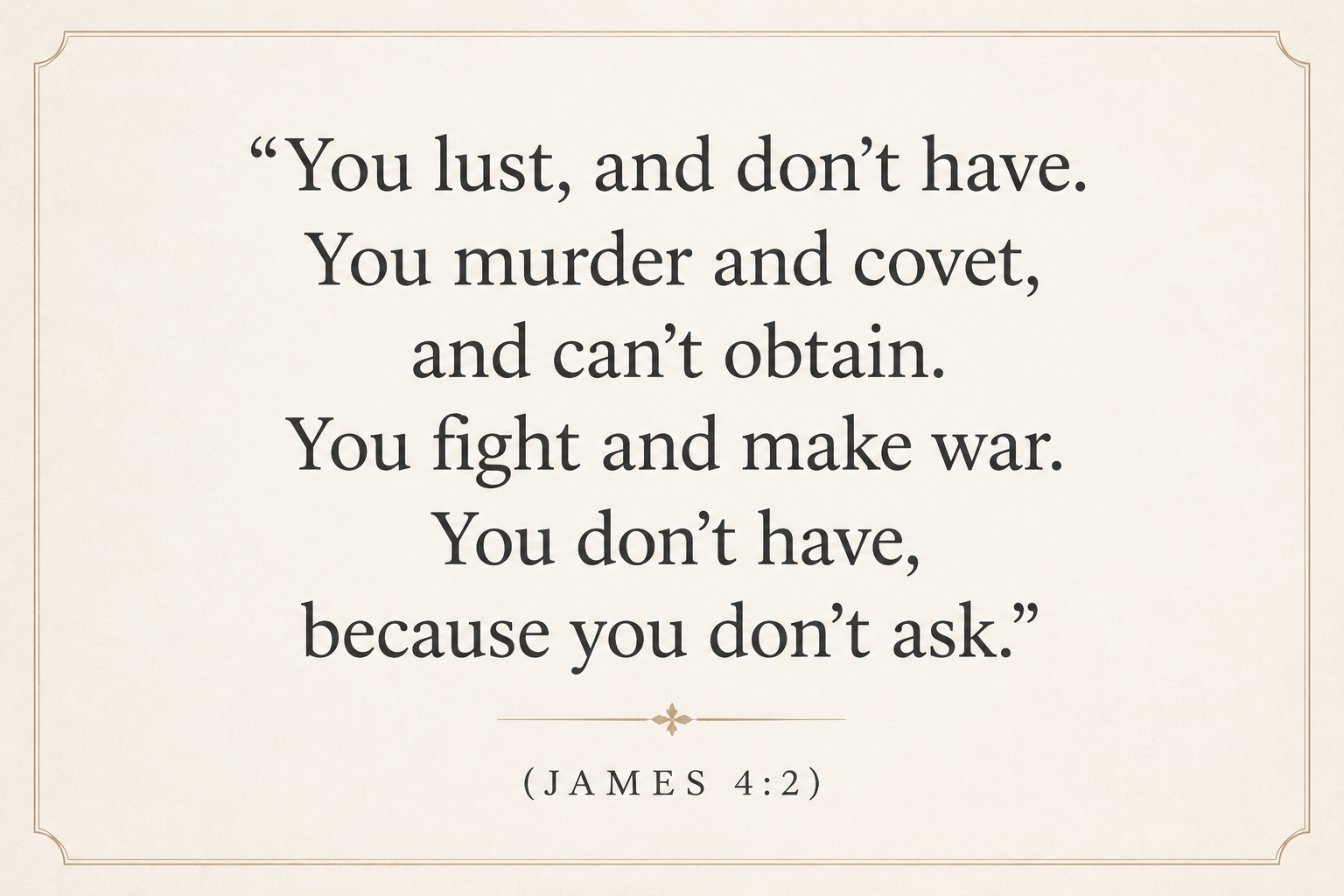
“You lust, and don’t have. You murder and covet, and can’t obtain. You fight and make war. You don’t have, because you don’t ask.” (James 4:2)
Here πολεμέω names conflict as one item in a chain of frustrated desire. The verse piles up verbs and outcomes—“lust,” “don’t have,” “murder,” “covet,” “can’t obtain”—and then places “You fight and make war” alongside them. Fighting is framed as a means people adopt when they “can’t obtain,” but it is grouped with the moral disorder of grasping and harming. The final line, “You don’t have, because you don’t ask,” sets fighting in contrast with asking; the scene portrays fighting as an expression of unmet cravings rather than a path to true gain.
“Repent therefore, or else I am coming to you quickly, and I will make war against them with the sword of my mouth.” (Revelation 2:16)
In this warning, πολεμέω is projected as an action the speaker will take: “I will make war against them.” The call to “Repent therefore” makes war a threatened response to continued wrongdoing, and the war is carried out “with the sword of my mouth.” The imagery locates the instrument of fighting not in conventional weapons but in what proceeds from the mouth, so the verb functions within a judicial, corrective announcement: coming “quickly” and waging war are linked as immediate intervention.
“There was war in the sky. Michael and his angels made war on the dragon. The dragon and his angels made war.” (Revelation 12:7)
πολεμέω here describes reciprocal combat in a heavenly setting: “war in the sky.” The verb is used twice to narrate a clash between two sides—“Michael and his angels” versus “the dragon” and his angels. The repeated “made war” balances the action, emphasizing direct opposition and sustained conflict rather than a single strike. Because the conflict is explicitly located “in the sky,” the verb is lifted from ordinary human strife into a cosmic arena, yet it still denotes fighting in a straightforward way.
“They worshiped the dragon, because he gave his authority to the beast, and they worshiped the beast, saying, “Who is like the beast? Who is able to make war with him?”” (Revelation 13:4)
Here πολεμέω appears inside a rhetorical boast: “Who is able to make war with him?” Fighting is treated as a test of matchlessness; the beast’s perceived uniqueness is expressed as invincibility in war. The question is framed within worship—“They worshiped the dragon… they worshiped the beast”—so the capacity to fight (and to withstand fighting) is made part of what draws allegiance. The verb thus contributes to the portrayal of power: warfare is imagined as the arena in which authority is proven and challengers are deterred.
“These will war against the Lamb, and the Lamb will overcome them, for he is Lord of lords, and King of kings, and those who are with him are called chosen and faithful.” (Revelation 17:14)
In this scene, πολεμέω is directed “against the Lamb,” marking a deliberate, hostile campaign. Yet the outcome is immediately stated: “the Lamb will overcome them.” The verb therefore sets up a conflict whose resolution is decisive, and it helps frame the Lamb’s victory as the defeat of organized opposition. The reason given—“for he is Lord of lords, and King of kings”—ties the overcoming to kingship; the fight is real, but it is waged against one whose rule surpasses theirs. The closing description of companions—“called chosen and faithful”—places those with the Lamb on the victorious side of the conflict the verb introduces.
“I saw the heaven opened, and behold, a white horse, and he who sat on it is called Faithful and True. In righteousness he judges and makes war.” (Revelation 19:11)
Here πολεμέω is paired with judging: “In righteousness he judges and makes war.” The vision’s setting—“the heaven opened… a white horse”—presents the warrior-judge as arriving from heaven, and the verb describes his active engagement in conflict. The adverbs and titles shape how the fighting is understood: “Faithful and True” and “In righteousness” qualify the war-making as consistent with just judgment. Thus πολεμέω functions not as random violence but as an aspect of righteous rule carried out by the rider.

Sense and Usage
Across these passages πολεμέω consistently expresses fighting, but the scenes show that “fighting” can be morally evaluated, rhetorically weaponized, or woven into visions of judgment. James 4:2 places fighting in the everyday realm of human relationships, where conflict emerges from cravings that cannot be satisfied and where the alternative commended is asking rather than grasping. In that setting, fighting is one symptom of disordered desire and a failed strategy for obtaining what is wanted.
Revelation uses the verb with a wider scope. In Revelation 2:16, the one speaking threatens to “make war against them,” and the means—“with the sword of my mouth”—ties the action to authoritative speech and immediate accountability. The fighting is not portrayed as a struggle for resources but as an intervention that answers a call to repentance. In Revelation 12:7, the verb moves into a cosmic register: war is “in the sky,” fought by angelic forces on both sides. The repeated use of “made war” underscores the symmetrical engagement of combatants, while the location elevates the conflict beyond human politics.
Revelation 13:4 places πολεμέω in the mouth of worshipers as they marvel, “Who is able to make war with him?” Here the verb serves the propaganda of power: war is imagined as the ultimate proving ground, and the beast’s stature is measured by the presumed inability of any opponent to fight successfully. This use shows how the concept of fighting can become a lens through which authority is recognized and allegiance is demanded.
Revelation 17:14 and 19:11 connect fighting to kingship and judgment. Those who “war against the Lamb” represent open opposition, but the narrative immediately states, “the Lamb will overcome them,” and grounds that outcome in his supremacy as “Lord of lords, and King of kings.” Fighting is thus situated within a hierarchy of rule: the conflict is real, yet it is decisively resolved by the superior king. In Revelation 19:11, the rider “judges and makes war” “In righteousness,” uniting judicial assessment with martial action; πολεμέω is integrated into a portrayal of rightful governance that confronts and answers resistance.
Imagery
The word’s imagery shifts sharply between epistle and apocalypse. In James 4:2, fighting sits among verbs of desire and frustration, making conflict look like the outward flare of inner cravings. In Revelation, πολεμέω gathers solemn weight: war is threatened from a mouth like a sword, waged in the sky by angelic hosts, boasted over by worshipers impressed with brute authority, directed against the Lamb yet overcome, and carried out by one who judges “In righteousness.” In these scenes, fighting is not a single kind of event; it is a repeated motif that exposes motives, tests claims of power, and accompanies judgment.
Sources: Lexical data from Strong’s Exhaustive Concordance and the Translators Brief Lexicon of Extended Strongs for Greek (STEPBible, CC BY). Occurrence data from the Translators Amalgamated Greek New Testament (STEPBible, CC BY). Scripture quotations from the World English Bible (public domain).




