Exploring the Meaning of Poimen in Greek
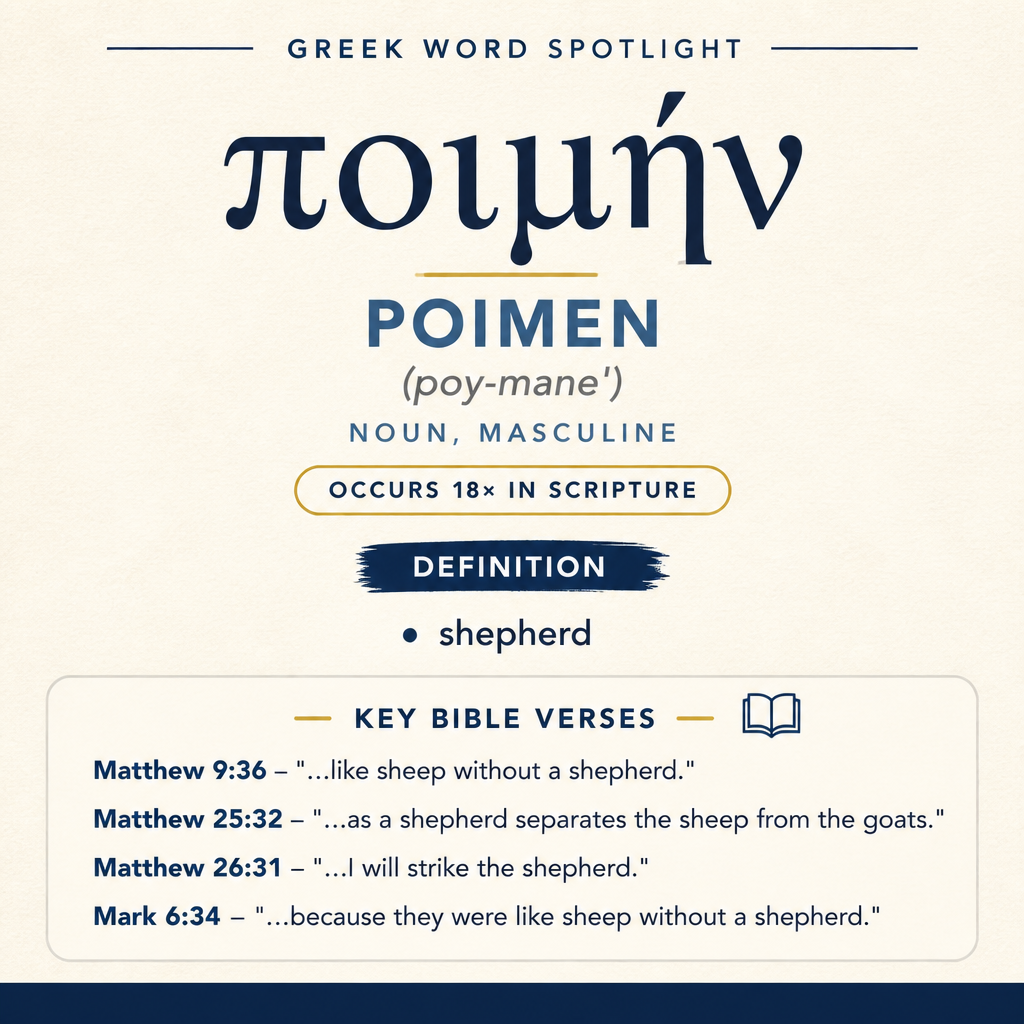
ποιμήν (Poimen) means “shepherd” and occurs 18 times in Scripture, including in Matthew, Mark, and Luke (Luke 2:8, 2:15, 2:18).
Gospel Usage
It appears in Matthew 9:36 and Mark 6:34 in the phrase “sheep without a shepherd.” It also appears in Matthew 25:32 about a shepherd separating sheep.
Learn More →Luke 2 Scenes
In Luke 2:8, shepherds keep watch over their flock by night. In Luke 2:15 and 2:18, the shepherds speak about what they heard.
Learn More →ποιμήν means “shepherd,” a word that appears in narrative scenes with literal shepherds and in teaching and prophecy-like quotations where the shepherd becomes a controlling image for guidance, protection, and the gathering or scattering of sheep. In the passages below, the term anchors both compassion for vulnerable crowds and vivid contrasts between faithful care and abandonment.
Occurrences
Matthew 9:36: “But when he saw the multitudes, he was moved with compassion for them, because they were harassed and scattered, like sheep without a shepherd.”
Here ποιμήν supplies the missing figure that explains the crowd’s condition. The people are pictured as “harassed and scattered,” and the comparison “like sheep without a shepherd” frames their distress as the exposure and disorder that follow when no shepherd is present to gather, direct, or watch over them.
Matthew 25:32: “Before him all the nations will be gathered, and he will separate them one from another, as a shepherd separates the sheep from the goats.”
In this scene of assembled “nations,” ποιμήν introduces an analogy for deliberate sorting. The shepherd’s familiar work—making distinctions within a mixed group—becomes the point of comparison for the described separation, presenting the shepherd as one who can recognize and divide animals appropriately.
Matthew 26:31: “Then Jesus said to them, “All of you will be made to stumble because of me tonight, for it is written, ‘I will strike the shepherd, and the sheep of the flock will be scattered.’”
ποιμήν stands at the center of a chain reaction: the shepherd is struck, and “the sheep of the flock” are “scattered.” The word therefore carries the weight of a role whose removal destabilizes the whole group. The emphasis falls on the shepherd as the unifying, stabilizing presence for the flock.
Mark 6:34: “Jesus came out, saw a great multitude, and he had compassion on them, because they were like sheep without a shepherd, and he began to teach them many things.”
Again the crowd is likened to sheep lacking a shepherd, but the verse immediately shows a response: “he began to teach them many things.” Within the verse’s own logic, teaching functions as a shepherd-like act toward people who are unprotected and directionless. The image thus connects their need (“without a shepherd”) to an act that addresses it (instruction).
Mark 14:27: “Jesus said to them, “All of you will be made to stumble because of me tonight, for it is written, ‘I will strike the shepherd, and the sheep will be scattered.’”
This parallels Matthew’s wording, with the same sequence: striking the shepherd results in scattering sheep. The repetition reinforces how the shepherd’s fate governs the flock’s coherence. The shepherd is not merely associated with sheep; his removal is portrayed as the direct cause of their dispersion.
Luke 2:8: “There were shepherds in the same country staying in the field, and keeping watch by night over their flock.”
Here ποιμήν is straightforwardly literal: shepherds are outdoors, “staying in the field,” performing a night watch “over their flock.” The word evokes routine vigilance and the responsibility of guarding animals during a vulnerable time (“by night”).
Luke 2:15: “When the angels went away from them into the sky, the shepherds said to one another, “Let’s go to Bethlehem, now, and see this thing that has happened, which the Lord has made known to us.””
ποιμήν identifies the speakers as the same field-watchers from the previous scene. They respond corporately—“said to one another”—and their role as shepherds places them among those who move from watching their flock to seeking confirmation of what they have been told, traveling to “Bethlehem” to “see this thing.”
Luke 2:18: “All who heard it wondered at the things which were spoken to them by the shepherds.”
The shepherds become messengers of what they have learned, and ποιμήν labels the unlikely source of public report: “things…spoken to them by the shepherds.” The term grounds the astonishment in the contrast between the ordinary identity of the speakers and the extraordinary content that provokes wonder.
Luke 2:20: “The shepherds returned, glorifying and praising God for all the things that they had heard and seen, just as it was told them.”
ποιμήν frames the conclusion of the episode: after their visit, “the shepherds returned.” The word keeps the scene anchored in their everyday station, even as their return is marked by “glorifying and praising God.” Their identity remains that of shepherds, but now colored by testimony confirmed (“heard and seen…just as it was told them”).
John 10:2: “But one who enters in by the door is the shepherd of the sheep.”
In this saying, ποιμήν is defined by relationship and rightful access: the shepherd is “of the sheep,” and he “enters in by the door.” The shepherd is portrayed as the legitimate entrant, distinguished from others by the proper way of approach and by a recognized connection to the sheep.
John 10:11: “I am the good shepherd. The good shepherd lays down his life for the sheep.”
ποιμήν is intensified by the description “good,” and the verse ties that goodness to a specific act: laying down one’s life “for the sheep.” The shepherd’s role is not only to lead or manage but to protect at personal cost. The word thus carries an ethical weight in the scene: the shepherd’s identity is expressed through sacrificial care.
John 10:12: “He who is a hired hand, and not a shepherd, who doesn’t own the sheep, sees the wolf coming, leaves the sheep, and flees. The wolf snatches the sheep, and scatters them.”
ποιμήν appears by contrast: “a hired hand, and not a shepherd.” The shepherd is implicitly characterized as the opposite of the hireling who “doesn’t own the sheep” and abandons them at danger. The verse supplies the consequence of lacking a true shepherd in crisis: the wolf “snatches” and “scatters” the sheep. In this scene, the shepherd is the one whose presence would prevent abandonment and resist dispersal.
Sense and Usage
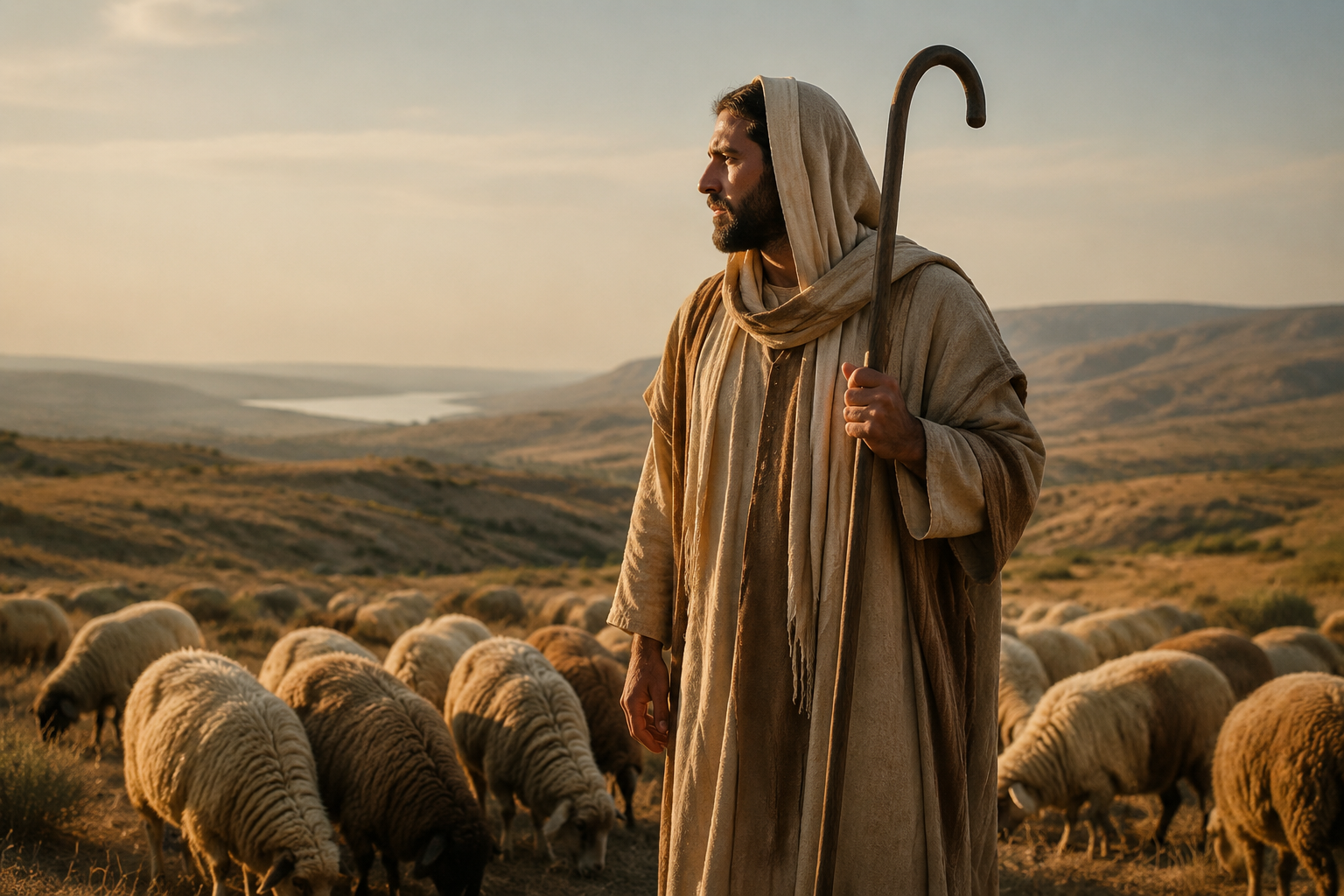
Across these passages, ποιμήν functions as more than an occupational label; it becomes a compact way to speak about what happens to a group that depends on oversight. When crowds are “like sheep without a shepherd” (Matthew 9:36; Mark 6:34), the shepherd stands for the organizing, protecting center that prevents people from becoming “harassed and scattered.” The image is not abstracted from the text; it is anchored in the immediate description of vulnerability, compassion, and the practical response of teaching.
In sayings that stress judgment or discernment, the shepherd’s work supplies a clear analogy: “as a shepherd separates the sheep from the goats” (Matthew 25:32). Here the shepherd is a figure who can distinguish within a gathered mass, and the comparison depends on the shepherd’s competence at separation as part of ordinary flock management.
Other texts press the shepherd image into a dramatic causal relationship with scattering. In Matthew 26:31 and Mark 14:27, striking the shepherd leads to the flock’s dispersal; in John 10:12, the hireling’s flight allows a predator to scatter the sheep. These scenes share a common logic: the flock’s cohesion is tied to the shepherd’s presence and action, and when that presence is removed—by being struck or by abandoning the sheep—the sheep are scattered. The repeated outcome (“scattered”) gives the term ποιμήν a narrative force: it is the role whose stability directly affects the group’s survival and unity.
Luke 2 shows the term in literal, concrete setting. Shepherds are out “in the field,” watching “by night” (Luke 2:8), then speaking, traveling, and returning (Luke 2:15, 2:20). The same word that supports layered imagery elsewhere is fully at home as a simple identifier for working people whose responsibilities and movements shape the scene. Yet even here, the shepherds’ watchfulness and their subsequent testimony (“spoken…by the shepherds,” Luke 2:18) give the term a texture of alertness and reporting: they keep watch, then they tell what they have heard and seen.
John 10 concentrates the meaning of the word around legitimacy, care, and costly protection. The shepherd “enters in by the door” (John 10:2), is explicitly “good,” and is defined by self-giving for the sheep (John 10:11). The contrasting figure is “not a shepherd” and is marked by lack of ownership and abandonment under threat (John 10:12). In these sayings, ποιμήν gathers up themes already present in the sheep-without-a-shepherd images: genuine shepherding is known by steadfast presence when danger approaches and by actions that secure the sheep rather than expose them.
Imagery
The passages repeatedly bind ποιμήν to the movements of sheep: gathered, separated, scattered, snatched, and protected. Whether the shepherd is missing (leaving sheep “harassed and scattered”), present and active (watching “by night,” teaching “many things,” entering “by the door”), or removed (struck, or replaced by a fleeing hireling), the word consistently supplies a vivid, pastoral frame for understanding leadership, responsibility, and the fragility of a flock when care fails.
Sources: Lexical data from Strong’s Exhaustive Concordance and the Translators Brief Lexicon of Extended Strongs for Greek (STEPBible, CC BY). Occurrence data from the Translators Amalgamated Greek New Testament (STEPBible, CC BY). Scripture quotations from the World English Bible (public domain).