Exploring the Meaning of Poieo in Greek
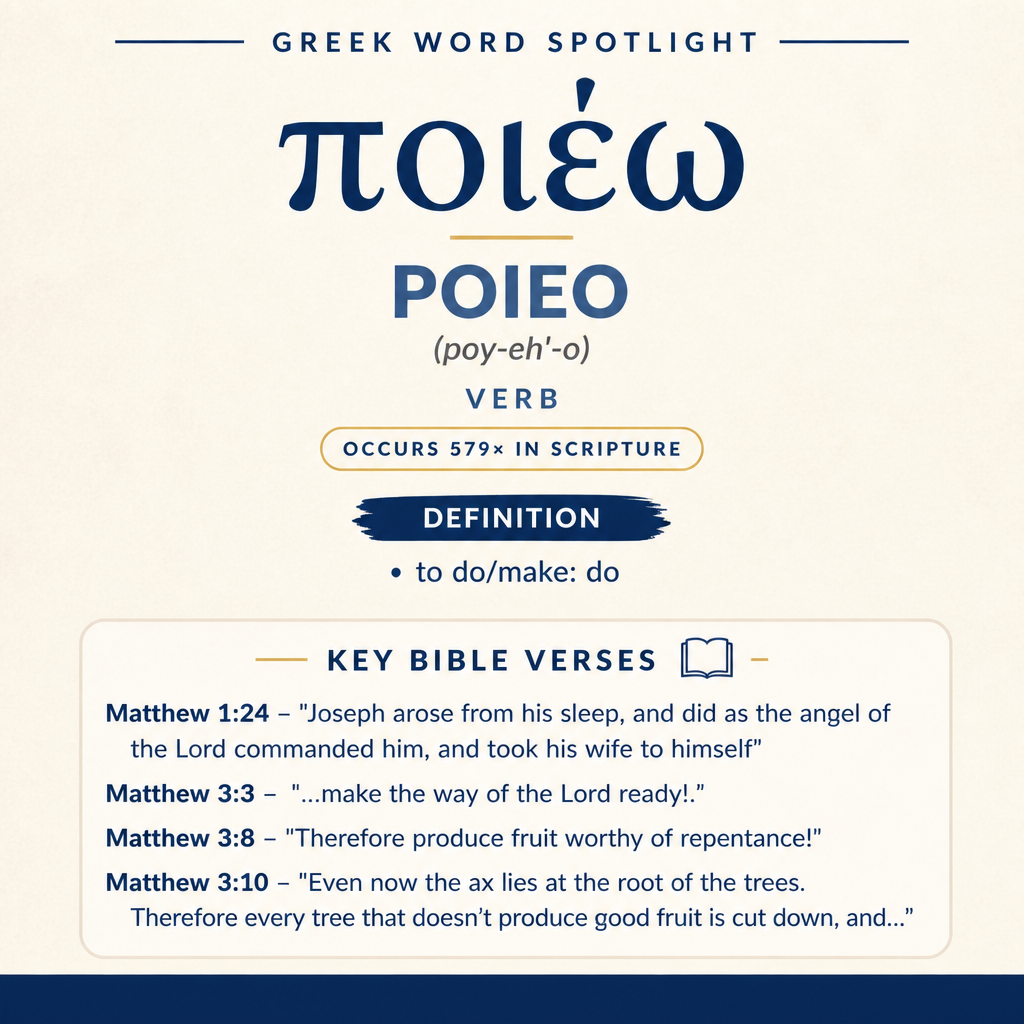
ποιέω means “to do/make,” appearing 579 times in Scripture, including Matthew 1:24 and multiple uses in Matthew 3–5.
Matthew Examples
In Matthew 1:24 Joseph “did” as the angel commanded. In Matthew 4:19 Jesus says, “I will make you fishers for men.”
Learn More →Fruit and Commands
Matthew 3:8–10 uses ποιέω for producing fruit worthy of repentance and producing good fruit. Matthew 5:19 speaks of teaching others to “do” the commandments.
Learn More →ποιέω expresses doing or making, covering actions carried out in obedience, moral practice, and the bringing about of outcomes. In the passages below it appears in narrative, prophetic quotation, and teaching, where it can describe concrete acts, habitual conduct, and effects a person brings about in others.
Occurrences
Matthew 1:24 — “Joseph arose from his sleep, and did as the angel of the Lord commanded him, and took his wife to himself;”
Here ποιέω marks compliance in response to a command. Joseph’s waking leads to an acted-upon instruction: the verb highlights that the angel’s message is not left as information but is carried into practice. The second clause (“and took his wife to himself”) shows the sort of outward, definable step that “did” encompasses in this scene.

Matthew 3:3 — “For this is he who was spoken of by Isaiah the prophet, saying, “The voice of one crying in the wilderness, make the way of the Lord ready! Make his paths straight!””
In the quoted proclamation, ποιέω takes the shape of an imperative directed to a broad audience: “make the way…ready” and “make his paths straight.” The verb frames preparation as an act of construction or arrangement—work that results in a ready “way” and “straight” “paths.” The scene ties “making” to readiness and alignment, not merely to intention.
Matthew 3:8 — “Therefore produce fruit worthy of repentance!”
ποιέω is used for the bringing forth of “fruit,” casting repentance in terms of an observable output. The imperative calls for a product that can be assessed (“worthy of repentance”), so “do/make” in this setting is oriented to results rather than claims. The verb presses for repentance to be expressed through what one brings about.
Matthew 3:10 — ““Even now the ax lies at the root of the trees. Therefore every tree that doesn’t produce good fruit is cut down, and cast into the fire.”
Within the image of trees under imminent judgment, ποιέω again describes producing fruit, this time with the qualifier “good.” The verb functions as the decisive criterion in the illustration: a tree’s failure to “produce good fruit” leads to being “cut down” and “cast into the fire.” “Doing/making” is presented as the testable manifestation that exposes what the tree is, in the face of urgent evaluation (“Even now”).
Matthew 4:19 — “He said to them, “Come after me, and I will make you fishers for men.””
ποιέω here is future and personal: “I will make you….” The verb describes an effect Jesus will bring about in those who follow him, shifting it from their immediate action to his transformative action upon them. The outcome is specified (“fishers for men”), so “make” carries the idea of producing a new role or function, not simply giving a new label.
Matthew 5:19 — “Whoever, therefore, shall break one of these least commandments, and teach others to do so, shall be called least in the Kingdom of Heaven; but whoever shall do and teach them shall be called great in the Kingdom of Heaven.”
In this instruction, ποιέω is set in contrast with breaking commandments. The verb appears in the pattern “do and teach,” showing that practice and instruction belong together; what is taught is expected to be enacted. The phrase “teach others to do so” also shows the social spread of action: people can be influenced into a course of doing, for good or ill, and the evaluation (“least…great”) turns on whether commands are practiced and taught.
Matthew 5:32 — “but I tell you that whoever puts away his wife, except for the cause of sexual immorality, makes her an adulteress; and whoever marries her when she is put away commits adultery.”
ποιέω describes causation: an action (“puts away his wife”) results in making her “an adulteress.” The verb therefore highlights that certain deeds generate consequences for others, not only for the doer. In this context, “make” is not a neutral activity but an act that produces a damaging social and moral outcome within relationships.
Matthew 5:36 — “Neither shall you swear by your head, for you can’t make one hair white or black.”
Here ποιέω points to human inability to produce a specific change: “you can’t make one hair white or black.” The verb clarifies the limits of a person’s power to effect outcomes, supporting the prohibition against swearing by one’s head. “Make” is tied to actual control over results; lacking that control exposes the emptiness of such oaths.
Matthew 5:44 — “But I tell you, love your enemies, bless those who curse you, do good to those who hate you, and pray for those who mistreat you and persecute you,”
ποιέω appears as “do good,” embedded among a series of imperatives that govern conduct toward enemies. The verb is directed outward, demanding concrete beneficence rather than merely refraining from harm. Within the list (love, bless, do good, pray), “do” places goodness in the realm of enacted behavior toward hostile people.
Matthew 5:46 — “For if you love those who love you, what reward do you have? Don’t even the tax collectors do the same?”
ποιέω serves as a comparison point: “Don’t even the tax collectors do the same?” The question assumes that a certain level of action is common and therefore not distinctive. “Do” here marks the baseline of ordinary social reciprocity—behavior that can be matched by those outside the circle of discipleship, and so cannot by itself claim special reward.
Matthew 5:47 — “If you only greet your friends, what more do you do than others? Don’t even the tax collectors do the same?”
In the parallel challenge about greetings, ποιέω again measures action by comparison: “what more do you do than others?” The verb frames ethical expectation in terms of surplus practice—something beyond the common standard. The repeated reference to what “tax collectors do” makes “doing” the field in which distinctiveness (or its absence) is visible.
Matthew 6:1 — ““Be careful that you don’t do your charitable giving before men, to be seen by them, or else you have no reward from your Father who is in heaven.”
ποιέω describes the performing of charitable giving, but the warning targets the manner and motive: doing it “before men, to be seen by them.” The verb therefore covers not only the act of giving but also its public staging as an action carried out in an audience’s sight. The consequence attached (“or else you have no reward from your Father who is in heaven”) shows that how one “does” an act can determine its value in the divine evaluation.

Sense and Usage
Across these scenes, ποιέω consistently anchors moral and spiritual teaching in actions that can be carried out and observed. In narrative (Matthew 1:24), it marks faithful execution of a command, where “doing” is the bridge between instruction and obedience. In prophetic and metaphorical language (Matthew 3:3, 3:8, 3:10), it frames preparation and fruit-bearing as acts that produce concrete outcomes—roads made ready, paths made straight, fruit produced and assessed.
The verb also ranges naturally from what a person does to what a person causes. Matthew 5:32 uses “make” for the way one decision can bring about a new status for another person, underlining the relational consequences that actions can generate. Matthew 4:19 places the subject of “make” with Jesus (“I will make you…”), where the action is directed toward forming people into a specified function; the verb can therefore describe producing a new capacity or role as an outcome.
Several occurrences show ποιέω as a diagnostic verb: it provides the measurable evidence by which conduct is evaluated. Matthew 5:19 links doing with teaching, so that instruction without practice—and practice without instruction—fails to meet the integrated pattern Jesus sets out. Matthew 5:46–47 uses “do” to expose the ordinariness of certain behaviors: the same actions can be performed by “tax collectors,” so the question becomes whether one’s doing exceeds what is typical. Matthew 6:1 sharpens the point by showing that the same outward deed (charitable giving) can be emptied of reward when it is done “to be seen by” people; ποιέω can thus encompass the public performance of a deed and bring motive into view through the described setting and aim.
Finally, Matthew 5:36 uses “make” to set a boundary: humans cannot produce even a small bodily change at will, so claims and vows should not presume control over what one cannot do. In that line, ποιέω helps distinguish between real agency (what one can effect) and presumed authority (what one claims by swearing).
Imagery in Context
In these passages, the strongest images attached to ποιέω are productive and constructive: a way made ready in the wilderness, paths made straight, and trees producing fruit under the looming presence of an ax (Matthew 3:3, 3:10). Alongside these are social images of enactment—greeting, giving, and doing good—where the verb pulls ethical teaching out of abstraction and into visible practice among friends, enemies, and the watching public (Matthew 5:44, 5:47; Matthew 6:1).
Sources: Lexical data from Strong’s Exhaustive Concordance and the Translators Brief Lexicon of Extended Strongs for Greek (STEPBible, CC BY). Occurrence data from the Translators Amalgamated Greek New Testament (STEPBible, CC BY). Scripture quotations from the World English Bible (public domain).