Exploring the Meaning of Poiema in Greek
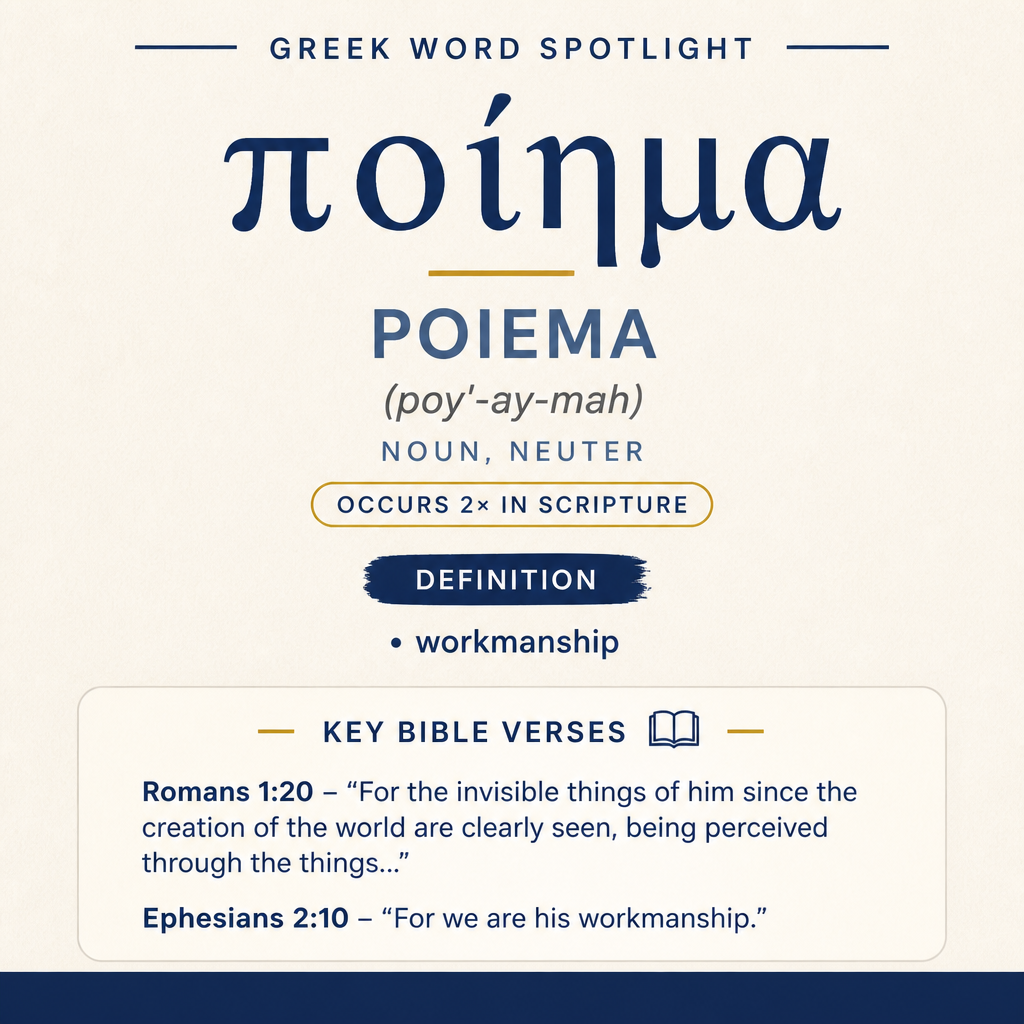
ποίημα means “workmanship” and appears twice in Scripture, in Romans 1:20 and Ephesians 2:10.
Scripture Occurrences
This word occurs 2 times in Scripture: Romans 1:20 and Ephesians 2:10.
Learn More →Context Highlights
In Romans 1:20 it is used in connection with “the creation of the world.” In Ephesians 2:10 it refers to believers as God’s workmanship, created in Christ Jesus for good works.
Learn More →ποίημα refers to “workmanship,” a term used once for the created order and once for the redeemed community. It appears in Romans 1:20 and Ephesians 2:10, each time pointing to something understood as the product of purposeful making.
Root and Related Words
ποίημα is related to the verb poieō (ποιέω), “to do/make” (Strong’s G4160). The noun presents the outcome or product in view when something is “done” or “made.”

Occurrences
“For the invisible things of him since the creation of the world are clearly seen, being perceived through the things that are made, even his everlasting power and divinity, that they may be without excuse.” (Romans 1:20)
In Romans 1:20, the focus is on what can be perceived “since the creation of the world.” The verse sets “the invisible things of him” alongside what is “clearly seen,” and it locates that clarity “through the things that are made.” Here ποίημα belongs to the realm of visible created realities that function as a medium of perception. The workmanship is not described for its own sake; it is presented as a set of made things through which God’s “everlasting power and divinity” are perceived. The term therefore supports the logic of accountability at the end of the sentence: because the workmanship is accessible to sight and perception, the result is “that they may be without excuse.” The workmanship in this scene stands as public, created evidence—something available to observation and capable of carrying meaning about God’s power and divinity.
“For we are his workmanship, created in Christ Jesus for good works, which God prepared before that we would walk in them.” (Ephesians 2:10)
In Ephesians 2:10, ποίημα is applied directly to “we,” identifying a people as “his workmanship.” The verse immediately adds a defining clause: “created in Christ Jesus for good works.” In this context the workmanship is not a general reference to the world but a specific description of persons as the product of God’s creative action in relation to Christ Jesus. The purpose of this workmanship is stated: “for good works.” The verse then continues by extending the idea of purposeful making into purposeful preparation: “which God prepared before that we would walk in them.” Thus the workmanship is portrayed as directed toward an ordered pattern of life—good works envisioned in advance, and a lived response described as “walk[ing] in them.” The word highlights both divine ownership (“his”) and a shaped outcome: a created people whose life is meant to move along a prepared path of good works.
Sense and Usage
Across these two uses, “workmanship” carries a consistent emphasis on a made result that can be pointed to as evidence of a maker’s action and intention. In Romans 1:20, the workmanship is aligned with the visible fabric of creation: it is what can be “clearly seen” and “perceived,” and it functions as a witness-bearing reality. The workmanship is not simply the fact that things exist; the verse links made things with intelligibility—human perception is able to move from the workmanship to an awareness of “everlasting power and divinity.” The term therefore serves a rhetorical purpose: it undergirds the claim that the knowledge in view is accessible enough to leave people “without excuse.”
In Ephesians 2:10, the same definition plays out in a more personal and communal register. The workmanship is “we,” and the maker’s ownership is explicit. The verse frames this workmanship with creation-language (“created in Christ Jesus”) and then immediately ties that creative act to ethical direction (“for good works”). The noun thus helps hold together identity and purpose: what God has made is presented not as static but as oriented toward a way of living. The final clause—“which God prepared before that we would walk in them”—extends the craftsmanship idea beyond the initial act of making to the shaping of a course. Workmanship here evokes a product that fits a purpose, with the purpose stated as a life characterized by good works.

These two occurrences also show the breadth of what can be designated as workmanship without changing the word’s core idea. One context speaks of “the things that are made” at the scale of “the creation of the world,” while the other speaks of a people formed “in Christ Jesus.” In both, workmanship is something that can be identified and spoken about as a concrete outcome—something with real effects: it makes perception possible in one case, and it grounds a prepared walk in good works in the other.
Imagery
Romans 1:20 uses workmanship imagery to connect sight and understanding: visible made realities become the arena in which the invisible is “perceived.” Ephesians 2:10 uses workmanship imagery to connect creation and conduct: a people made by God are pictured as set on a path, meant to “walk” in good works already prepared.
Sources: Lexical data from Strong’s Exhaustive Concordance and the Translators Brief Lexicon of Extended Strongs for Greek (STEPBible, CC BY). Occurrence data from the Translators Amalgamated Greek New Testament (STEPBible, CC BY). Scripture quotations from the World English Bible (public domain).