
Exploring the Meaning of Pleonektes Greek
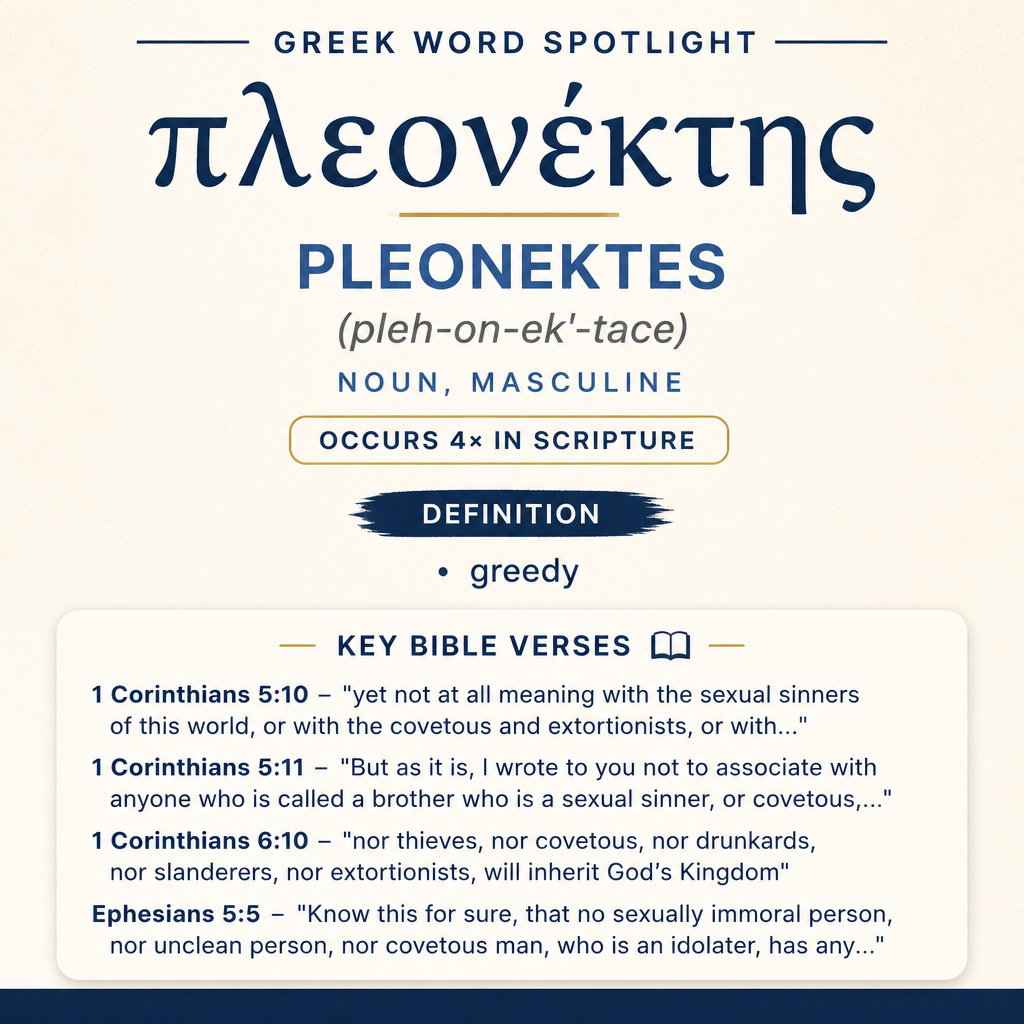
πλεονέκτης (Pleonektes) means “greedy” and appears four times in Scripture: 1 Corinthians 5:10–11, 1 Corinthians 6:10, and Ephesians 5:5.
Where It Appears
This word occurs 4 times in Scripture. It appears in 1 Corinthians 5:10–11, 1 Corinthians 6:10, and Ephesians 5:5.
Learn More →Context in Lists
In 1 Corinthians 5:10–11 and 6:10, it appears among lists including “extortionists” and “idolaters.” In Ephesians 5:5, it appears with “sexually immoral” and “unclean.”
Learn More →Pleonektes means “greedy” and appears in vice lists that define who a Christian community must not treat as acceptable. In its four New Testament occurrences, it stands alongside other patterns of behavior that disrupt fellowship and exclude from inheritance in God’s kingdom.
Root and Related Words
Pleonektes is connected with the verb echo (ἔχω), “to have/be” (Strong’s G2192), and with pleion (πλείων, πλεῖον), “greater” (Strong’s G4119).

Occurrences
“yet not at all meaning with the sexual sinners of this world, or with the covetous and extortionists, or with idolaters; for then you would have to leave the world.” (1 Corinthians 5:10)
Here Paul clarifies a boundary: his instruction is not a demand for physical withdrawal from society. “The covetous” appear as one category among others—“sexual sinners,” “extortionists,” and “idolaters”—that exist broadly “of this world.” In this setting, Pleonektes helps name a recognizable moral type outside the church, and the point is practical: if believers attempted to avoid every such person, ordinary life would become impossible (“for then you would have to leave the world”). The term functions as part of a realistic description of the world believers inhabit, setting up a more precise instruction about relationships within the Christian community.
“But as it is, I wrote to you not to associate with anyone who is called a brother who is a sexual sinner, or covetous, or an idolater, or a slanderer, or a drunkard, or an extortionist. Don’t even eat with such a person.” (1 Corinthians 5:11)
In the next verse, the focus narrows sharply from “this world” to “anyone who is called a brother.” Within that circle, “covetous” is no longer merely one feature of the surrounding society; it becomes incompatible with being treated as a brother in good standing. Pleonektes contributes to the list of behaviors that require distance: “not to associate,” intensified by the concrete social marker, “Don’t even eat with such a person.” The word therefore has a community-shaping role. It helps define a kind of life that, if persistent and unrepented, must not be normalized through ordinary fellowship, especially table fellowship, which in this context signals acceptance and shared life.
“nor thieves, nor covetous, nor drunkards, nor slanderers, nor extortionists, will inherit God’s Kingdom.” (1 Corinthians 6:10)
This occurrence places “covetous” within a warning about inheritance: certain ways of life are named as excluding from “God’s Kingdom.” The list is tightly framed and weighty: “thieves” and “extortionists” bracket forms of taking; “drunkards” and “slanderers” point to other destructive patterns. By appearing among these, Pleonektes contributes to a moral portrait with eschatological consequences: greed is treated not as a minor flaw but as belonging to the same class of conduct that bars inheritance. The term also helps the list read as comprehensive in effect—not by covering every possible sin, but by offering recognizable categories that cover public, relational, and acquisitive wrongs.
“Know this for sure, that no sexually immoral person, nor unclean person, nor covetous man, who is an idolater, has any inheritance in the Kingdom of Christ and God.” (Ephesians 5:5)
In Ephesians the warning is introduced with emphatic certainty: “Know this for sure.” Pleonektes appears as “covetous man,” and the sentence tightens the description by adding, “who is an idolater.” The word thus participates in a statement about identity as well as behavior: the covetous person is presented in a way that aligns him with idolatry, and the consequence is again stated in terms of inheritance—“has any inheritance in the Kingdom of Christ and God.” In this scene, greed is not treated as a private inclination; it is set within a framework of worship and allegiance, and it is named as fundamentally inconsistent with sharing in the kingdom’s inheritance.
Sense and Usage
Across these passages, Pleonektes (“greedy”) functions as a diagnostic label in lists that mark out conduct incompatible with Christian life. The word’s placement is consistent: it appears among other named patterns rather than in isolation, and the lists themselves do practical and theological work. In 1 Corinthians 5, the term helps draw a crucial distinction between contact with the world and recognized fellowship within the church. Paul can assume believers will encounter greedy people in ordinary life, but he refuses to treat greed as a trait that can coexist comfortably with the public claim of being “called a brother.” The instruction “not to associate” and “Don’t even eat with such a person” shows that the issue is not momentary temptation but an identifiable, ongoing posture that affects communal integrity.
In 1 Corinthians 6:10 and Ephesians 5:5, the same term is tied directly to inheritance in God’s kingdom. This frames greed as more than a social nuisance; it is a kingdom-level issue. The lists do not merely warn against social embarrassment or interpersonal damage; they state that those defined by such patterns “will inherit” nothing. In Ephesians the point is reinforced by the categorical phrasing (“no… person”) and by linking the greedy person with idolatry (“who is an idolater”), giving the word a sharper moral contour. Greed is portrayed as a rival allegiance that displaces proper devotion and therefore disqualifies from the “inheritance in the Kingdom of Christ and God.”
In all four occurrences, the term sits close to other wrongs that involve taking, exploiting, or misusing others—especially “thieves” and “extortionists” (1 Corinthians 6:10) and “extortionists” again (1 Corinthians 5:10–11). That repeated clustering shapes how the reader hears the label: greed is not merely internal desire but a disposition that commonly expresses itself in harmful action and broken relationships. The passages treat it as recognizable, nameable, and serious enough to warrant clear community boundaries and sober warnings about the future.
Imagery
The imagery carried by Pleonektes in these verses is social and relational rather than abstract: a person whose life is marked by greed is someone from whom believers must withhold ordinary signs of acceptance (“Don’t even eat with such a person,” 1 Corinthians 5:11). The word also evokes the courtroom-like finality of an inheritance decision—“will inherit God’s Kingdom” (1 Corinthians 6:10) and “has any inheritance in the Kingdom of Christ and God” (Ephesians 5:5)—so that greed is pictured not just as a personal issue but as a dividing line with lasting consequence.
Sources: Lexical data from Strong’s Exhaustive Concordance and the Translators Brief Lexicon of Extended Strongs for Greek (STEPBible, CC BY). Occurrence data from the Translators Amalgamated Greek New Testament (STEPBible, CC BY). Scripture quotations from the World English Bible (public domain).




