Exploring the Meaning of Pistos Greek
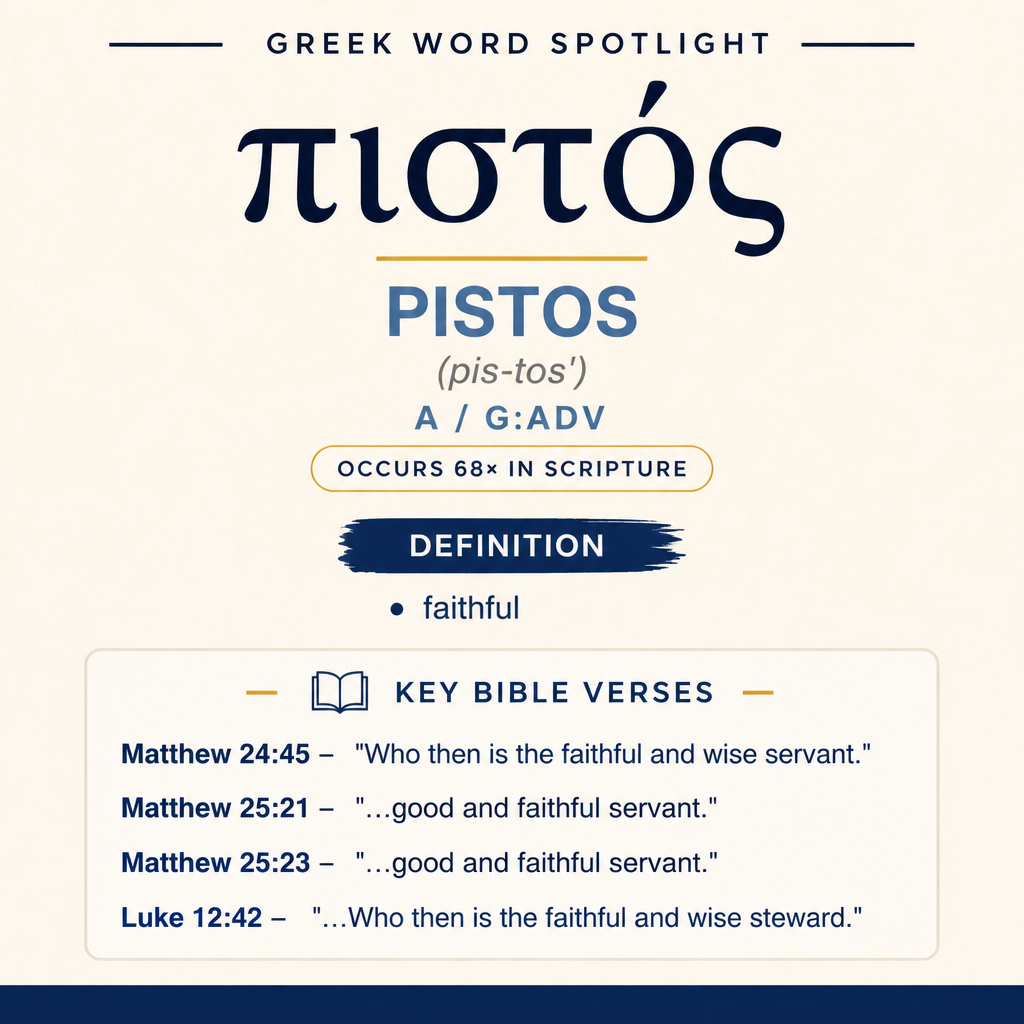
πιστός (Pistos) means “faithful,” occurs 68 times in Scripture, and appears in passages such as Matthew 24:45 and Luke 16:10–12.
Servant Contexts
In Matthew 24:45 and Matthew 25:21, 23, πιστός describes a servant commended by his lord as faithful.
Learn More →Trust and Stewardship
Luke 16:10–12 links being faithful in little with being entrusted with much, including true riches.
Learn More →πιστός means “faithful,” describing steadiness that can be counted on in relationships of responsibility and trust. In the passages cited here, it is applied to servants and stewards under a lord, to integrity in handling resources, to Thomas’s response to Jesus, and to people marked out by belief.
Occurrences
“Who then is the faithful and wise servant, whom his lord has set over his household, to give them their food in due season?” (Matthew 24:45)
Here πιστός qualifies a “servant” placed “over his household.” Faithfulness is shown in ongoing dependability within an assigned task: the servant is expected to provide “their food in due season.” The verse frames faithfulness as the character trait that fits someone for delegated oversight, especially where others rely on timely provision.
“His lord said to him, ‘Well done, good and faithful servant. You have been faithful over a few things, I will set you over many things. Enter into the joy of your lord.’” (Matthew 25:21)
πιστός is part of a commendation: “good and faithful servant.” The saying ties faithfulness to proved reliability “over a few things,” and it becomes the stated reason for expanded responsibility (“I will set you over many things”). The scene links faithfulness with tested stewardship and with a future welcome (“Enter into the joy of your lord”).
“His lord said to him, ‘Well done, good and faithful servant. You have been faithful over a few things, I will set you over many things. Enter into the joy of your lord.’” (Matthew 25:23)
The same commendation is repeated, reinforcing what “faithful” looks like in this setting: consistent performance in limited duties that justifies being entrusted with more. The repetition itself strengthens the association between faithfulness and trustworthiness under a master’s evaluation.
The Lord said, “Who then is the faithful and wise steward, whom his lord will set over his household, to give them their portion of food at the right times?” (Luke 12:42)
In Luke’s wording, πιστός modifies a “steward” rather than simply a servant. Faithfulness is paired with wisdom, and it is directed toward a practical charge: distributing “their portion of food” punctually (“at the right times”). The term carries the sense of reliability in managing a household’s needs on behalf of someone else.
He who is faithful in a very little is faithful also in much. He who is dishonest in a very little is also dishonest in much. (Luke 16:10)
πιστός is placed in a maxim that scales character from “a very little” to “much.” Faithfulness is presented as consistent across contexts: the same person is faithful regardless of the amount at stake. The saying contrasts faithfulness with dishonesty, making faithfulness the opposite of a divided or opportunistic approach to responsibility.
If therefore you have not been faithful in the unrighteous mammon, who will commit to your trust the true riches? (Luke 16:11)
Faithfulness is measured by how one handles “the unrighteous mammon,” and the consequence is relational: being “commit[ted] to your trust” something greater (“the true riches”). πιστός here contributes the idea that trust is granted on the basis of prior fidelity in managing lesser, morally fraught, or temporally limited resources; the logic depends on proven reliability.
If you have not been faithful in that which is another’s, who will give you that which is your own? (Luke 16:12)
The contrast is between what belongs to “another” and what could become “your own.” πιστός functions as the criterion for transfer from stewardship to possession: if one cannot be counted on with another person’s property, one is not fit to receive property in one’s own right. Faithfulness is thus aligned with respect for entrusted goods and accountability to the owner.
“He said to him, ‘Well done, you good servant! Because you were found faithful with very little, you shall have authority over ten cities.’” (Luke 19:17)
Here faithfulness is something that can be “found,” implying assessment after the fact. The servant’s being “faithful with very little” becomes grounds for a dramatic increase in responsibility: “authority over ten cities.” πιστός highlights the dependable character that justifies elevation, and it frames authority as a trust granted in response to demonstrated fidelity.
Then he said to Thomas, “Reach here your finger, and see my hands. Reach here your hand, and put it into my side. Don’t be unbelieving, but believing.” (John 20:27)
Although this verse speaks in the imperative (“Don’t be unbelieving, but believing”), it contributes to the same field of trustworthiness in a different direction: not a servant’s performance, but a person’s settled stance in response to Jesus. The call presses Thomas away from a posture of refusal and toward a posture of belief grounded in what Jesus invites him to examine.
They of the circumcision who believed were amazed, as many as came with Peter, because the gift of the Holy Spirit was also poured out on the Gentiles. (Acts 10:45)
In this narrative description, “who believed” marks a group identity: people characterized by belief are present with Peter and react with amazement. The focus is not on household management or material resources, but on the response of believers as they witness the Spirit’s gift being poured out “on the Gentiles.” Faithfulness, in this scene, is tied to belonging among those who believe and to their perception of God’s action.
“Concerning that he raised him up from the dead, now no more to return to corruption, he has spoken thus: ‘I will give you the holy and sure blessings of David.’” (Acts 13:34)
The phrase “holy and sure blessings” sets the tone of reliability and certainty. Within the statement about being raised “now no more to return to corruption,” the “sure” quality of the blessings strengthens the claim of dependable promise: what is given is presented as stable and secure. πιστός, in such a setting, resonates with what can be relied on as fixed and trustworthy.
He came to Derbe and Lystra: and behold, a certain disciple was there, named Timothy, the son of a Jewess who believed; but his father was a Greek. (Acts 16:1)
Timothy is introduced through family description, and his mother is identified as one “who believed.” The wording uses belief as a defining trait in a personal profile, distinguishing her within a mixed household (“but his father was a Greek”). Faithfulness is thus attached to identity and confession, not merely to performance of a task.

Sense and Usage
Across these passages, “faithful” repeatedly functions as a suitability-marker for entrusted responsibility: a servant over a household (Matthew 24:45), a steward tasked with timely provision (Luke 12:42), and servants evaluated on what they did “over a few things” or “with very little” (Matthew 25:21, 25:23; Luke 19:17). In each, the word attaches to roles where another party’s interests are at stake—food for a household, goods to be managed, or authority to be exercised—and it names the quality that makes delegation safe.
Luke 16 presses the term into moral logic: faithfulness is not episodic but coherent from “a very little” to “much” (Luke 16:10). The sayings then connect faithfulness directly to the granting of trust: being entrusted with “true riches” is contingent on prior faithfulness with “the unrighteous mammon” (Luke 16:11), and receiving what is “your own” is contingent on faithfulness with “that which is another’s” (Luke 16:12). In this cluster, faithfulness is less a compliment than a prerequisite—an observable pattern that determines what others will commit into one’s care.
Other occurrences widen the setting beyond stewardship. John 20:27 places the concern at the level of belief: Thomas is confronted with tangible invitation (“Reach here your finger…”) and commanded toward believing rather than unbelieving. Acts similarly uses believing language to identify people (Acts 10:45; Acts 16:1) and to underscore the dependable character of what God gives (“holy and sure blessings,” Acts 13:34). Taken together, these uses show “faithful” at work both in the practical sphere of managing what is entrusted and in the relational sphere of believing response and dependable promise.
Imagery in Context
The dominant imagery is domestic and administrative: a household that must be fed “in due season” (Matthew 24:45) and “at the right times” (Luke 12:42), and servants whose small proven reliability opens the way to larger oversight (Matthew 25:21, 25:23; Luke 19:17). Against this stands the intimate scene of invited verification in John 20:27, where faithfulness is pressed not through task-completion but through a move from unbelief to belief. Acts adds a communal dimension—believers witnessing an unexpected outpouring (Acts 10:45) and hearing of blessings described as “sure” (Acts 13:34)—so that faithfulness is felt both in everyday trust and in the stability of what is given and received.
Sources: Lexical data from Strong’s Exhaustive Concordance and the Translators Brief Lexicon of Extended Strongs for Greek (STEPBible, CC BY). Occurrence data from the Translators Amalgamated Greek New Testament (STEPBible, CC BY). Scripture quotations from the World English Bible (public domain).