Exploring the Meaning of Pisteuo in Greek
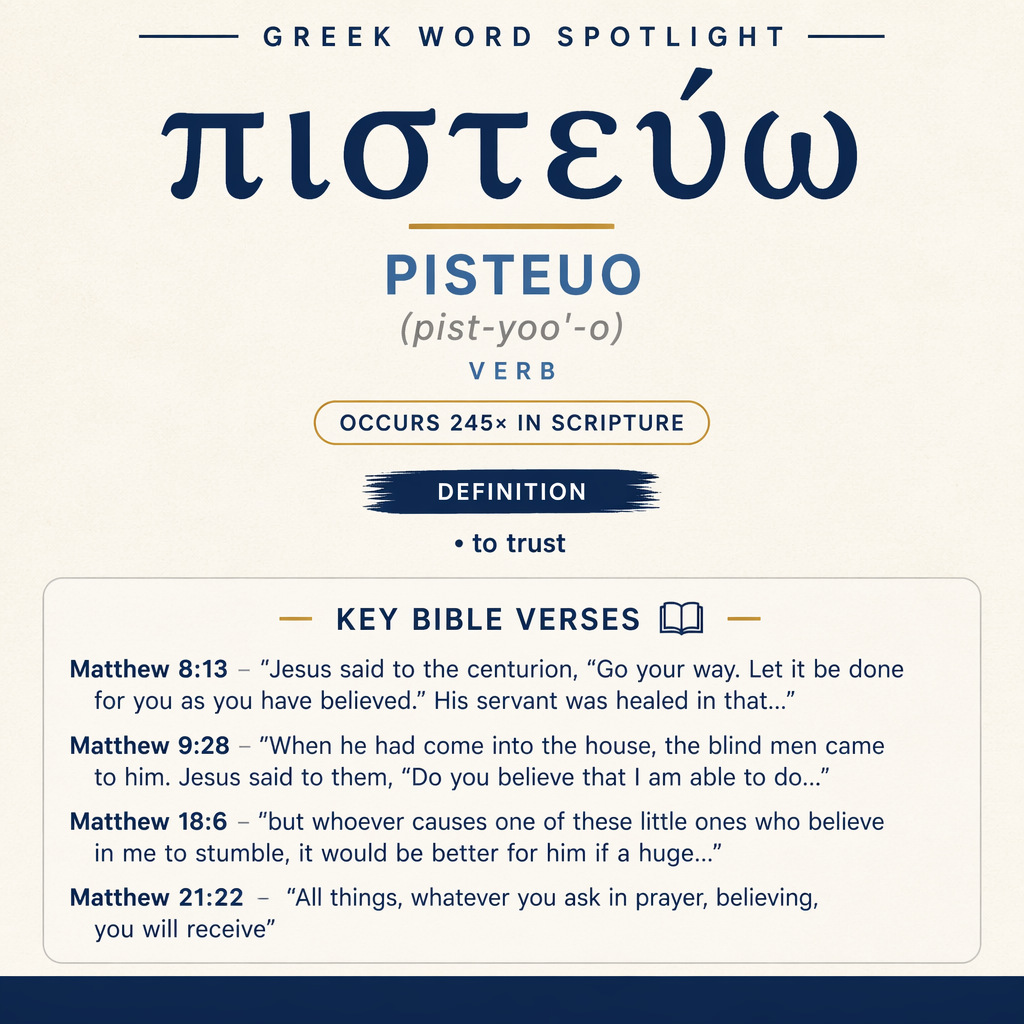
πιστεύω (Pisteuo) means “to trust” and occurs 245 times in Scripture, including in Matthew 8:13; 9:28; 18:6; 21:22; 21:32; 24:23; 24:26.
Core Meaning
πιστεύω means “to trust.” In Matthew it describes believing Jesus, believing John, and refusing false claims about the Christ.
Learn More →Matthew Snapshots
It appears in healing contexts (“as you have believed,” Matthew 8:13; “Do you believe…?” Matthew 9:28). It also appears in prayer (“believing,” Matthew 21:22).
Learn More →Warning & Discernment
Matthew warns against causing believers to stumble (Matthew 18:6). Jesus also commands, “don’t believe it,” when claims about the Christ are false (Matthew 24:23; 24:26).
Learn More →πιστεύω expresses the act of trusting, whether in a person’s word, in Jesus’ ability, or in a report that calls for acceptance or rejection. In the passages quoted here it appears in scenes of healing, prayer, moral warning, public controversy, and urgent instruction.
Occurrences
Jesus said to the centurion, “Go your way. Let it be done for you as you have believed.” His servant was healed in that hour. (Matthew 8:13)
Here trusting is treated as a settled stance the centurion already holds: “as you have believed.” The result is framed in the passive (“Let it be done for you”), and the narrative immediately ties that trust to a concrete outcome—“His servant was healed in that hour.” πιστεύω contributes the centurion’s confident reliance that Jesus can act, and the sentence makes the healing correspond to that reliance.

When he had come into the house, the blind men came to him. Jesus said to them, “Do you believe that I am able to do this?” They told him, “Yes, Lord.” (Matthew 9:28)
πιστεύω is placed on Jesus’ lips as a diagnostic question: trust is not abstract but directed toward a specific claim, “that I am able to do this.” The blind men’s answer (“Yes, Lord”) shows trust expressed as assent to Jesus’ ability in the immediate situation inside the house, before any narrated result in this verse. The verb functions as the hinge between request and expectation.
but whoever causes one of these little ones who believe in me to stumble, it would be better for him if a huge millstone were hung around his neck, and that he were sunk in the depths of the sea. (Matthew 18:6)
In this warning, πιστεύω marks a vulnerable group defined by their trust “in me.” The consequence is directed at anyone who makes such people “stumble,” and the grim imagery of a millstone and drowning supplies the weight of the warning. The verb establishes that the “little ones” stand in a trusting relationship to Jesus, a relationship treated as morally serious and protected.
All things, whatever you ask in prayer, believing, you will receive.” (Matthew 21:22)
πιστεύω appears as a participial condition accompanying prayer: “whatever you ask in prayer, believing.” Trust is presented as the manner in which asking is to be carried out, and the promise “you will receive” is grammatically attached to that condition. The verb thus gives prayer an internal posture—trusting as one asks—rather than mere verbal request.
The baptism of John, where was it from? From heaven or from men?” They reasoned with themselves, saying, “If we say, ‘From heaven,’ he will ask us, ‘Why then did you not believe him?’” (Matthew 21:25)
Here trusting is directed toward John (“believe him”) and is discussed as an obligation implied by a verdict about origin (“From heaven”). The leaders’ private reasoning shows that πιστεύω can describe accepting a messenger’s testimony: if they acknowledge a heavenly source, their failure to trust John becomes indefensible. The verb functions as a measure of integrity between public statements and corresponding trust.
For John came to you in the way of righteousness, and you didn’t believe him, but the tax collectors and the prostitutes believed him. When you saw it, you didn’t even repent afterward, that you might believe him. (Matthew 21:32)
πιστεύω is repeated to contrast responses to the same figure, John: “you didn’t believe him” versus “believed him.” The sentence adds a second layer—what the leaders “saw” in others’ response should have led to repentance “that you might believe him.” Trust here is not merely a private judgment; it is tied to observable social reversal (tax collectors and prostitutes responding) and to a change of mind that could have opened the way to trust.
“Then if any man tells you, ‘Behold, here is the Christ,’ or, ‘There,’ don’t believe it. (Matthew 24:23)
πιστεύω is used negatively as a safeguard against deception. The object is an announcement—someone “tells you” a location-based claim about “the Christ”—and the imperative “don’t believe it” treats trust as something that can be wrongly granted to speech. The verb therefore marks the boundary between hearing a report and entrusting oneself to its truthfulness.
If therefore they tell you, ‘Behold, he is in the wilderness,’ don’t go out; or ‘Behold, he is in the inner rooms,’ don’t believe it. (Matthew 24:26)
The instruction is sharpened with two settings (“in the wilderness,” “in the inner rooms”) and two responses: “don’t go out” and “don’t believe it.” πιστεύω governs the second response, showing that trust has practical consequences; refusing trust is paired with refusing movement toward the claimed location. The verb thus stands for an inward commitment that would otherwise drive outward action.
“He saved others, but he can’t save himself. If he is the King of Israel, let him come down from the cross now, and we will believe in him. (Matthew 27:42)
πιστεύω appears in the mouths of mockers as a conditional promise: “let him come down… and we will believe in him.” Trust is framed as something they would grant if Jesus meets their demanded sign, and it is explicitly directed toward him (“believe in him”). The verb exposes a posture that makes trust contingent on control—trust offered only on terms set by the speakers.
and saying, “The time is fulfilled, and God’s Kingdom is at hand! Repent, and believe in the Good News.” (Mark 1:15)
Here πιστεύω is an imperative paired with “Repent,” placed within a proclamation about time and nearness: “The time is fulfilled… God’s Kingdom is at hand!” Trust is oriented toward a message, “the Good News,” and the command form presents trusting as a decisive response to the announced situation. The verb carries the force of committing oneself to the proclamation rather than treating it as information alone.
But Jesus, when he heard the message spoken, immediately said to the ruler of the synagogue, “Don’t be afraid, only believe.” (Mark 5:36)
πιστεύω functions as the counterweight to fear: “Don’t be afraid, only believe.” The immediacy (“immediately”) and the context of a “message spoken” give the moment urgency, and Jesus’ short command narrows the ruler’s focus to trusting rather than being ruled by what he has just heard. The verb thus names the single permitted stance in a crisis moment.
Jesus said to him, “If you can believe, all things are possible to him who believes.” (Mark 9:23)
This saying highlights πιστεύω as the point at issue—“If you can believe”—and then generalizes: “all things are possible to him who believes.” Trust is presented as the decisive human factor in view, not as mere optimism but as a stance that opens the horizon of what is possible. The repetition (“believe… believes”) makes trusting both the condition and the identity marker of the person addressed.

Sense and Usage
Across these scenes, πιστεύω consistently depicts trusting as an act directed toward a person, a message, or a particular claim. In Matthew 8:13 and 9:28 it is trust in Jesus’ ability in a concrete need, voiced either as Jesus’ recognition (“as you have believed”) or as Jesus’ question (“Do you believe that I am able to do this?”). In Matthew 21:25 and 21:32 the verb takes a human messenger as its object (“believe him”), where trusting means receiving John’s ministry as credible and responding accordingly; the contrast between groups shows that trust is not evenly distributed across social or religious boundaries.
Several passages show πιστεύω operating as a hinge between inner conviction and outward consequences. Matthew 21:22 binds trusting to prayer as its qualifying posture; trust is not a separate spiritual achievement but the manner in which asking proceeds. Mark 5:36 sets trusting against fear as mutually exclusive controlling stances, and Mark 9:23 links trusting with the realm of possibility, portraying it as something that shapes what the person can face and expect.
Other texts emphasize the discretion involved in trusting. Matthew 24:23 and 24:26 command refusal to trust certain reports about the Christ, showing that πιστεύω can be misapplied to persuasive speech; trusting is therefore ethically and practically significant, not neutral. Matthew 27:42 illustrates a distorted, bargaining posture toward trust—offered as a reward for satisfying a demanded spectacle—while Matthew 18:6 highlights the opposite: those who already trust “in me” must not be harmed or destabilized. Together these uses show trusting as both personal reliance and public allegiance, capable of being strengthened, withheld, demanded, or exploited.
Imagery and Weight
The passages attach vivid pictures to trusting: a servant healed “in that hour” (Matthew 8:13), blind men confronting the question of Jesus’ ability in a house (Matthew 9:28), prayer shaped by trusting (Matthew 21:22), and warnings against being swept along by location-specific rumors (“in the wilderness… in the inner rooms,” Matthew 24:26). The strongest negative image—millstone and drowning (Matthew 18:6)—frames the protection owed to those who trust in Jesus, while the cross scene (Matthew 27:42) shows how easily trust can be turned into a taunt and made conditional. In Mark, trusting is pressed as a decisive response to news—either the “Good News” (Mark 1:15) or a crisis message (Mark 5:36)—and as the central question of what a person can bring to Jesus: “If you can believe” (Mark 9:23).
Sources: Lexical data from Strong’s Exhaustive Concordance and the Translators Brief Lexicon of Extended Strongs for Greek (STEPBible, CC BY). Occurrence data from the Translators Amalgamated Greek New Testament (STEPBible, CC BY). Scripture quotations from the World English Bible (public domain).