Exploring the Meaning of Phero in Greek
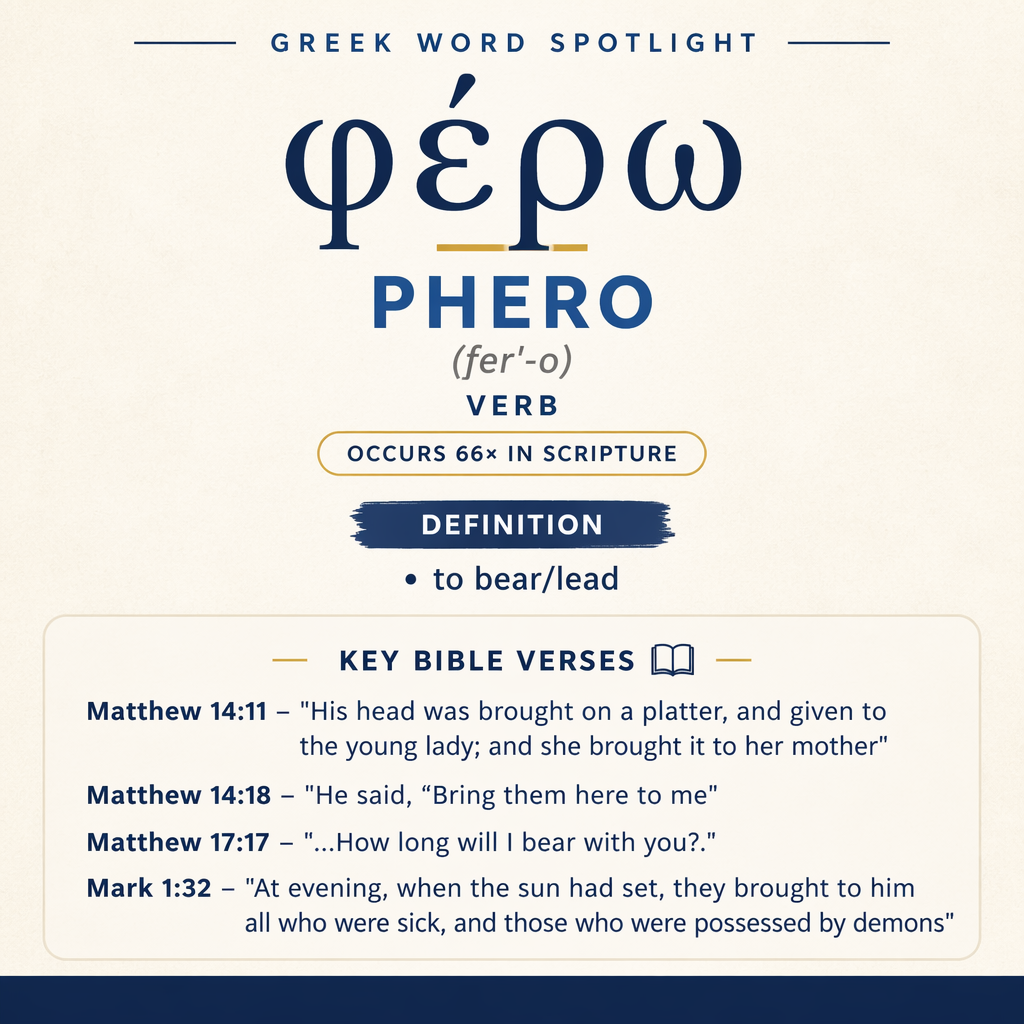
φέρω (Phero) means “to bear/lead” and appears 66 times in Scripture, including Matthew 14:11, 14:18, 17:17 and Mark 1:32; 2:3; 6:27–28.
Core Meaning
φέρω means “to bear/lead.” In the listed verses it is used for bringing or carrying.
Learn More →Gospel Examples
In Matthew 14:11 and Mark 6:28, John’s head was brought on a platter and given. In Mark 2:3, four people came carrying a paralytic to Jesus.
Learn More →Range of Use
In Matthew 17:17, Jesus asks, “How long will I bear with you?” In Mark 1:32, people brought to him all who were sick and demon-possessed.
Learn More →φέρω expresses the action of bearing or leading something or someone so that they arrive where they are intended to be. In the passages below it appears in scenes of presentation (bringing an object to a recipient), conveyance of afflicted persons to Jesus, and the yielding of fruit.
Occurrences
Matthew 14:11 — “His head was brought on a platter, and given to the young lady; and she brought it to her mother.”
Here φέρω frames a grim sequence of transfers. The head is borne in a concrete way—placed “on a platter” and carried in—and then the young lady herself bears it onward to her mother. The verb supplies the motion that turns an execution into a delivered object, emphasizing the act of conveyance from one set of hands to another.

Matthew 14:18 — “He said, “Bring them here to me.””
In this brief command, φέρω is directive and immediate: the requested items are to be led from where they are to Jesus’ location (“here to me”). The verb highlights that what is needed is not merely possession but arrival—having the items present before him.
Matthew 17:17 — “Jesus answered, “Faithless and perverse generation! How long will I be with you? How long will I bear with you? Bring him here to me.””
φέρω operates on two levels within the same verse. First, “bear with you” uses the verb for sustained carrying in a relational sense: Jesus speaks of enduring and continuing alongside the generation addressed. Immediately afterward, “Bring him here to me” returns to physical leading, calling for the afflicted person to be conveyed into Jesus’ presence. Together they show the verb spanning continued bearing and concrete bringing within one utterance.
Mark 1:32 — “At evening, when the sun had set, they brought to him all who were sick, and those who were possessed by demons.”
φέρω here depicts a communal movement toward Jesus: “they” act as bearers who lead “all who were sick” and “those who were possessed by demons” to him. The verb supplies the logistics of access—people who cannot simply come on their own are made present by others’ carrying and guidance. The scope (“all”) intensifies the repeated action implied: bringing person after person.
Mark 2:3 — “Four people came, carrying a paralytic to him.”
In this snapshot, φέρω is tied to a specific embodied effort: four people bear a paralytic. The verb focuses attention on their active conveyance of someone unable to walk, making the paralytic’s arrival at Jesus an event accomplished by others’ bearing.
Mark 4:8 — “Others fell into the good ground, and yielded fruit, growing up and increasing. Some produced thirty times, some sixty times, and some one hundred times as much.”
Within the imagery of seed and soil, φέρω aligns with “yielded fruit.” The verb presents fruitfulness as something carried outward from the plant: growth issues in a borne result. The escalating numbers (“thirty… sixty… one hundred”) place emphasis on the measurable outcome that the good ground enables—the fruit that is borne.
Mark 6:27 — “Immediately the king sent out a soldier of his guard, and commanded to bring John’s head, and he went and beheaded him in the prison,”
φέρω stands behind the king’s command that turns a death into an item to be conveyed. The order is not only to kill but to have “John’s head” brought—transported from the prison to the setting where the king’s command will be satisfied. The verb gives the narrative its next step: the intended delivery.
Mark 6:28 — “and brought his head on a platter, and gave it to the young lady; and the young lady gave it to her mother.”
As in Matthew’s account, φέρω marks the physical act of bearing the head “on a platter.” The verb underlines the deliberate presentation: the object is carried in a manner suited for display and handoff, and then it becomes part of a chain of giving from bearer to recipient.
Mark 7:32 — “They brought to him one who was deaf and had an impediment in his speech. They begged him to lay his hand on him.”
Here φέρω introduces the afflicted person into the scene. The group’s bringing is paired with their plea; they do not merely report the man’s condition but bear him to Jesus as the one from whom help is sought. The verb stresses that access to Jesus is achieved by escort and conveyance—placing the man within reach of the requested touch.
Mark 8:22 — “He came to Bethsaida. They brought a blind man to him, and begged him to touch him.”
φέρω again describes others acting for someone impaired. The blind man is borne “to him,” and the bringing is joined to a specific request: that Jesus “touch him.” The verb highlights movement toward a point of encounter—bringing the blind man into the proximity where the begged-for touch can occur.
Mark 9:17 — “One of the multitude answered, “Teacher, I brought to you my son, who has a mute spirit;”
In the father’s report, φέρω summarizes his decisive action: he has borne his son to Jesus. The bringing is purposeful and relational—“my son”—and it frames the son’s condition (“a mute spirit”) as the reason for the conveyance. The verb carries the weight of seeking help by physically leading the afflicted into Jesus’ presence.
Mark 9:19 — “He answered him, “Unbelieving generation, how long shall I be with you? How long shall I bear with you? Bring him to me.””
This verse mirrors the twofold use seen earlier: φέρω expresses Jesus’ continuing endurance (“bear with you”) and then issues the imperative of conveyance (“Bring him to me”). The shift from bearing a generation to bringing an individual tightens the scene from broad frustration to focused action—leading the afflicted person directly to Jesus.

Sense and Usage
Across these passages, φέρω consistently supplies the dynamic of making someone or something present by carrying or leading it from one place to another. In the accounts of John’s head (Matthew 14:11; Mark 6:27–28), the verb highlights conveyance as a form of presentation: what is carried is meant to be seen and handed over. The repeated mention of a platter and the subsequent giving underscore that bearing can serve the purposes of display and transfer, not merely transport.
In the healing narratives (Mark 1:32; 2:3; 7:32; 8:22; 9:17, 9:19; and the imperative in Matthew 17:17), φέρω emphasizes mediated access. The sick, the demon-possessed, the paralytic, the deaf man, the blind man, and the son with a mute spirit are repeatedly brought by others. The verb therefore places agency on the bearers: people act as carriers and guides, moving the afflicted into the presence of Jesus, where requests are made (“They begged him to lay his hand on him”; “begged him to touch him”). The bringing is not background detail; it is the practical means by which need is set before Jesus.
The phrase “bear with you” (Matthew 17:17; Mark 9:19) extends the verb beyond physical conveyance to sustained relational bearing. In both verses, the wording joins three ideas: Jesus’ continued presence (“How long will I be with you?” / “How long shall I be with you?”), his endurance (“How long will I bear with you?” / “How long shall I bear with you?”), and a command to bring the afflicted person. The verb thus connects endurance and action: the one who bears with the crowd also calls for the immediate bearing of the individual to himself.
Finally, in the agricultural image (Mark 4:8), φέρω is tied to result rather than route: fruit is borne as the outcome of growth in “good ground.” Even here the verb retains a sense of carrying forth something tangible—the plant’s increase issues in what is yielded, in counted abundance.
Imagery
The scenes cluster around hands, movement, and arrival. Platters carried into a room, a paralytic borne by four, crowds leading the sick at evening, and petitioners escorting the deaf and blind all portray bearing as the act that bridges distance—whether the distance is physical (bringing “to him”) or interpersonal (bearing “with” a generation). Mark 4:8 adds a quieter image: the earth receiving seed until growth carries fruit into view, turning hidden life into visible yield.
Sources: Lexical data from Strong’s Exhaustive Concordance and the Translators Brief Lexicon of Extended Strongs for Greek (STEPBible, CC BY). Occurrence data from the Translators Amalgamated Greek New Testament (STEPBible, CC BY). Scripture quotations from the World English Bible (public domain).